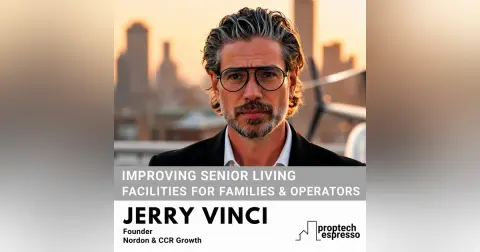
Jerry Vinci - Improving Senior Living Facilities For Families & Operators

 Apple Podcasts
 Spotify
 Castro
 RSS Feed
 We talk with senior living marketing tech entrepreneur Jerry Vinci about why senior housing is an operating business inside a real estate wrapper and why PropTech only matters when it solves a real human problem. We break down what drives occupancy, where operators lose families in the funnel, and how investors can spot risk before it shows up in the financials.
• defining PropTech around human problems in real estate
• why family experience often decides tool adoption
• early lessons on systems over effort and relationship as product
• senior living levels of care and why the asset class is misunderstood
• demographic shifts pushing demand toward ages 80 to 85
• demand generation versus traditional marketing and owning the full funnel
• speed to human, long nurture cycles, and attribution that ties to move-ins
• virtual tours and virtual staging as trust-building tools
• emerging risks from AI search, staffing churn, and referral aggregator dependence
• Nordon’s independent diagnostics for senior housing underwriting
• why Jerry launched the Leads To Leases podcast for unpolished operator lessons
Be sure to subscribe to the podcast on Apple Podcasts, Google Podcasts, or wherever you listen to podcasts.
To learn more, visit www.proptechespresso.com.
Where is this appearing?
00:00 - Welcome And Guest Introduction
01:08 - Defining PropTech As A Human Problem
03:19 - Family Experience Versus Operator Workflow
04:26 - Early Career Lessons On Systems
08:01 - Why Senior Living Drew Him In
09:50 - Senior Living Explained For Real Estate
13:10 - Demographics And The Coming Demand Wave
16:41 - Demand Generation From Search To Move-In
18:41 - Speed To Human, Nurture, Attribution
23:48 - Virtual Tours And Better Trust Building
27:56 - AI Search, Staffing, Aggregator Risk
33:12 - Nordon Diagnostics For Investor Underwriting
36:57 - Why He Started Leads To Leases
40:42 - Where To Find Jerry And Closing
Welcome And Guest Introduction
SPEAKER_00Welcome to Prop Tech Expresso. My name is Mark Hurst, a former investment banker and serial startup junkie turned real estate technologies. So on each 15 to 20 minute episode, you'll hear from leading entrepreneurs and industry experts on the opportunities and challenges for the rapidly changing Prop Tech sector. Thanks for listening today. Grab your favorite beverage and let's learn something more.
SPEAKER_02Welcome to My guest today is Jerry Vinci, founder of CCR Growth, a demand generation firm that helps senior living operators build predictable, sustainable occupancy. A serial entrepreneur and operator with almost 30 years in the senior living space. He also co-founded and is an executive at Nordon, the first independent diagnostic firm built for investors and capital allocators underwriting senior housing. Jerry Ernde, BA in graphic design from Mora Vean University, and his MBA from Florida Institute of Technology. Jerry, welcome to the show.
SPEAKER_03Hey Mark, thanks for having me.
SPEAKER_02Well, excited for our conversation today. And as you and I discussed, you are my first uh expert in the senior living space. So I know there's a lot to uh uncover and educate the audience on.
Defining PropTech As A Human Problem
SPEAKER_02But we're going to start out with my traditional Prop Tech Expresso question, which is how do you define PropTech? And since you've been in and kind of touching this space for a while, I'm interested to see if you've seen any uh evolution in the definition during your time in this space.
SPEAKER_03Yeah, no, thanks for the question and thanks for having me on the show. Appreciate it. Um you know, prop tech to me, um, it's it's always it's technology that starts with a specific human problem. Um, and then that problem exists inside of a real estate context to some degree. Um, I think I think you can only call something prop tech if it actually solves the problem, because I think the problem is the story, not necessarily the technology behind it. So um that would be my my kind of rough, rough definition of it. Um and I've and in the senior living space, I mean, I I think probably one of the biggest ways that we see prop tech utilized is like uh is in designing, say, a CRM. You know, you see a CRM that's designed for say like hotel staff or hotel sales or something like that, and then they'll try to retrofit it for a community to fill assisted living beds and um or like an e-commerce tool that gets redeployed for for senior living. And it's just they're they're just very different animals and they just require their own their own set of tools, their own solutions.
SPEAKER_02Yeah. That's awesome. And and it what I love about this question is that there is so much uh uniqueness and new answers that come out of asking that, even though I've asked it, you know, hundreds of times now. Um and I uh you know the fact that you described it as a human problem related to real estate and and kind of real, you know, that it's it's not really the the the the assets issue or problem that you're kind of uh providing a solution for. It is the the the human side for of of that problem. So um love that um kind of uh spin on the uh on the on the question and and how you answered that.
Family Experience Versus Operator Workflow
SPEAKER_03And and with prop tech too, I think in in senior living, there's kind of this one question that needs to be asked, and it's like um does the solution does it start with the family's experience or does it start with the operator's workflow? Because it tends to be the one that's that solves the problem on the family side or the ones that get adopted, and then the other ones tend to sit, you know, on like the server and they never get used.
SPEAKER_02Yep. Yep. Um uh have had um secondhand experience kind of uh watching um my wife's family, their uh grandmother go into assisted living. So I've kind of seen a little bit from afar. So I'm gonna be interested in kind of um, you know, from somebody that's that understands the the the space very well. Um I certainly can appreciate that the the broader family dynamic that's part of the decision making um that you were just kind of uh alluding
Early Career Lessons On Systems
SPEAKER_02to. Um but before we we kind of jump jump there, I I love to understand people's background and kind of where they um started their careers. And um I from our discussion, you you talked about um uh your parents owning a printing business, and then you kind of uh while not directly following in their footsteps, kind of uh uh started your own marketing agency. So there was kind of a a little bit of uh uh kind of family uh uh tradition in in in that sense. But uh interested, kind of where were you did you expect to follow in your family's footsteps and uh when when you went to college and and I know you got a graphic design degree? Kind of what what were things that uh you were uh exploring kind of early in your career and and thought you might uh uh go after professionally?
SPEAKER_03Yeah, I don't think anyone wakes up and says, I I want to be running a printing press in seventh grade, you know. So um yeah, I mean sometimes we're just we're we're a part of the business we're kind of born into, and that was the way it was for my family. Um I did get a very good inside track on marketing and advertising from an early age and how how vital that was for businesses um to to grow or to maintain um you know their their current footprint. So that was that was really where it started for me. And um and the lessons that kind of stuck with me watching small businesses, watching my father's business, which never grew to beyond, I think, like 20, 20 employees, something like that. But I saw that um there were kind of like two big takeaways for me. The the the first, I think, was probably the the the lack of systems and that the fact that like systems matter more than effort. And I think that can be said a lot in a small business, and especially today when you see like there's so many startups and AI startups where it's like one person doing the job with 10 people now, and you're like, how is that even possible? Um, but it's because they have proper systems in place. And it's like I I've watched my father, for example, for years, you know, struggle to grow just because like it wasn't that he wasn't working hard, he just didn't have systems in place. So every time he started to do something, he had to kind of rebuild from scratch every single time for every new customer. And uh, and so that lesson stuck with me. And then the second was probably um, and this kind of ties into senior living, I think, is that relationship is the product. It's um, you know, in a marketing agency, for example, you can do great work and lose clients left and right um because that relationship wasn't right. But if the relationship is right, you can, I don't want to say you can do bad work, but you can definitely make mistakes and own it and still keep that client. I mean, we've we've had clients for over 15 years that have stuck with us because we've we've been honest and accountable in that entire time. Yep. Awesome, awesome.
SPEAKER_02Um wanted to uh understand if there was any early interest in real estate, or was real estate just kind of uh and your kind of uh move into senior living was that uh happenstance, or or was there something in the back of your head that uh kind of was a uh kind of a an inclination that that there was something in this real estate um area that you wanted to explore um in the future?
SPEAKER_03I
Why Senior Living Drew Him In
SPEAKER_03mean, my interest in senior living specifically was definitely my grandparents, watching all four of them go through some level of senior care and watching my family struggle to make those decisions, just as you were you were talking about your family. It is a stressful, you know, time of crisis often that doesn't have a lot of planning. There isn't a lot of talk before those things happen. Um, so seeing families try to navigate that in a in a very short amount of time was interesting for me as a marketer. Um, from a real estate perspective, I I hadn't really thought about it before senior living. But when I started to watch senior living and how there were two things happening in tandem. There was there was the operation running inside the asset, and then there was the asset itself. And there were there were deals being done in both spaces. There were, you know, inside a senior living operation, it's complex. You've got it's not just about um, you know, rent and residential living. It's also healthcare, it's um, it's dining, it's entertainment, it's transportation, it's social service, it's all of these things kind of wrapped into this one operational business that sits inside of a real estate wrapper. So you have to consider both. And I think just the complexity of that um was really interesting uh for me. And the more I got into it, the more I saw that there was a need on both the capital side of senior housing as well as on the operational side to help improve experiences for both groups of people. So that's kind of where my time started to get split between helping operators fill their buildings and helping capital decide which investments were going to be uh, you know, sound investments or that had a lower risk profile than others.
SPEAKER_02Gotcha,
Senior Living Explained For Real Estate
SPEAKER_02gotcha. Well, um, as I as I mentioned, we we haven't dug into senior living um on this podcast before. And I would uh categorize it as the least understood real estate asset class. So would love to kind of tee up a rather open-ended question for you of like, what should everybody know about senior living that's um, you know, a somebody that's uh from the lens of somebody that's involved in in real estate, you know, that I think that there's lots of opportunity, lots of areas of improvement, as you were uh just describing. But um what can you share um about this and kind of broaden our our understanding of of this uh particular uh asset class?
SPEAKER_03I think most of what I just said holds true and the fact that senior living is it's probably it's one of the most undervalued asset classes for sure, but it's it's an operating business wrapped around a real estate asset. So once once you understand that and the scope of that, um, you know, understanding how to underwrite it, how to operate it, and then even just build technology for it starts to kind of make sense. Um, it covers a broad spectrum, you know, it's a very blanket term. There's multiple different levels of care, which I think is is what kind of throws people too. You've got, you know, independent living, which is basically age-restricted apartments for active retirees who don't necessarily need any help yet. Then you move into assisted living and memory care, where residents are they're paying for housing and they're paying for those care services, dining activities, all that. Um, and then you get into like skilled nursing, which is on the far end of the higher acuity needs. And there's even buildings called like CCRC's, continuing care retirement communities or life plan communities where someone can transition through all those different levels of care, all while staying in the same on the same campus. Um, so that's kind of that's the overall complexity of it. Um, but actually, like who's making the decision, I think, is the other piece of senior living that not a lot of people think about until they're actually in it, is that statistically, I think 80% of decisions in senior living are made by the adult children, even if it's for independent living, they're they're often weighing in. Um, so there's a lot more players at stake than just just the person who might potentially be living in that community.
SPEAKER_02Yep. Um would you classify um over 55 communities as falling into that senior living asset class? Or is that a completely different asset class or fringe asset class, I guess?
SPEAKER_03It probably would depend on who you speak with. I mean, I've heard I've heard 55 plus and independent living used synonymously, and then other times I've heard them as as specific assets, like 55 plus apartments versus independent living, which is more of a quote unquote retirement community. But even that term retirement community is kind of going out the window because how many people do you know that are actively retired, you know, at 55 plus or even 65 these days? That number is is waning and
Demographics And The Coming Demand Wave
SPEAKER_03waning fast. And um, you know, the demographics around senior living, I think, is interesting because we keep hearing that 65 number as as the time when senior living begins, but it's actually closer to 80 or 85. You know, I mean, if we look at the silver tsunami, for example, the the oldest baby boomers just turned 80 years old this year. Uh by 2030, all baby boomers will be 65. So we're still at the very beginning stages of this. And by 2034, there'll be more adults over the age of 65 than there will be children in America for the first time in the history of America. So we're seeing this swell, and it's only going to increase from there. You know, by 2040, we'll have 2x the number of 80 plus year olds, uh, and by 2050, three times the number. So those, you know, for essentially the next three decades, we're gonna see this monumental shift in in everything, not just in housing, but in the economy and in, you know, in uh care workers, uh, you know, all the products that are going to be developed on the market. There's gonna be this very strong. I mean, you can even see it on Netflix. How many shows now are leaning more towards the the older adults, right? Compared to kids. You've got, you know, Stranger Things for the kids, and then you've got the burrows for the older adults. Like yeah, I mean, it's it's kind of cool to see this transition, but it is happening solely right before our eyes.
SPEAKER_02Definitely, definitely. Um, I was gonna mention uh something that uh I hadn't uh shared with you, but that my wife uh is an interior designer and she worked on a number of projects in Japan that were these very high-end uh CCR buildings where like they are just um gorgeous, like uh very high-end uh apartments. And uh you you move into them and yes, uh depending on the care that you need, you're kind of changing up apartment floors um in order to have access to uh different um uh kind of facilities and and kind of level levels of of care. So um it's it's definitely um I'm I'm sure that exists in some areas of of or some places in in the US, but um it was uh it was eye-opening from having her share kind of this um very uh you know luxurious living that like was very different from kind of the the tradition or the the mindset that I had around uh senior living.
SPEAKER_03Yeah. That that narrative is strong. I mean, my my parents still to this day will say, I'm not moving into a nursing home. You know, it's like if you would just look at one of these buildings, you would see they are so far from that. And and what you're describing are are kind of like the CCRCs or the life plan communities I was talking about earlier. The the catch with those is there's usually a buy-in, which is pretty significant. I mean, there's one community we manage in San Francisco, for example, that the buy-in, uh I think it's like $1.5 or $1.6 million just to get into the building. And then there's a monthly rent cost on top of that. Um, so obviously most older adults moving into those types of communities are are selling their assets off because this is kind of like a forever move, right? They're moving in and they're gonna be able to age in place for the rest of their lives.
SPEAKER_02Gotcha, gotcha.
Demand Generation From Search To Move-In
SPEAKER_02Um I know you touched on this, this, this briefly, and and kind of your your experience and um kind of your your your kind of observation as a as a marketer and and kind of operator, but what was what was missing in the space when when you started to um uh kind of dip your toes in into this and and what what are what's the platform the and the services that CCR is providing, um CCR growth is providing in order to kind of fill the the needs of this this space.
SPEAKER_03Um yeah, no, that's a good question too. And originally um I would say we were a marketing agency. Um and we've transitioned now to a demand generation agency. And not many people understand the difference between the two, but marketing agency, I would say is about building and deploying campaigns, building brand assets, and then like you know, counting leads, and at the end of the day, handing that off to the team and saying, Yeah, we did our job, we got your leads, good luck with that. So, with demand generation, you're essentially owning that that entire funnel from the from the family's first search on Google or wherever they're doing it, all the way through to a move-in. And you're looking at all of those systems that are all involved in that process of pulling that person in uh and then nurturing them through the program and then getting them to tour and then eventually deposit and move in. And so we're kind of owning that entire arc um and and all the systems involved in that and helping, not not that we are the ones you know doing the sales or anything that, but we're building the systems that then help those teams uh be more efficient, effective, and and produce like more consistent, uh sustainable results over time.
unknownGotcha.
SPEAKER_02What
Speed To Human, Nurture, Attribution
SPEAKER_02what what are some of the what what had previously been some of the big drop-offs that you had observed when you were kind of uh seeing how it was how it was being run and and kind of where the uh the solutions weren't being provided for this for this senior living space?
SPEAKER_03Um I I think that there was a lot of generic tools. And even today you'll see like tools that are built for a specific industry, or maybe not built for industry at all. They're just built for for users, right? Um those trying to be adopted or retrofitted to the senior living framework. Um, you know, and instead, because we've been in this space for so long, you know, 20 plus years inside the industry, like we have benchmarks that we use, we have patterns that we recognize, playbooks we've built. So everything, everything we do is kind of native to senior living. Um, so that that's kind of like the first the first part about it. Um and then I think in terms of in terms of what we've built, um the first thing we built around, and and I'm gonna change this, but I'm gonna say speed to lead because that's what people understand and know. And and even in the in the real estate world, I know that speed to lead is a very important concept. Um you know, there's research that says that like essentially contact rates drop by about 10x um within the first hour if someone doesn't reach out. Um or on the flip side of that, conversion communities will convert at an 85% higher rate if they reach out within the first five minutes. So we noticed that was a problem. We do a lot of like mystery shopping with communities that we manage, and we noticed that they either were not answering um or they were waiting 24 to 48 hours to get back, or sometimes they weren't even responding at all if they felt like it wasn't a good lead. Um, so we kind of built that infrastructure to make sure that there was an immediate personalized response, no matter if it was on 10 p.m. on a Sunday or um or any other time, you know, make sure that they had a sustain a substantive like touch point immediately. And I say now speed to human is the biggest thing because with AI, anybody can do speed to lead, right? I mean, as soon as the form fill comes into my website, I can have a bot immediately reach out or or uh uh send a send a text message or something like that. But that that's not meaningful. That's not something that's gonna uh be the difference between a family choosing me and and choosing another community. It's really how fast can I get a human being to pick up the phone or to reach out to that family to to help them in their time of crisis. Um the second piece I think is is the the nurture infrastructure. Um, you know, there was a there was this thought process, I think, with a lot of our our communities that we were managing, where like if uh if the family didn't schedule a tour on the first touch point, then they're not a good lead or or it's not worth following up on them. But most families, they're in like a 90 to 180 day uh decision cycle. The average, the average sales cycle for assisted living, for example, is 180 days. So no one's making a quick decision. So if we have, you know, if we're only relying on the fact that that first touch point didn't go well, that this is not going to be a good lead for this community. And just toss it out, we're, we're leaving a lot of money on the table and potentially, you know, a lot of families that need help and could potentially eventually move in. Um, so making sure that we are having meaningful touch points and that we're nurturing them all the way through, no matter where they are in the sequence, where they drop off in the sequence, we're we're monitoring that. Um, and then I think the last piece um was probably attribution. Um that's huge because I will say if for whatever reason, in senior living just seems to be antiquated when it comes to the way that marketing is done. But I would say the majority of operators they can tell you how many leads they have coming in, but none of them can tell you which channel is producing them, which piece of content perform well, uh, which community touch point actually produce the move in. Most of them don't even know that. So we've built systems to make sure we're tracking all of that. Gotcha.
SPEAKER_01Gotcha.
SPEAKER_02Um from a technology standpoint and uh kind of uh a little bit uh beyond the specific area that CCR growth is involved with, um what where where have you seen technology kind of continue to infiltrate this this space? And you know, you talked about it being a this this complexity of this like hospitality and experiential um and environment. Um you know, given given some of the other um kind of trends that you were uh alluding to, kind of what what are you how are you seeing this space evolve, I guess, and um with with technology um uh hopefully for the for the better.
SPEAKER_03Yeah,
Virtual Tours And Better Trust Building
SPEAKER_03no, because exactly what you said, technology and experiential are both kind of equally kind of growing up at the same time. I think one of the coolest areas that I've seen uh communities using, and and not only communities could do this, but multifamily could as well. But virtual staging is a big one that I find uh really interesting from a prop tech perspective, just because um in communities they've historically kept like a few vacant units that are stages like model apartments, right? And and some buildings they have they have studios, they have single bedroom, they have two bedroom, sometimes three bedroom units, you know, and and they would keep those as model apartments and not not ever fill those units. But now with virtual staging, you could essentially present any unit digitally uh and let families kind of experience the space remotely, and then you can rent those model units out. So you're recovering revenue from rooms that previously, you know, had previously were just pure overhead. So um I think that's one of the coolest things I've seen. That and and just virtual tours in general, I think, um, because it's experiential, because somebody can literally tour the entire building. So by by the time they actually physically come to tour in person, they already know where everything is. They're like, I know where the cafeteria is, I know where the the game room is, I've I've seen all these things. Um, so it just it trust building is probably the biggest thing in senior living. The sooner you can build trust, the better. And these types of tools are a great way to do that.
SPEAKER_02Yeah. No, very familiar with the the virtual staging side of things. Uh I always think uh I I haven't seen it yet, it probably exists out there, but I would I I have this vision of of being able to like take a picture of your current home and it for it to grab all like the items and then for it to stage um or prevent present different stagings of this of the new space with your actual furniture so you can truly imagine your um kind of living in there with your with your stuff. I think that that would be uh um uh uh an interesting bridge to to these um to kind of moving to different different spaces. Um I'm sure it's coming soon.
SPEAKER_03Um it's and we we've done that in our in our house. We just moved from from California to Utah and literally every room we wanted to design, we took pictures and measurements of the empty rooms and even the stuff that we wanted to put in the room, we put that all into into different AI models and were able to model out some some pretty cool renderings where you know we weren't starting from scratch, we knew exactly how to how to lay out the space. So yeah, it's pretty cool.
SPEAKER_02Yeah, and you kind of like, am I gonna can I keep this stuff? Is it gonna fit into these these new spaces? You know, is it is it do I want to um you know, I want to pay to move all this stuff and then actually uh you know put it in a storage unit or have to sell it, or should I just get rid of it before I I move over? Yeah, those those are gonna be uh definitely just part and parcel of of kind of living going forward, I'm I'm sure. Um what's um are there other emerging trends in uh senior living that are um both uh either experiential or kind of uh behind the scenes that um are uh areas that um are are of group of growth for these organizations. You know, uh we talked um uh you know the the the demographic change, the elongation of of of life and and you know stays, I imagine the length of stays are probably changing in in in these in these facilities. Um and then that that has additional ramifications. So anything else that you're kind of um observing um kind of uh that are being kind of in, you know, that operators are thinking about and that are kind of uh part of their their their planning?
AI Search, Staffing, Aggregator Risk
SPEAKER_03Yeah, either operators are thinking about or not thinking about and they should be thinking about. That's for sure. Um yeah, there's there's definitely some some concerns, I would say, about how so I'm always looking at this from the operator angle because um my goal is to help help them maintain a full building as as best as possible and and retain those residents as long as possible. So so what what can we do to make sure that happens? Um the the trends that I'm seeing right now, um I would say overall they're not positive, uh, but they're definitely things to to keep an eye on. First and foremost is the I think from a prop tech perspective, is that the way families are searching now has completely changed. You know, Google keyword search was the name of the game for years. You know, people would type in like assisted living near me or or you know, uh something like that. But now families, they're looking in Claude, ChatGPT, Perplexity, and the other models, and they're they're asking more conversational questions like what's the best memory care community in Puwaukee, Wisconsin for someone in early stage Alzheimer's. It's like something very, very specific like that. And instead of just getting a list of links, now they're getting like a synthesized list of recommendations. Um, so if a community isn't on that list, they're essentially invisible. And even if they rank well in Google, they may not show up on that list at all. Yep. And so a lot of the industry doesn't know that shift is happening, or if they do, they don't know what to do about it, or they're still investing in kind of outdated strategies. Now, I'm not someone who's gonna say take your entire SEO strategy and push it over to AI search because there are players in our market specifically, like a place for mom, which is one of the biggest third-party aggregators out there, but they have abandoned SEO altogether and are leaning all into AI, which in my opinion is a major mistake. Um AI searches are still based on content that's driven from your website and your other online assets. So it's still it still matters. Optimization is still important, content's still important. So I think they're making a mistake there. But that's probably one of the one of the bigger ones. Um, the second trend, I think, is around staffing because that's been it's been problematic for for this industry for a long time. Um, I think the turnover rate for frontline care workers is over 50% year over year. And for dining staff, it's over 70%. But the biggest challenge right now is the fact that we've got an administration in office that literally just changed the the temporary protective status laws around Haitian and Syrian uh workforce. And about 40% of the workforce in senior living is foreign born. And I think in some markets, it's anywhere from 10 to 20% of that workforce could potentially be Haitian or Syrian. So I don't know how communities are gonna solve that gap because we're already having a workforce shortage. And now to add that on top of it, that's gonna be really, really problematic. Um, so they're gonna have to figure some things out there. And then the last trend that I see, unfortunately, is um there's communities that are kind of abandoning their internal uh marketing engine and they're relying solely on these third-party aggregators like a place for mom. Um, so they're essentially outsourcing their lead generation to referral platforms. The problem is those referral platforms, they charge one month's rent per placement. So for every move-in, you're paying anywhere from like five to seven thousand dollars on average, um, which sounds okay if you know if you're guaranteed occupancy, but that's not gonna be the case for long because if if you think about the demographic wave that's coming, if if we're sitting at roughly 90% occupancy right now before the wave even hits, what's gonna happen when most of these buildings are maxed out? There's gonna be so many leads filling the system. These third-party aggregators are gonna be sending one lead to say 20 different communities. And now 20 different sales teams are gonna have to be fighting for that one person. It's gonna create major chaos, not only for the sales teams, but for the families themselves who are trying to navigate this really difficult time. Um, so those are kind of the trends of where I see things going. And it, you know, I I don't I don't have answers for how to solve it necessarily. Um, but I do think it's something we need to keep an eye on.
SPEAKER_02For sure, for sure. Um, definitely not uh uh not gonna get any easier for these for these businesses and and certainly, you know, with um capacity risk constraints on on building new facilities, just from a general uh kind of new new construction starts and and the financing kind of penciling out, like there, it's not like you're there's uh a lot of additional rooms coming um uh in into play that is gonna uh provide uh more spaces for the the this population to get access to.
SPEAKER_03Yeah.
Nordon Diagnostics For Investor Underwriting
SPEAKER_02Um I wanna I want to touch on your the uh your other business that um is um on on the newer side, if if you can share a little bit about Nordon and and kind of what um what services that you're providing there and how that ties into kind of the the uh uh the expertise that you've you've developed at CCR Growth.
SPEAKER_03Yeah, thanks for bringing that up. I'm really excited about Nordon. This is something we launched a couple months ago and it um it's specifically looking at the capital side of senior housing, but it came out of watching the same problem I help operators solve that was showing up on the investor side. So um, you know, just like any industry, investors who are who are looking at real estate or or or capital, um, I'm sorry, commercial real estate specifically, you know, they're doing their thorough financial diligence, um, but they're completely missing the one variable that decides the outcome in the long term, which is the question of whether the operator can sustain or grow occupancy in that specific local market. You know, that sounds it sounds easy to answer, but um if you think about um what am I trying to say? So the question like you can look at financials all day long, but financials, those those are are past numbers, right? That's a performance-based number. It's not telling you how that asset's gonna perform in the future, right? Um, and that's that's ultimately the goal is to figure out can the can the community continue to perform at the level uh it's at, you know, is the occupancy real? Is it durable? Or is it rented from like a third-party aggregator? Um, you know, are there other things that are starting to go wrong in say the market or maybe the reputation of the community, or there's other things that that may show up in the financials later that aren't showing up right now? Um, so Norton essentially fills that gap. We do an independent diagnostic aside from the legal and the and the financial due diligence, and we're looking at those signals, the market performance-based signals that start to go wrong before the financials. So uh how is their digital presence? You know, are they still as visible on Google and AI search as they were? How are families finding the community? What kind of reputation do they have? Are the are they still getting the same reviews? Are they are they getting less? Are they getting negative reviews? Um, what are the referral relationships look like? What is what pipeline indicators are we seeing, you know, for the next six to 12 months, things like that. And the cool thing about that is most of those data points are observable from the outside. So I don't need to, I don't need a team of investors to then ask the operator to give me the data to be able to analyze it. I can see all that from the outside. Um, and the the important point about that is that if if most of these deals are based on information that's provided by the operator or by the seller. So of course that information is gonna look good. It's gonna look great because they want they want the sale. They want to, they want to secure, you know, they want to secure that. So we're able to kind of say, hey, you know, there's some questionable things in here. Um, and and we don't take positions, we're not, we're not in these deals, we don't own the buildings. We're, you know, you got to think of us like an auditor, not an owner. And and that's where the value in our reporting comes from because we have no inherent um, you know, reason to be involved other than to make sure that this is a sound investment, or you know, what risk profile are we looking at when we look at this?
SPEAKER_02Gotcha, gotcha. Um
Why He Started Leads To Leases
SPEAKER_02another thing I know you're involved with is your uh your podcast uh leads to leases. Um would love to, before we wrap up, hear a little bit about um uh why what inspired you to start this podcast and what are the kind of the stories that you talk about um on your on your episodes and um kind of the the focus for the uh the industry.
SPEAKER_03Yeah, I think from leads to leases um was kind of born out of the same curiosity and and insights that I was seeing with our our agency CCR Growth. You know, I kept having those same conversations with operators and executives about like um just about the whole industry overall, you know, and I and I thought, wow, wouldn't it be nice to have a platform where everyone could hear these conversations and not not the polished conference panel version of those conversations, but like the real ones where people talk about, you know, what's broken or what's working or how they fixed it or what they'd do differently if they were in a similar situation. Um, and there was really no good place for those conversations to live publicly in in senior living. So uh three years ago we started the show and um you know the formats straightforward, just deep conversations with people who are who are in the trenches, the operators, the the sales and marketing leaders, uh technology founders, innovators, um, you know, anyone who's helping to kind of support that that industry. And um, you know, it's it has really become, and from other people talking about it, it has become kind of like a knowledge infrastructure for the industry where where people from all different areas of of the senior living space are coming to listen and and absorb this and and take it for, you know, take it and run with it and and putting those ideas into their own community. So it's it's been pretty rewarding.
SPEAKER_02Awesome, awesome. Yeah, I mean the the podcasts uh you know are there's such a willingness for people to um engage in this format, you know, whereas um you know if you're if you're if you're doing a an article in a in a in a in a industry rag or something like that, there's so much polish and so much approvals and and and you know it it's it's scripted, it's it it it's just uh it doesn't have that kind of um as you said, conversational kind of knowledge transfer that I think is just um uh in inherent in in this um in this space with the the way people are really relaxed and engaged and and and wanting to talk about their businesses and the and the issues that they're addressing. So I uh go ahead.
SPEAKER_03It's interesting too that so many of these conversations have kind of come to the same uh I don't say that the same general consensus, but there's been some similarities across the board, even where you wouldn't think there would be. And everything we've learned, we've been able to apply back to CCR growth and now to Norton. So it's been it's been highly educational for both myself and for the guests typically. But um, you know, I the problems that face like a three community regional operator are the same as like a 50 community operator often. And it's like, you know, it's like fundamental stuff, like building a team that stays, or how uh how do you make marketing and sales systems that actually work together, like simple things that that wouldn't seem like rocket science, but when you start to lift the hood uh in a lot of these operations, they're just not doing it.
SPEAKER_02Definitely, definitely.
Where To Find Jerry And Closing
SPEAKER_02With that, Jerry, unfortunately, got to draw a conversation to an end. Uh, thank you so much for coming coming on the podcast, sharing your your story and and uh all the things that you're you're doing within the senior living space, both at CCR Growth and Norton. Um, for anybody that's in the audience looking to contact you, what's the best way for them to reach out?
SPEAKER_03Yeah, no, thanks for having me, Mark. Thank you for this platform and and for um for just the opportunity. And uh yeah, anyone who wants to reach out to me directly, you can find me on LinkedIn, search Jerry Vinci, you'll be able to find me. Anyone who's uh interested in learning more about the operational side of senior living, you can go to uh ccrgrowth.com and you can also find my podcast there. And for the capital investors looking to learn more about senior housing, you can find me at uh Nortonadvisory.com. That's n o r d o n advisory.com.
SPEAKER_02Thanks so much. Looking forward to uh uh following you and uh listening to your your podcast.
SPEAKER_00Thanks, Mark. You've been listening to an episode of Prop Tech Expresso. Be sure to subscribe to the podcast on Apple Podcasts, Google Podcasts, or wherever you listen to podcasts. To learn more, visit hearstex.com backslash podcast. Thanks for listening, and we'll be back soon with a new episode.