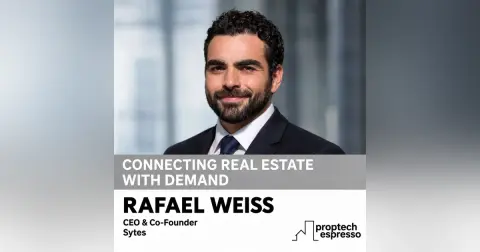
Rafael Weiss - Connecting Real Estate with Demand

 Apple Podcasts
 Spotify
 Castro
 RSS Feed
 We talk with Rafael Weiss, CEO of Sytes, about why commercial real estate deals stall when tenant demand stays hidden inside inboxes and personal networks. We share how a marketplace model, disciplined pricing, and targeted AI automation can turn site selection into a faster, cleaner pipeline for tenants, brokers, landlords, and developers.
• defining proptech as software for real estate and why some models falter
• why “can we build it” is different from “should we run it”
• Rafael’s background in music and how content builds early traction
• hiking the Appalachian Trail and resetting career direction
• how Sytes starts with an MVP and wins region by region
• the core problem of noise in site submissions and slow information velocity
• making tenant intent visible so reps filter faster and close more deals
• why charging tenants drives adoption and better response behavior
• how Rio AI automates email intake, missing info requests, and CRM-like workflows
• the moat of marketplace network effects and proprietary data
• what’s next: prospecting beyond the platform and portfolio-level matching
• macro pressure from scarcity, high construction costs, and tight supply
Be sure to subscribe to the podcast on Apple Podcasts, Spotify, or wherever you listen to podcasts. To learn more, visit proptechespresso.com.
Where is this appearing?
00:00 - Welcome And Guest Introduction
01:44 - What Proptech Means Now
05:40 - From Music Career To Real Estate
13:00 - The Appalachian Trail Reset
17:20 - The Spark And The MVP Launch
22:00 - Fixing The Noise In Leasing
31:00 - Why Tenants Pay And Use It
34:25 - Rio The AI Email Agent
38:45 - What’s Next And Market Scarcity
Welcome And Guest Introduction
Speaker 1Welcome to Proptech Espresso. My name is Mark Hurst, a former investment banker, s erial startup junkie turned real estate technologist. On each 15 to 20 minute episode, you'll hear from leading entrepreneurs and expertise on the opportunities and challenges of the rapidly changing prop tech sector. Thanks for listening today. Grab your favorite beverage and let's learn something new.
Speaker 2My guest today is Rafael Weiss, CEO of Sytes, the expansion marketplace for commercial real estate. Sytes shines a light on invisible demand and has facilitated more than $5 billion in deal value, working with well-known brands like Dutch Brothers, Papa John's, Cinnabon, and Doctopia. Outside of work, Rafael breeds and races thoroughbred horses in his home state of Florida. A former DJ and music producer, he's also impressively hiked the entire Appalachian Trail in six months. Rafael attended the University of Miami where he studied film, cinema, and video. Rafael, welcome to the show.
SpeakerYeah, thank you. Thank you very much. Uh we we 5 billion has not been transacted on Sytes. I hope to God that that's true. Uh there's about 5 billion of deal uh deal activity living on Sytes right now in terms of deals to be done. But yeah, just wanted to clarify there.
Speaker 2Awesome, awesome. Well, I'm sure you given the uh the rate of success that you've had, that milestone will uh come uh and uh be surpassed in in hopefully not too long of a time.
SpeakerUh yeah, absolutely. There's been about uh say 150 to 200 million of actual like lease value in cap rates signed from Sytes. I can effectively say that. Awesome, awesome.
Speaker 2Well, impressive given the um uh kind of where where you are and how you've been the platform. So we'll we'll definitely dive in in into that as we kind of go
What Proptech Means Now
Speaker 2forward here. But would love to start off with what is my traditional prop tech expresso question. Would love to hear your definition of of prop tech and if you've seen any kind of change in that definition during the somewhat short time that you've been in the in this space, but um, you know, somebody that's that's definitely uh uh kind of been been part of the the growth here recently.
SpeakerYeah, absolutely. I don't think I've seen a change in definition for prop tech. I mean, effectively it's just software technology for real estate, right? Um have I seen a change in what types of prop tech companies we're seeing make the most headway in it right now, and where certain prop tech companies that were supposedly industry leaders are faltering. Absolutely. Uh I'm sure we've all seen CoSTars uh stock price, right? It's has a substantial drop. Um there's a clear correlation between per seat models uh and a drop a drop in in stock price. Um AI can replicate a lot. I think what people are realizing is that while AI can replicate a lot, what seems to be more difficult is operating and managing all of the things that the AI actually creates for you. Uh so I can't tell you how many people tried to replicate what sites does, which isn't too difficult uh to a certain degree outside of the marketplace, which is impossible. But in terms of like the site submission portals, et cetera, et cetera, uh I had a customer that tried to replicate it six months ago. They're like, no, we're just gonna build this internally. I said, okay, great. Uh six months ago, he told me that I tried to submit a site to their through their build portal about a month and a half ago. Didn't work. I was like, I texted the guy. I'm like, this isn't working. Uh I'm I we could have gotten you set up in five minutes. And of course, they're signing up now. You know, uh it's it's just funny because we yeah, it's almost like we've ended up in this in this in this situation where, okay, I know I can I I know I have a kitchen now, and I know I can get the ingredients and cook whatever I want, but does that make restaurants uh uh irrelevant? No, of course not. A chef is gonna prepare exactly uh the meal that you requested in most likely a better way than you could ever make it yourself, outside of like putting a lot of work in, right? And there's a convenience factor. And I think that that's that's kind of uh the the situation we're in. It's it's not can we build everything, it's should we?
Speaker 2Yep. No, we're definitely gonna dig into that because um you know, obviously there's um, you know, uh AI has certainly uh enabled um a lot of people to to do a lot of things, which is which is great. Um but I think everybody to your point needs uh understand like should they be building these things? Are they going to be able to maintain these things? Um and um uh as as you said, like uh just because you can build it doesn't mean that you can run run it on an ongoing basis, to your point, about like being you know, actually operating these these sorts of uh platforms and and and technologies. Um so uh definitely uh plenty of um things for us to to
From Music Career To Real Estate
Speaker 2explore. Uh but let's uh want to spend a little bit of time just kind of getting to know you and your in your in your background. We'd love to hear um kind of the backstory about kind of growing up and and kind of your your college experience just to uh kind of set the stage, I think, for some of the stuff that we'll be diving into a little bit later on.
SpeakerYeah, interesting. Um yeah, so I mean, I grew up in a commercial real estate family. My mom was a realtor, she worked for Cogmole Banker, and now she works for Sotheby's. My dad was a commercial real estate developer. So uh, you know, I would go when I was a little kid, I would literally go to showings with my mom. Uh my dad had some buildings in in Miami, and you know, he'd take me along to do little site tours and make sure the property manager was doing his job, et cetera, et cetera. So I was really lucky. I, you know, I can 100% address that, right? Um yeah, I was very privileged in the way I grew up, especially being uh exposed to commercial real estate uh to the level of degree that I was. So uh I have an unfair advantage in this space, right? I grew up in it, and when I started trying to do development and uh go after uh single tenant deals or strip center deals, I realized that it was completely broken, and that's kind of what brought me into the world of sites. Um but I guess before that, uh I I was I was in the music industry. Uh I uh I was a touring DJ and a music producer. I did music for film and TV. So uh I did sync music. I had uh the trailer for Gossip Girl, one of the trailers I did. Uh I had uh my music in the Call of Duty mobile commercials. If you're like a video game person, like League of Legends and and uh Riot Games used my music as like the theme song for one of the uh tournaments. And I was, you know, I'm in the League of Legends playlists and all sorts of different uh games. Valorant was another one. I don't know if you're familiar with it, but anyways, um uh a lot of interesting video games. I'm a big I was a big gamer my whole life, so I'm a nerd, right? Uh and uh I think probably the two the two commercial real estate and you know this like odd tech adjacent background kind of led me to uh to to starting a prop tech company, which I never planned on doing. It wasn't a dream of mine.
Speaker 2Well for yeah, I mean for for those that are kind of looking at out from the outside looking in and like thinking, wow, like you know, the music industry and and working at video games like really exciting and like that's where I want to be. What um uh you know, for somebody that was in that um had some success and and ultimately chose to leave, like one, um what what uh uh what was it really like? And then two, um what are some lessons that you kind of have taken away from that experience that you apply kind of in your um you know role as CEO of a of a uh commercial real estate tech company?
SpeakerYeah, uh well what was interesting is there's a lot of similarities, oddly enough, in a startup and uh a music career. And I know it sounds crazy, but it's true. It is a business. Uh and not only is it a business, but it's almost a business in the in a in a similar sense to how uh a day one startup comes about. You have absolutely no awareness, no brand awareness, you have no following, nobody knows what you're doing, you don't know how to get any customers, how are you gonna get people to listen to your music? So you you you have to get creative, right? You have to think outside of the box. How do I start getting a customer base? And and and and not piss away a bunch of money, and excuse my language, but uh because in the music industry, you don't have a lot of money to spend on like acquisition. You kind of have to gain an organic following. And then once you have that, then you know where to start putting your marketing dollars, right? Um so honestly, it it almost trained me for starting sites. Like I was doing a ton of content for my music industry stuff, right? So uh all I would do is post Facebook videos and Instagram videos, and I would put together uh you know, uh teasers and this and that. And it's the same thing I'm doing I did for sites. That's how I got to 10,000 LinkedIn followers. I had zero LinkedIn followers two years ago. Um, I started posting content about sites and what we were doing and what we were building and building excitement around it, even though we had nothing going on, uh, and got people bought into the idea, right? And I made it captivating. Same thing with the music industry. And oddly enough, there's other people in this space that came from the same music industry that I was in that I knew from the music industry days that are doing amazing in commercial real estate. Number one, Aviva. Uh, I don't know if you guys if you've ever heard of Aviva, a warehouse hotline. She's the number one uh commercial real estate broker on TikTok. He has tons, tons of views. I used to post her music on on my SoundCloud and promote and help promote her because I had some channels to promote uh different artists. So and and and I ended up doing a deal with her. I she she represented me on a 9.6 million dollar industrial deal that I bought in Colorado. Um, so you know that was crazy. It's it's just crazy what a small world it is. Another one, Brandon Weiss, was a guy that I used to be on blogs with. Our remixes used to be in the same articles, right? Used to go by Kasume. Well, now he's head of real estate for Saks Global and he's constantly on X and he makes content and he understands the importance of that, right? So we all leveraged our past to be able to improve our careers today, right?
Speaker 2Awesome, awesome. That's that's great. I love how um the prior um relationships and and just prior worlds like come come back together and and and intersect. That's that's uh um always puts a smile on my face when you when when those sorts of things um happen unexpectedly or or on purpose. Um I know you you you were mentioning about kind of your your family's involvement in in commercial real estate. Um when you started to dabble yourself in in this, and and you mentioned kind of uncovering the um the issues that kind of plague the this particular uh space of real estate, um were you um was this something you were doing kind of completely independent of your of your family, or were they um uh uh were they like
The Appalachian Trail Reset
Speaker 2kind of letting you uh kind of get the scars that are necessary that um to kind of learn about this? Uh kind of tell me tell me how your kind of personal um real estate um uh journey began outside of um kind of family stuff you were doing early on.
SpeakerYeah, so right around the age of 25, uh I was so I there was two stages to the music career. Okay. Okay. There was the DJing phase, and then there was the sync music phase, which I got into later on. Um DJing fell apart for me. I I used to have get booked for shows and tour and make money from that, and I had like a nice skyrocket rise and then uh a complete collapse. And I was really sad about it around the age of 24. I launched a new project. I thought I was gonna do great and it kind of didn't work out. Um, so I decided to hike the Appalachian Trail at 25. I pretty much put everything I owned in storage, sold my car, and I decided to hike. During the hike, I was like, okay, I need to learn another industry. Like, I'm done with music, like I can't do this. Logical step, commercial real estate, right? So I just constantly listened to audiobooks on commercial real estate throughout the entire hike. Honestly, I should there are some books I shouldn't have been listening to. I didn't even know what a cap rate was at that time. I didn't actually, that's a lie. I knew what a cap rate was, but I didn't know like maybe some more intricate levels of commercial real estate development. Like I didn't understand like how to get geotech and uh you know phase ones and kind of like the development process as a whole. Uh and I I was just listening to whatever I could. I was absorbing any information that I could possibly get a hold of. Uh so uh throughout those six months I learned a lot. And when I came back, I moved back to LA and I went to UCLA for uh uh real estate and I chose a certificate in development or a specialization in development. So I have a certificate from UCLA in in commercial real estate. Um so that kind of led into you know working with my dad a little bit, seeing what he was doing, and then uh he got sick. Uh so I had to basically hurry up the process, move back to Boca and help him out because he called me. He's like, listen, like this isn't going the right direction. Yeah, unfortunately, he passed away. Sorry to hear his later. So, you know, it was uh it was kind of a quick um process to to get all set up. But yeah, uh that that's that's the story of it, really.
Speaker 2Gotcha, gotcha. One one quick quick question about the the the hike. Were you doing this by yourself or were you with somebody else um doing the the the six months? No, I I did it uh on my own. Amazing, amazing. Um uh another another time we'll we'll go into more detail about that because I'm I'm definitely a hiker and and uh know a little bit about that, but um would love to hear about your your full experience as I'm sure it was um uh um you know challenging, um amazing, uh push you to the limits, I'm sure, in in in many different ways.
SpeakerYeah, I I'll I'll say this. Um uh there's definitely some days where the AT it feels like it was way easier than writing a stunt up. I'll say that. Yeah, gotcha. Yeah. Awesome. Man, yeah, I I wish I could get back out there, honestly. I dream I want to be a triple crowner. Um, just on a quick side note, there's three main trails uh for through hikers to hike. There's the Appalachian Trail, the Pacific Crest Trail, which goes from Mexico to Canada, and the CDT, which is the Continental Divide Trail, uh, which goes from I believe it's uh what is it, New Mexico to uh Canada as well, but it goes through an alternate route through the center of the country. Um so yeah, anyways, I would like to do that one day.
Speaker 2That that is a great bucket list item. So I I hope you uh I hope you accomplish those uh formidable
The Spark And The MVP Launch
Speaker 2uh formidable uh um you know milestones.
SpeakerUm yeah, hopefully one day.
Speaker 2Yeah. So um uh you you came back to Florida, you kind of got immersed in the the the the family business in in a in rapid succession. When did the inspiration for sites strike you and and kind of how did that move perhaps from a frustration to a like I am going to solve this uh sort of uh uh light bulb uh moment?
SpeakerSo uh funnily enough, I went to a music school called Icon Collective, and uh it was in Los Angeles in North Hollywood. It doesn't exist anymore. Um, but that was like my real college experience, if you will. Um and I met this guy, Dean Slows, and we kept in touch, we became friends at from school, and he ended up promoting a lot of my music on Spotify. He had a Spotify promotion company, so you would hire these guys to put your music in playlists that were relevant to people who had them. So uh he would get me in front of an audience, and Dean got into tech. Okay, so Dean tried to get me to invest in a startup that he had, and I did, and it failed, but it got me kind of interested in you know what he was doing. And he he would always ask me, like, is there anything in like real estate that you're like trying to do? Like, I'm like, Yeah, I do have this one idea, and I didn't want to tell him and I did not want to tell Dean. I was like, I don't want to tell Dean because yeah, when you're so take let's take a step back here. When you're a uh not a free even a first-time founder, but when when you don't know too much about startups, you become extremely guarded about the ideas that you have, and then you once you get into the space, you quickly realize ideas are a dime a dozen. You can find an idea of you know walking around on the street, pick it up off on the off the bottom of your shoe. No ideas don't matter, it's execution that matters, right? It's the only thing that matters. It's can the entrepreneur execute the idea, right? A million people had this idea uh of sites of a marketplace that showed tenant demand. They all failed, right? Um so I started telling Dean, he finally convinced me, right? So I started telling Dean the idea, and uh he's like, we need to do this, we need to do this. I'm like, okay, okay, fine. So he built an MVP very quickly because he run he runs a software development company, right? Uh so he employs engineers and all sorts of different uh uh roles within software, and he helps them get hired, and then he also uses them for his own projects. So he built this MVP, and I'm like, oh shit, he actually built this thing. Like he's like, yeah, I built this thing. Like, what are you doing? Like, get me a customer. Like, we don't have a customer, like I wasted all this time building this thing. We negotiated all this. I'm like, oh shit, okay. So I I had I go out there and like I had a couple close connections. One of them was GoToFoods, the other one was at Papa John's. Papa John's ended up signing up way later, but we got GoTo Foods. And GoToFoods had seven different brands, right? Jamba Juice, Annie, Schlotsky's, McAllister, Cinnamon, uh, Carvel, uh, Mo's Southwest Grill. Uh, so we got all these tenants in South Florida. We piloted in South Florida, and basically we sold them on the dream, right? We showed them this MVP. We're like, this is what we can do, this is what we're gonna get you to. They start giving us ideas. We started building some of the ideas that they had, and we had success. South Florida was great. Then we moved into the Southeast. Southeast was great. Then we pushed out into Texas. Once we got Texas, everything came up. It was like, it was like the walls fell down. They're like, oh, we need this nationally. Then we started getting other customers, and that's how it went on from there. So yeah, it was a music industry connection that got me to build this software. And uh he, you know, I didn't even think it was really gonna happen. And then he did it, and I'm like, he got upset at me because I didn't, we didn't have any customers. I'm like, all right, I'll get some customers, and it kind of just worked out like that. It wasn't like some grand master plan or anything of that. And they it it it it was just a it was almost like a spontaneous series of events that kept snowballing because the core idea was good. It came from from somebody who had uh an actual issue with this system, right? There is a serious problem in the way that information uh uh uh flows and the speed uh at which
Fixing The Noise In Leasing
SpeakerInformation flows in commercial real estate. That is our number one issue. And there's a reason that since the 1980s, equity is 40xed and real estate has 4x'd, right? Why? Because the velocity of information and also the ability to make trades and make moves within equities, I mean, it's it's incomparable to what the technology was in the 80s. Have we really changed that much in commercial real estate? In some ways, yes, but in some other ways, it functions exactly like it did. You know a guy that knows a guy that knows a guy that, oh, I had I golfed with this guy once and he has a tenant. And oh, he knows that I have this site and then it's gonna work. That's crazy that we're doing business like that in 2026. There has to be a way where you can know if a tenant wants to be on your site and to be able to send it to them easily. I shouldn't have to figure out and become Sherlock Holmes every time I want to send Wawa a site. That's crazy. You know, that information, I can't even get an email. Yeah, you know. So um I had a serious problem with it because I was trying to develop myself. And I I I had good real estate, you know. I was I was I'm part of a company that has been around for a long time, has good quality real estate, and I can't get a uh an email response for three, four weeks. Why? Well, I I quickly found out it had nothing to do with me, they didn't like me. It was that the they were overwhelmed. Anybody that had uh a piece of or sorry, anybody that had a piece of real estate that was reaching out to these tenant reps and real estate reps, well, they were going through an email inbox that was 2,000 uh emails deep. And these tenant reps and real estate reps have to look through all of this, right? So the issue wasn't that there wasn't a deal pipeline, it was there was no filtration system for what they were dealing with, right? So the the the problem is is that everybody sends everybody everything, right? Because you don't know you're we're all blind. We don't know that that tenant wants to be on our site. So we're like, okay, we just figure out who's not in the market and we send them the site. We email them the site and we use crappy, shady uh ways to get their contact info that may or may not be accurate. We don't even know if that person still works there or if they are manage that region or anything, and we just send everybody everything. And and and at scale, what that does is it creates a massive amount of noise, a noise floor. Okay. And the amount of signal is very, very small that that that makes it through. And these reps have to filter through everything, right? So my idea was okay, let's make the demand signal perfect, right? So you know if they want to be there, you know if they have intent, so you're not wasting your time sending a deal, right? And then on the on the rep side, when they get sent that site, they already know that they want to be in that market, they already know it meets their criteria on a basic level, right, in terms of square footage, acreage, certain uh utilities or whatever it is that they deem necessary. And then they can just evaluate a perfect list of sites instead of going through an inbox that has uh an industrial site being sent to them when their church is chicken.
Speaker 2Gotcha.
SpeakerThat's science, right? So that you're talking on that rant.
Speaker 2No, no, no, no. It kind of brought us back to kind of what my and I think you're starting to kind of get into this is like you uh you you describe sites as the the tender for commercial real estates and uh uh you know, tenants, landlords, and developers. So you have this um you know trifecta of of of groups that are um historically inefficiently um uh working um in this space, and you're describing kind of like the uh just the uh the avalanche of of information that is sent out with um you know no sort of discrepancy in the hopes that somebody finds finds this. Um you know what the this you know this this Tinder analogy, how how is the experience, you know, how how how is that um uh experience changing with the the for for all of these individuals uh I I would say that number one, there's no more guessing, right?
SpeakerOkay, number two, the amount of deals that they can filter out easily saves hundreds of thousands of hours a year for these real estate reps. So they're focusing on getting more deals done. I don't think that there's any coincidence that Church's Chicken is going through an absolute revival right now. And they've implemented sites better than any other tenant. They require it for every single site submission, it's on their website. Every single real estate rep at churches has the site submission portal in their signature. If you email churches a site, they forward it to our AI that handles the site submission intake so they don't have to deal with the email. And guess what? They've had over 500 site submissions via sites, and the last time I talked to them, they have 16 deals done. Okay. And they've been on the platform in six months. They've closed on four deals for franchisees, they've been able to spur franchisee growth because they have such a strong site submission pipeline that they're able to put new sites in front of franchisees, yep, and that they that they never never would have had access to, right? Uh so yeah, they're marketing. It's at the end of the day, they are marketing and they're making their their process more efficient than anything, right? Because not only are we getting uh the sites filtered for them that get sent to them, but if a landlord, developer, broker has a match with Church's Chicken, they will see that at the front of their matches for that site, right? So just imagine you open up your platform, you see every site that you have, and you click it and you see see how many matches you have. You have three matches, okay. Uh learning experience, church's chicken, Dutch bread, whatever. Uh that's marketing. Maybe that landlord, developer, broker didn't realize that that tenant wanted to be in that market, right? Right. So that's that's low-hanging fruit for them. So maybe church's chicken isn't the highest and best use for that piece of real estate, but they've made it so easy and frictionless to do a deal with them that they're now getting sent that site. And this is one of the things that I've been thinking about so much. Uh why don't tenants market to landlords and developers more? And then I realized there are a lot of different tenants that do that, and they get the most real estate sent to them. So it's kind of amazing to see that uh we're putting we're doing this marketing for them and it's working, right? Uh so anyways, that I went on a bit of a tangent there again. I keep doing that. Yeah.
Speaker 2No, no, I uh it's obviously you're you're you're passionate and and and kind of um sharing kind of how this is solving the problems that you know that you're uh that you understand it at a at a deep level. Um I love the you know this um you know you were kind of bringing in this notion of the um the the franchisees and like it it sounds to me like um if there are some uh some smart franchisees um out there that they should be definitely on sites and and and you know growing their business by by utilizing the the platform um and um um uh kind of taking advantage of of something that um is going to help them grow their portfolio um uh given given the inform you know what's um all all of this uh commercial real estate that's on the platform and the the opportunities that um um that can be uncovered here.
SpeakerUm yeah, absolutely. We do have a few large-scale franchisees on there, impeccable brands, Briad Group. We have one of the Flynn Group brands. Um so yeah.
Speaker 2Awesome. Awesome. Um uh, you know,
Why Tenants Pay And Use It
Speaker 2uh just from your kind of brief overview of the kind of the origin story and kind of where things go, it it definitely sounds like you've you've been um successful, you've bootstrapped this um and kind of created a a fairly profitable business um in a short amount of time. Um what were what were any any kind of key decisions along the way that you think were um instrumental in in in in being able to um uh achieve that? Obviously, you were fortunate enough to um uh have a friend that had a development company. Um you were obviously in the business, you had a pain point, you knew some customers. Um any other questions on any other decision points that kind of um you kind of look at, you look back at as like a fork that you made kind of um the right decision that kind of took the took sites in in a an upward trajectory and prevent and and one that didn't kind of take it down the technology um you know startup rabbit hole that um you know many many prop techs uh enter and do not escape from.
SpeakerYeah, I think one decision that we made was not giving the product out for free. That was a massive argument. Uh everyone told me give out the give it to the tenants for free, give it to the tenants for free. I wholeheartedly believe that if you give somebody a product for free, they will not use it effectively, they will not adopt it. And if you're relying on that tenant to be able to manage and respond to your customers and they're not utilizing it effectively, your platform, your marketplace is is built on nothing. You're it's it's built on it's built on stilts that are made out of sandpaper. Uh you won't be able to sustain it. So you may have a meteoric meteoric rise, uh, but I don't think that in the long run it would work out. We decided to go the opposite route. And we charged every tenant, we built slow. We don't have every tenant on planet Earth. But what we do have is the tenants that are using us are actually on the platform, they're responding, they are using it how it's supposed to be used, they're on annual contracts, so they are not going anywhere for a little while, and they've adopted it, right? So you're getting actual responses and real information from these people instead of shoddy, half-assed uh stuff with a free freemium product, right?
Speaker 2Yeah. Let's uh I want to touch base on something we kind of um uh or circle back to something that touched on earlier in in terms of kind of um AI and how it fits into site strategy as well as the um perhaps uh uh you know um false confidence that it can give um others that
Rio The AI Email Agent
Speaker 2kind of are using AI but not um like really um you know building tools beyond kind of internal internal tools. So how let let's let's hear kind of how you've how you're using it and kind of um where you see the the opportunities and the pitfalls with with with sites.
SpeakerYeah, so the most AI-enabled tool that we have is Rio. Rio is what we call our email AI agent. So if a real estate rep, if a tenant rep broker gets sent a site and they have a sites account, all they need to do is put that email into a certain folder, call it the sites folder. Rio lives in that folder and will essentially take every site that is inside of that folder, automatically upload it into sites, tell you if it fits one of your tenants based on where the site is located and what your tenants' criteria are. And then if there's any missing information within that site, which there always is, Rio will email the site submitter, get the missing information, automatically update the site within your site's dashboard, and let you know when it's ready for your final review, now that all the information is present for you to be able to make a decision on if you want to put a tenant on that piece of real estate or not. Right. So, what is that product? It's an CRM, right? That's automated, it does everything for you, automatically uploads everything. You don't have to type anything in, and you just log in and and and determine if the site's a fit or not. And it saves you time from emailing, right? Uh so that's the most AI-enabled piece of of tech that we have uh for our tenant side customers. Now, on the other side, we have a matching system that's powered by AI where it matches sites with tenants and it gives you a percentage match. Uh, so we do have that piece that affects the landlords and the tenants. And same thing with the portals. Our RIA lives in the portal. So anytime a site is submitted through a site submission portal, the AI once again does its job, goes through everything, finds out the missing info, goes through that same process. Uh so we're partially relying on AI. We have AI in our product, but it's not the full stack, if you will. Um I would say the most important piece is the marketplace itself and network effects. Yeah. Uh we have people transacting on both sides of the equation. AI can't create a, I mean, it can create a marketplace, but it can't create users, right? Yep. Um, the most difficult part is getting a market of getting a marketplace going, is solving the chicken or the egg, the cold start, right? Yep. Um, so we we've we've accomplished that. And that's the best moat that we can have. So once we had that foundation, and and we got very lucky because we started building this right before AI became extremely relevant uh in terms of like developing software. Uh so I think if we waited a year and a half, two years, this product would look a lot different. And I don't think we'd have the same level of moat that we currently have because we have so much proprietary data and network effects that you just it it would be impossible to replicate.
Speaker 2Awesome. Um, well, just uh one more question before uh gotta wrap the conversation. Um uh would love to hear kind of um anything that you can share around what's next for sites and if you you know kind of looking out in the on the horizon, anything in the commercial real estate um kind of uh uh kind of macro macro macro that may be impacting kind of this this space that you're
What’s Next And Market Scarcity
Speaker 2paying attention to. Interesting.
SpeakerUm yeah, we are coming out with a prospecting tool that allows landlords, developers, and brokers to reach tenants that aren't on the platform. So uh we're gonna we have a void analysis tool that we've created. We're gonna be able to see what tenants aren't in a market, and then we have their contact info, and we just shoot out the uh the site to them. It's all on your dashboard and ready to go. So not only do you have access to the tenants that are on sites that are already matching with you, but you can also do your cold outreach directly from a platform, manage everything in one place. That is our next goal uh for your average customer for our uh REITs, our large family offices, uh, our private equity funds. We have something called the portfolio review tool. So if you have a national account with sites, you're able to see every single tenant that you have a match with across the country. So uh a company like Chimco, for example, which we're testing the product with now, uh can go on and see that my iDoctor matches on a hundred different uh sites with them or 50 different vacancies that they have. Uh that's a large number, but you know, we're just using examples here. It's probably something more like 13, 14, maybe seven, right? Uh they're able to send every site to my i doctor with one click. Not only are they able to do that, but they're able to then negotiate a potential portfolio lease across a blanket lease across their entire portfolio and knock out seven at once. And we also can front run the leases because what we're doing is we're getting the time that a certain tenant would want to be in a market. And we're also getting the time that the lease runs out on the landlord side. So we're able to match timelines now, like we've never been able to do before, right? Yes, because we know certain tenants might want to be in a market three years from now, two years from now. Yeah, but because the the market's so tight, you're able to front run where you'd want to be even before you get there, and you can have agreements in place to lock in uh at least uh three years from now, two years from now.
Speaker 1Nice, nice, awesome, awesome.
SpeakerThen and then on the macro side, sorry, uh no please, yeah, yeah, please, please. Uh yeah, uh I think that I I think that the the one thing that I've noticed more than anything is is scarcity. There is just not enough product out there. I I think construction costs are extremely high. If you're looking at new newly delivered centers in retail, uh it's the lowest it's ever been in terms of newly delivered shopping centers. I think it's gonna be more and more difficult to find space. I think the the the scarcity problem is gonna continue because I don't see construction costs lowering anytime soon. And uh I I think that people are gonna have to get very creative uh on the tenant side to be able to start getting and growing the the amount that their shareholders want them to grow. Interesting.
Speaker 2Um awesome. Well, with that, Raphael, unfortunately, got to draw a conversation to an end. Really uh appreciate you coming on the show, sharing your uh fascinating background and and really enjoyed hearing about uh what you're building at sites is you know the origination through where you're taking the platform. Um hopefully uh people listening um can can learn more. Um if they're interested, uh how do they uh kind of get in contact with you or or uh or sites?
SpeakerYeah, so I'm on LinkedIn. I'm an absolute LinkedIn addict. Uh if you want to find me, it's just Rafael Weiss, R-A F-A-E-L-W-E-I-S-S. Uh I'm posting every day. If you want to check sites out, it's s y-t-e-s-c-re- dot com. We have a brand new website that we paid a lot of money to a designer for. So I hope you enjoy it. I think it's very, very visually appealing. Uh, so take a look.
Speaker 2Awesome. Raphael, thank you so much. Um, hopefully we can um continue the discussion and uh look forward to uh tracking the progress of sites.
Speaker 1Absolutely. It was a pleasure. Thank you, Mark. You've been listening to an episode of Prop Tech Expresso. Be sure to subscribe to the podcast on Apple Podcasts, Google Podcasts, or wherever you listen to podcasts. To learn more, visit hearstex.com backslash podcast. Thanks for listening, and we'll be back soon with a new episode.