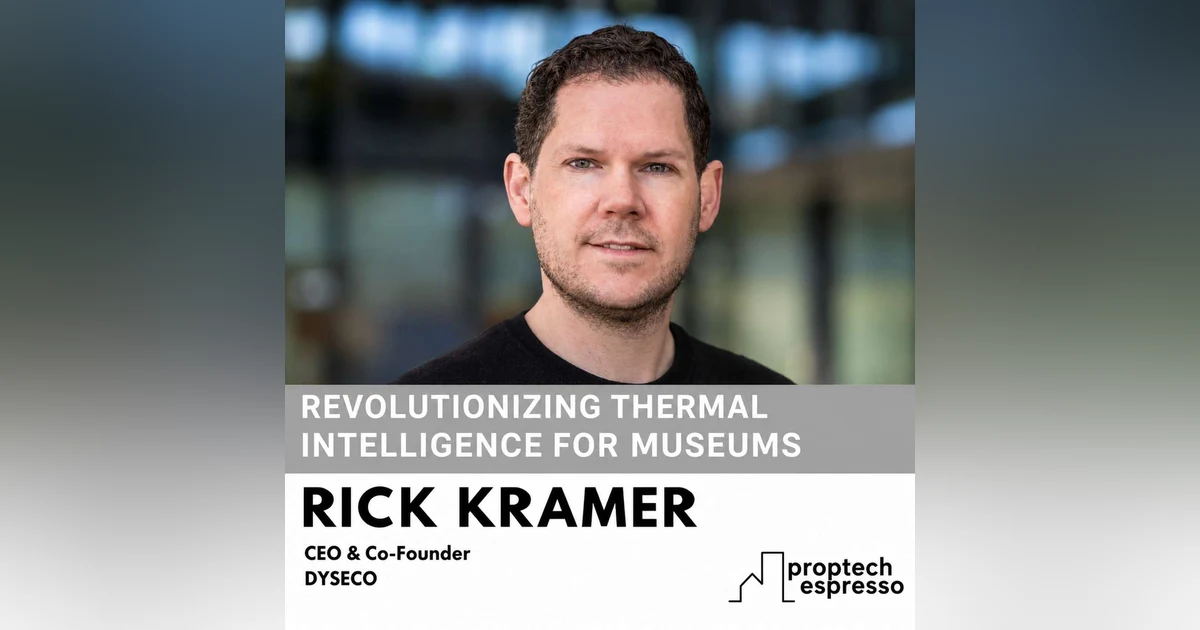
Rick Kramer - Revolutionizing Thermal Intelligence For Museums


 Apple Podcasts
 Spotify
 Castro
 RSS Feed
 We talk with Rick Kramer, CEO and co-founder of DYSECO, about why “smart” building technology is really about better operational decisions that protect people and assets. We break down how museums can cut HVAC energy while staying inside conservation-approved temperature and relative humidity limits, with clear fail-safes and measurable results.
• defining proptech as technology that helps buildings perform their real purpose better
• why DYSECO sits at the intersection of proptech and climatetech
• Rick’s path from mechanical engineering and the Marine Corps to museum climate research
• the gap between academic research and what museums can actually deploy
• why museums require trust, evidence, and consensus across facilities, conservation, finance, IT, and leadership
• creating a shared data set so facilities and conservators stop arguing over whose data is correct
• improving decarbonization economics by optimizing existing HVAC before replacing equipment
• how physics-informed, data-driven control stays inside hard preservation boundaries
• what happens when the internet fails and why fallback behavior matters
• lessons from major Dutch museum projects and why US museums face the same physical problem
Be sure to subscribe to the podcast on Apple Podcasts, Google Podcasts, or wherever you listen to podcasts.
To learn more, visit proptechespresso.com.
Where is this appearing?
00:00 - Welcome And The PropTech Definition
03:43 - Rick’s Unusual Road To Museums
08:10 - From Research To A Real Product
12:42 - Selling Tech In A Zero-Risk Culture
20:21 - Decarbonization Without Replacing HVAC
25:17 - Real Time Tradeoffs And Fail Safes
36:06 - Beyond Museums And Why Now
40:59 - Where To Learn More And Close
Welcome And The PropTech Definition
Speaker
Welcome to Proptech Espresso. My name is Mark Hurst, a former investment banker, s erial startup junkie turned real estate technologist. On each 15 to 20 minute episode, you'll hear from leading entrepreneurs and expertise on the opportunities and challenges of the rapidly changing prop tech sector. Thanks for listening today. Grab your favorite beverage and let's learn something new.
Speaker
My guest today is Rick Kramer, CEO and co-founder of DYSECO, a technology company providing state-of-the-art dynamic climate control. DYSECO is rooted in his scientific work as assistant professor at Eidenhoven University of Technology in the Netherlands, where he focuses on machine learning for optimizing indoor climate control in complex environments where temperature and humidity are critical. With DYSECO, he provides energy efficient, effective, and scalable indoor environmental management in the cultural, clean tech, and healthcare sectors. Rick, welcome to the show.
Speaker 1
Well, thank you, Mark, for having me today.
Speaker
I think it's going to be a great conversation. Excited to dig into DYSECO, but we're going to start out with my traditional Prop Tech Expresso question, which I ask all my guests. Would love to hear your definition of PropTech.
Speaker 1
Oh, yeah. Um, that you know, PropTech, um, which is short for property technology, is of course can be defined pretty broadly. Um, it it's in essence, it's IT and software that helps to um to uh help that helps uh to better uh design, construct, manage buildings in general. But to me, ProTech as I use it, uh it's a technology that helped that helps a building perform its actual purpose better. That purpose is not simply to exist or consume less energy, and therefore it's not the core of what we are aiming for is to reduce energy use. But for example, an office should support the people working there, so it should uh provide a healthy and productive environment. Uh, on the other hand, a museum must protect its collection and welcome visitors, so it has a complete um other set of uh requirements when it comes to indoor climate control. And then on the other hand, a clean room must maintain conditions for a critical process that can be in RD or a production process. So the the smart part, so if you're talking about smart technology, the smart part is not how many sensors or gadgets you install. I think it's whether you use data to make better operational decisions. So DISECO is sits actually at the intersection of prop tech and climate tech. We use data and building physics to help exist in climate systems protect people and assets while using much less analogy. So for me, that balance is what good prop tech should accomplish.
Speaker
Gotcha, gotcha. Um so given given that uh kind of intersection you were talking about, do you think Diseco is more prop tech or more climate tech?
Speaker 1
Well, it's genuinely both. The mechanism is small building operation, but the result is lower energy use and carbon commissions, uh carbon emissions in mostly mission critical environments. So my definition comes directly from the rather unusual route that brought me from mechanical engineering into museums.
Speaker
Gotcha. Thanks for the the the definition there there, Rick.
Rick’s Unusual Road To Museums
Speaker
Um, let's get to know you a little bit because I know um you got an interesting uh background and would love to have you share your backstory, including kind of where you grew up, what you started at college, and your early career.
Speaker 1
Well, I I grew up in in the south of the Netherlands, Europe. And when I think about it, like three people that really determined, like really uh put a stand on my uh interests and and career. Um so my grandfather, for example, he was a mechanical engineer in the coal mines, and mining brought enormous prosperity to our region during the 1950s and 60s, and he sparked my fascination with classical mechanical engineering. Um, my uncle, he's an architect, so he added an interest in buildings, and then during I remember that I visited the Rijksmuseum in Amsterdam when I when I was about, I think I was about 12 years old, I became fascinated by cultural heritage. And today my work is almost exactly where those three interests meet. But my career did not begin in the museum environment because after high school I was craving some adventure. I was fascinated by the US Navy SEALs, which led me to officer training with the Royal Netherlands Marine Corps. So it was extremely intense, and I eventually left without completing it. But it gave me a lot of good lessons and it gave me resilience and a can-do mindset that still influences me as an entrepreneur. Um, after I left the Marine Corps, I then studied mechanical engineering. I worked in research and development environments and worked as a building services engineer at a consultancy company. And um I always wanted to be busy in you know in practical means, but the the idea got to me that I wanted to pursue a master of science. So I started um my master's at Eindhoven University of Technology in the Netherlands, um, where I completed my master's degree, and later uh I completed my PhD degree there on energy efficient climate control for museums. So basically, today I combine academic research with entrepreneurship. And what drives me is taking state-of-the-art research and turning it into something that creates measurable impact in real buildings.
Speaker
Awesome, awesome. Um, you mentioned uh the the Marine Corps. Um are there um experiences from that uh uh part of your your background that you uh reflect on and leveraged as a uh a founder and entrepreneur?
Speaker 1
Oh, absolutely. Um and I think that when you're young, you don't always realize what lessons you learn somewhere. And often you come across those, you you experience that you learn those lessons later on when you encounter specific situations. So, for example, um there are many lessons that I learned in the Marine Corps, um, but one that really struck with me is that difficult situations become manageable when you stay calm and divide the problem into steps and keep moving. So, research also, especially a PhD, can be pretty lonely. Uh, it's a four-year uh lonely research journey with very limited supervision often. So, in research, it also you also require uh persistence. But building a company requires it every day uh for many years in a row. So that combination of research, engineering, and cultural heritage eventually became uh eventually became Diseco uh uh uh with some good ingredients that I that I learned in the Marine Corps, like persistence.
Speaker
Awesome.
From Research To A Real Product
Speaker
Well, tell us about DYSECO um and um kind of the light bulb moment that uh kind of inspired you to found the company.
Speaker 1
Well, the um you know, after I finished my PhD, uh I I had quite a good network internationally with uh you know folks at museums, working at museums in the you know facilities domain and also conservation domain. Uh but what I noticed was that despite the fact that at Eindhoven University we are doing some uh really good appliable engineering uh and research, nevertheless, the uptake by the market and the uptake by the field was negligible, uh basically zero. Um, because there is simply a big gap between science and um and practice. So I founded DYSECO together with my uh co-founder uh at Gal Neuhaus in 2019, um, and we became operational, so we developed our MVP, our minimum viable product, in 2020, just before uh COVID broke out, and that that was of course uh a pretty bad timing for us, um, as for many people, because many museums had to shut down, um had to close for the public, so that was a really bad um circumstance, and um but we managed, and um so museums, you know that the the the the main reason why we started DYSECO is that because museums were using enormous amounts of energy to keep temperature and relative humidity close to one fixed set point, 24 hours per day. Yet collection preservation research showed that the safe climate is not necessarily one perfect number. So, depending on the collection and its requirements, it can be an approved range of temperature or and an improved range for relative humidity with carefully limited changes. So that created the central question for us if we know the safe boundaries, can we operate the existing HVAC system intelligently inside those boundaries instead of constantly forcing the building back to one rigid target? So the founding research I conducted at Eindhoven University of Technology and is available through the academic literature, so it's uh open uh open research and it's it's uh findable. But then with DYSECO, we performed the engineering part and the RD required to turn that insight from research into a practical product that is robust and can work in a practical and real-life environment. So basically, DYSECO owns the patent for the technology, so I describe it as a research spin-off rather than suggesting a formal university ownership relationship. And I founded the company with Adgar Neuhaus, as I mentioned, and Adgar brought a strong network and many years of practical consulting experience in cultural heritage. And I brought the control research and the core product concept. So I focus primarily on HVAC control, heating, ventilation, and air conditioning systems control as CEO. And Edgar, our COO, focuses more on the building physics side and practical heritage applications. So research gave us the principle, but together we turned it into something museums could actually use. Yeah.
Speaker
Seems like you you're uh like like many great founding teams, you guys have complementary skills that allow you to um uh kind of uh uh work work together well, uh attack the problem um and uh provide a solution that's definitely gotten uh traction in the market, both um obviously in your in your local Netherlands uh um as well as uh the US, which I know you'll uh start to talk to us about uh as we go on in this conversation here.
Selling Tech In A Zero-Risk Culture
Speaker
Um technology adoption isn't the first thing that comes to mind when when people uh think about museums. Um it's obviously a uh uh an environment that um you know um when you're uh kind of in there, you're you're oftentimes looking at um uh older um artifacts and um kind of focused on on those things and you and you don't see um technology and um uh that aspect of of a museum. It's not not the central focus. Um what are some of the unique factors that technology providers to museums need to understand when selling into this sector?
Speaker 1
Yeah, good question because it's quite a unique sector. Um so the first thing to understand is that a museum is not buying ordinary building software. People are responsible for objects that are unique and sometimes literally priceless. So if you are a conservator accountable for, let's say, a Rembrandt painting, even a small perceived risk can outweigh a very attractive energy saving proposal. So the second factor is that this is a consensus decision within the organization of a museum. So facilities understand the HVAC system, collections and conservation determine the what environmental conditions are actually acceptable, uh, finance evaluates the investment, and IT uh needs to review the security and connectivity uh requirements. Also, of course, leadership is uh involved and may need to approve the project, and uh an external controls contractor may implement a part of it. So each person is asking different questions. Facility asks, will it work with my system? And conservation asks, is the collection safe? Finance asks us, can we prove the savings? Uh while IT asks us what connects to our network. So the the sales process begins with listening and evidence. You cannot lead only with energy savings. First, uh we establish the preservation boundaries together with the conservation team. We establish the technical fit, fallback behavior, and the measurement method for determining to determine the uh the energy savings. So in museums, trust is really part of the of the technology.
Speaker
Gotcha. When when you're doing this um uh kind of selling process and and you mentioned all these different stakeholders that you're working with, is there a typical um internal champion that you are um able to identify or um how does uh how do you how do you uh how do you kind of identify that individual that's gonna really help um lead the internal efforts to uh uh kind of move forward with DYSCEO?
Speaker 1
Well, it it can be pretty pretty diverse, actually. So we can we can start with um different teams. Uh it it sometimes depends on the situation, but but most often facility opens the door because they experience the operational problem, but the project only progresses when conservation is comfortable and finance understands the business case. So we often start with facilities and they often lead the effort within the organization.
Speaker
Gotcha, makes sense. Makes sense. Um, you are also describing kind of the the different stakeholders and how you uh how it's a um uh that all of these individuals need to be involved in this sort of decision making when evaluating in uh a new technology like DYSECO. Um does Diseco change the relationship between these uh disparate teams like the facility teams and the collections when they um have access to a solution like Diceco?
Speaker 1
Um absolutely. Um when we come in, we see that in many museums, the facilities and conservation teams are looking at two different versions of the same building. So the conservation team may have its own temperature and humidity data loggers and facilities has data inside the building management system. Conservation may need to request information from facilities, and when the data sets or time periods differ, a technical discussion can quickly become a discussion about whose data is correct. Yeah, so yeah, so with DISECO, we really um empower those teams to work from one central data set in our Dimetrix dashboard, but they do not have to look at the data in the same way, uh so we provide tailored pages and analysis um uh methods um for the conservators and other tools for the you know tailored to the needs of the facility teams. Uh the conservators they see whether each space remained inside its approved temperature and humidity limits, while facilities uh see set points, control signals, uh, system behavior, and energy performance. So that really changes the con conversation. You know, instead of conservation saying, I am worried about this room, and facilities replying, my system says everything is fine. Now both teams can examine the same event and decide what it really means. So the dashboard becomes a shared language between preservation and operations.
Speaker
Gotcha. Um, do any of the team do the teams like the conservativists ever feel like uh they are giving up uh decision-making control with DICECO? Um, how's what's your experience been around that?
Speaker 1
Um, it is definitely one of the questions that we often get, you know, because the the the the teams uh especially the conservators, they don't want to get that feeling that we are doing some fancy automated control, and they can they they do not understand what's going on uh and and don't have any control anymore. So that's totally not the case. Um uh the conservation team tells us exactly the approved boundaries for temperature and relative humidity, and then Diseco optimizes the um the control of their system, so their air handling system within those boundaries and makes the resulting performance transparent using the Dimetrix uh platform. So once those teams agree on the safe operating space, the museum can begin finding substantial savings without immediately replacing you know its mechanical systems.
Speaker
Yep.
Decarbonization Without Replacing HVAC
Speaker
Um great lead into the next question, which um you know, museums as as many other uh real estate asset classes are are also are kind of under um uh enormous pressure to decarbonize. Um but many facilities teams don't um have the the capital to replace um HVAC systems, which are a pretty uh pricey uh system within uh the buildings. Um how does Diseco change the economics of decarbonization for museums?
Speaker 1
Yeah, I mean if if you look at the conventional decarbonization uh uh strategies, they often start with new equipment, you know, replace the air handlers, install new chillers, or renovate the entire mechanical system. Super costly, it's time consuming, it's it's you know uh um disrupting the operation, the core operation of the novel building. Yeah, so those projects can be valuable, but they are expensive and slow. So Tayseko asks a question that should come first. So, how efficiently are you operating the equipment you already own? So because we connect a small edge device to the existing building automation system, and our software then optimizes how that system operates. So, across our projects, the average measured reduction is 32% at the ERM in process level, although results very similar. Significantly by building that. But the payback periods we have seen range from approximately six months to four years maximum. And I think related to this question, the Bonifonte Museum in in Maastricht in the Netherlands is a very good example because the museum has air handlers dating from the 1990s that were believed to be nearing replacement. And by uh optimizing their operation, uh we reduced air handling energy by 42%. Uh and that contributed to a measured 23% reduction in whole-building electricity use. And the museum was able to postpone major capital replacement because they realized hey, if we control those air handers in a smarter way, they can you know continue for a couple of years. So it was really that combination of reduced energy use but also postponing the major capital replacement cost.
Speaker
Yeah. Um probably what's uh not uh not uh known by most people is that kind of the way the way a um uh a system like an HVAC is is used um you know or uh traditionally puts a lot of stress on on the on the piece of equipment itself. So um if it's done in a um uh a more um uh using the the the solutions that DISECO is providing, it's it puts less strain on the system and can elongate the the the the life there. So um uh definitely something I know you guys bring bring to the table. Um but in in terms of like um the the replacement um uh solutions, um is it really possible to safely delay the equipment replacement? Or are you introducing risk to the museum and it's um the artifacts in there by um uh kind of uh by delaying the equipment replacement?
Speaker 1
Yeah, I mean we are we are not claiming that software can rescue defective or badly designed equipment. You know, some some systems genuinely need replacing, but before spending millions on new equipment, it makes sense to optimize the load, understand what the building actually needs, and then size future investments around that improved reality. So, for example, at the Bonifonta Museum, it worked out really well, and they lowered their operating demand and strain on their HVAC systems. So they they basically extended their lifetime.
Speaker
Nice.
Real Time Tradeoffs And Fail Safes
Speaker
Um, the DISECO solution is designed to balance collection, preservation, um, occupant comfort and and energy use. Um, how does the system make these trade-offs in in real time?
Speaker 1
Um, well, I think the the most important point is that ISECO does not decide what is safe. So the collection team does. Um for every space, the collection team defines the allowable temperature and relative humidity limits together with the maximum permitted rates of change. So those are really hard boundaries. And every minute, the ISECCO reads the indoor temperature and relative humidity and examines control signals for heating, cooling, humidification, and dehumidification. So our physics-informed models consider how the building responds to outdoor conditions, indoor loads, and the building's own thermal behavior. You know, the system then calculates the most efficient space level and supply air condition set points. So the clever part is really all about the timing, because you know the safe range may shift gradually through the year. And the same for relative humidity, but the rate of change uh that is permitted depends very much on the collection uh that is uh exhibited or you know stored. Um but also the uh the absolute limits are really uh you know essential and key for maintaining those those collections. So the algorithm determines when moving the range and uh and within the range will reduce energy demand while maintaining the collection protection and and comfort of visitors. So the the existing building management system and local controllers they still operate the heating, cooling, and other equipment, but now they simply receive better targets you know provided by Diseco and the museum retains override and fallback control. So basically, you could say the collection team draws the box while DISECO finds the lowest energy route through it.
Speaker
Gotcha. Um people all often kind of wonder what happens in a worst case scenario. So in in in the if kind of an event where Diseco or the an internet connection fails, how does the system uh respond?
Speaker 1
I I think this is a nice question that is exactly pinpointing at you know the huge gap between science and practice, because you know, the scientific part can be finished and you know exactly what your technology should do, but then designing it and engineering it into a product is so much more time costly than people expect in advance, because you have to take into account all those um possible scenarios, like what you say, you know, what happens if the internet connection fails. So we have thought that through very well um and and engineered our solution very robust because we are working with a you know zero tolerance environment uh in museums. So the building management system remains the executing controller, it can hold the last valid in-range set points that we provide, or it can revert to the museum's native control strategy according to the agreed fallback configuration. So, in the end, you know, when when it happens the internet that the internet connection fails, there's really no no uh material uh risk.
Speaker
Great, great. Um what is the biggest uh misconception museums have about the relationship between collection preservation and energy consumption?
Speaker 1
I think the biggest misconception is definitely that collection preservation and energy consumption, or I must say energy efficiency, are basically mutually exclusive, so that one cannot go hand in hand with the the other. Um, you know, they often the paradigm is still uh that tighter the control of temperature and humidity automatically means better preservation. But for many years, museums aimed you know for one perfect temperature and relative humidity value and forced the building to maintain it every hour of the year. But preservation is about controlling risk. So depending on the collection and its requirements, recognized guidance can allow a safe range and carefully limited seasonal movement. That does not mean relaxing the standards. The conservator still defines the boundaries and the permitted rate of change, but it means avoiding unnecessary heating, cooling, humidification, and dehumidification when the collection is already safe. And sometimes rigid control can even increase mechanical strain or create building-related problems such as condensation of moist air. That especially happens often in in western Europe where the the winters can be uh harsh. Uh, but of course, it can also happen in the in the uh north northern eastern part of the of the US. So very importantly, more analogy is therefore not automatically more protection. The goal is to, you know, the goal is the correct climate, not the most aggressively controlled climate. So in a nutshell, precision is not the same here as protection.
Speaker
Great, great. Um what have you learned from working with um museums like the Van Gogh Museum, the Rijks Museum, uh Marshall House, and uh the Anne Frank um house that could change how US museums think about climate control?
Speaker 1
Um well, the first lesson is that you do not need to choose between preservation and efficiency. So you need better evidence and better control. So at the Van Gogh Museum in Amsterdam, a key reference project for us, the measured reduction in air handling energy was 61%. 61% reduced air handling energy. That is important because it shows that meaningful improvement can still be found in a sophisticated museum with modern HVAC systems. Uh, at the Rakes Museum, uh, we performed a multi-year demonstration there. Um uh we did a comparison, it was almost like a competition of the you know automated process control by Diseko versus um um two uh building automation system uh engineers that were working constantly to um improve a system and air handing uh unit, and we were automatic automatically uh tuning another air handling unit unit that was uh identical and in a you know identical room basically. So we did that for a couple of years, and um you know the data-driven commissioning and optimization proved considerably more cost-effective than a manual process involving those two engineers. So the lesson there is that automation can scale expert knowledge rather than replace the need for expertise. Uh at the at the Mauritz house in in The Hague, we measured a 42% reduction at the building energy meter level through climate control optimization. So 42% at the building level. Um, at the Anna Frank house, the project is especially interesting because it combines optimized air handling with display cases that provide localized microclimate control. So for US museums, I would say that the the broader lesson is to begin with the collections actual requirements and then examine the building data and only then decide how hard the mechanical system needs to work. So existing equipment may have far more flexibility than than people assume. So the yeah, the technology matters, but successful project projects also require facilities and conservation to agree on the limits, on the evidence, and then the definition of success. So the the lesson from the Dutch museums is simple. Start with what the collection actually needs and not with how hard the HVAC has always worked.
Speaker
Gotcha. Any fundamental differences between Dutch museums and and US museums?
Speaker 1
Well, the uh the uh the institutions differ and the the standards differ, but the the physical problem is remarkably similar. Uh I mean in both countries there are many valuable collections. Uh in both countries, uh facilities struggle with aging systems. We look at organizations that often have multiple stakeholders and and quite a hierarchical structure, so making decisions and and changing things is not always easy. And of course, the enormous energy demand uh from maintaining temperature and humidity strictly is definitely present in in both the US and also in Europe.
Speaker
For sure. For sure.
Beyond Museums And Why Now
Speaker
The technology DISECO is using has applications beyond museums. Uh, what are other real estate asset classes that DISECO is anticipating extended to in the future?
Speaker 1
Um, our strongest current markets are museums, archives, and our storage facilities. So they share the same fundamental problem, which is basically temperature and humidity are mission critical, but maintaining them consumes a great deal of energy. We are also currently piloting the approach in an office environment where we are getting some really promising results, but there the asset being protected is different, of course. It's not about art, but it's about human comfort, health, and performance of people. But the idea of dynamically responding to the actual needs remains relevant. And also healthcare at clean rooms are the next, you know, the next major commercial opportunities. So although we do not yet have active DICECO projects in those sectors, we we are convinced that you know we can uh provide a lot of uh added value to those sectors uh because these environments use significant analogy to maintain tightly controlled conditions. And just as museums, failures can affect you know critical processes like uh patient care or critical production processes. So the uh the common denominator is not the type of building, it is an environment where conditions matter. Analgy use is high, and the generic uh fixed control strategy leaves room for improvement. So our market is not necessarily defined by a building label, it's really defined by the conditions that that matter most.
Speaker
Exciting times um ahead for uh Diseco for sure. Um, why is now the moment for museums, especially in the US, to rethink how they control their indoor climates?
Speaker 1
Yeah, absolutely. Um uh well museums are facing several pressures at the same time. Um, amulgy remains expensive, decal modernization targets are becoming more concrete, uh uh, and many institutions are operating aging aging HVAC systems with limited capital for replacement. So at the same time, no museum can compromise um uh its collection responsibilities. I mean, you know, the show must go on, and the collection needs to be safe at all times, and that makes operational optimization unusually valuable these times because it can reduce the energy demand now, create evidence for sustainability recording, and very importantly, we help an institution to understand its optimized load before sizing future equipment. So before they go into uh renovation, we can help them set a new baseline, you know, with uh more better energy efficiency. Of course, that could potentially mean that they can save uh on the newly uh acquired equipment by downsizing. So the United States is particularly important for us because it has you know it has many large collection holding institutions, complex mechanical systems, and a strong culture of measuring both financial and environmental performance. So our installation at LACMA in in Los Angeles is operational and currently being evaluated. The you know the early savings are visible, but we will wait for a longer evaluation period before be publishing uh a result. We also have customers at the Frist Art Museum in Nashville, uh Tennessee, and the Winterthur Museum Garden and Library near uh Philadelphia. So we are actually already operating in different climate regions um from the west coast to the east coast. And for us, the US opportunity begins with museums where our evidence is strongest, and from there we see significant potential in healthcare and clean rooms as well.
Speaker
Awesome. I know it's uh uh gonna be an exciting time here as you uh as you start to work with more and more US museums and um the they learn about the the opportunities for for Diceco. Um one more question before we um wrap things
Where To Learn More And Close
Speaker
up. Um where can um people that are interested in learning more about Dice Echo and your research uh go to to uh to hear about uh uh the uh the uh the solutions and um the opportunities for uh utilizing that technology?
Speaker 1
Oh uh we we they can visit our website uh www.disseco.io. Um we uh we also provide sometimes we uh we do webinars uh for uh facilities teams and conservation teams. We also love to educate the um the sector on conferences, like uh in a few weeks, uh next week, actually, I will be presenting at the uh IANFA conference in Florence. And IANFA is actually a nice platform because it's the International Association for Museum Facilities Administrators. Um so it's very much focused on the facilities side of the house, but um uh uh it is a it's a great uh um platform that originated in the US, but they are now really expanding uh internationally and also uh engaging with uh European museums as well. And uh yeah, so that that's also a very nice platform um next week.
Speaker
All right. Well, have a have a great time while you're there. Um with that, Rick, we unfortunately need to draw the conversation to an end. Uh, thank you so much for coming on the podcast and sharing um your background, um the inspiration for Dice Echo as well as the um all the benefits that uh Dice Echo can bring to the um museum community. Um looking forward to uh uh keeping in contact and following the journey and success that you're having. Um would love to have you back um in the future for another episode.
Speaker 1
I would love to, Mark. Thank you so much.
Speaker
All right, Rick. Take care. Thank you. You've been listening to an episode of Prop Tech Expresso. Be sure to subscribe to the podcast on Apple Podcasts, Google Podcasts, or wherever you listen to podcasts. To learn more, visit herstex.com backslash podcast. Thanks for listening, and we'll be back soon with a new episode.