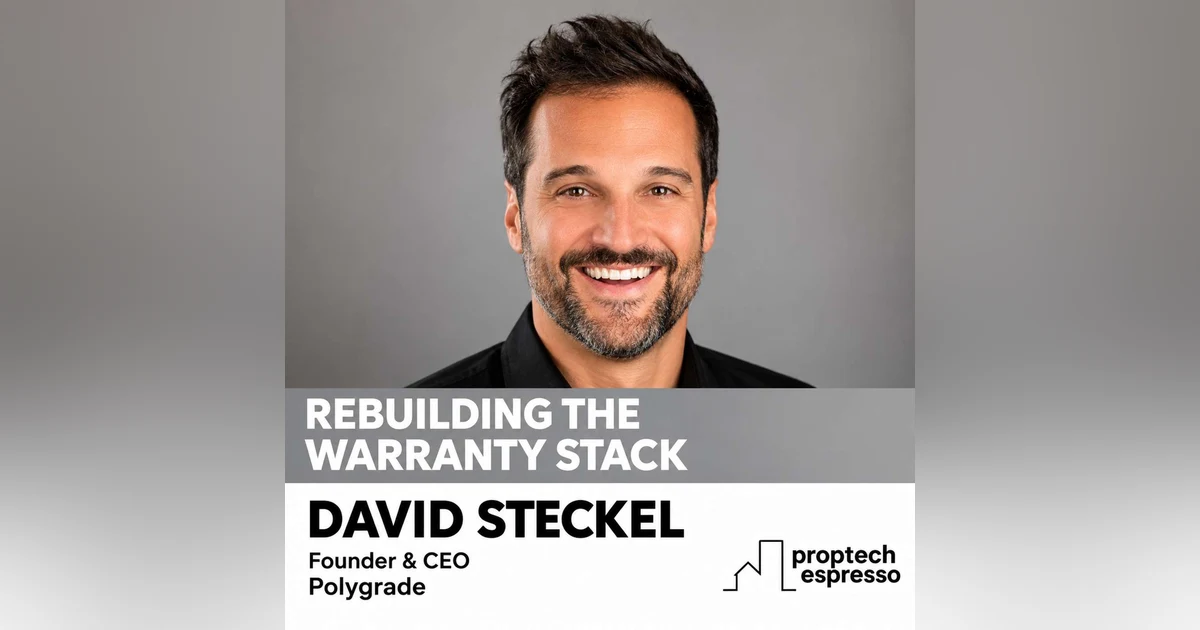
David Steckel - Rebuilding the Warranty Stack

 Apple Podcasts
 Spotify
 Castro
 RSS Feed
 Where is this appearing?
00:00 - Welcome And Guest Introduction
01:36 - Why PropTech Should Split Apart
07:00 - From Construction To Startups
11:33 - Hard Lessons From Building Companies
19:11 - Home Warranty Explained Without Fluff
24:52 - Why People Distrust Extended Warranties
29:09 - Legacy Tech And Resistance To Change
35:02 - Why Polygrade Starts With Home Warranty
38:42 - Design First AI Claims And Whats Next
Welcome And Guest Introduction
Speaker 2Welcome to Proptech Espresso. My name is Mark Hurst, a former investment banker, s erial startup junkie turned real estate technologist. On each 15 to 20 minute episode, you'll hear from leading entrepreneurs and expertise on the opportunities and challenges of the rapidly changing prop tech sector. Thanks for listening today. Grab your favorite beverage and let's learn something new.
Speaker 3My guest today is David Steckel, CEO and co-founder of Polygrade, an AI native warranty claims platform disrupting the home warranty space. Prior to founding Polygrade, David was Chief Product Officer at Sears Home Service, where he helped execute a digital and AI transformation. Before this, he held several senior roles at ThumbTech, which acquired Setter, his previous home management and concierge startup. David's early career, which shaped his later work in PropTech, was centered on custom home building and contracting. David earned an HBA in English language and literature from the University of Toronto. David, welcome to the show.
SpeakerThanks for having me, Mark. It's great to be here and it's great to be reconnected. It's been a while.
Speaker 3It has.
Why PropTech Should Split Apart
SpeakerYeah, I actually I actually have a hot take here, I think. So you and I met probably back in 2016 when I started Setter. And so that was 10 years ago. That's when ServiceTitan was getting going. And one of the slides I used to present was sort of the evolution of technology in other industries. And I took an example of a phone and I showed how you went from a rotary phone, like the dial phone, to a button phone, to basically a phone that could launch a spaceship in the span of like 50 years. And then on the other side of the page was innovation in construction over the last 5,000 years. And I started off with, you know, a wooden dowel, then a smaller wooden dowel, then a nail, then a screw. So nothing had really changed, but there has really, in the last few years, I will say, there's absolutely been a paradigm shift. But my hot take is actually and is that PropTech has, from my experience, from 2016 to let's say the early 2020s, it was mostly real estate focused. It was for realtors, it was for mortgage brokers, it was to find a home. I actually think it would better serve the entire technology ecosystem if there was a bifurcation around real estate tech, construction tech, hard tech like for robotics or modular. Instead of trying to lump them all into prop tech, it does a disservice to the construction side of things. Or I don't know if you think that's a hot take.
Speaker 3Um, because nobody's ever uh taken that approach before. But um uh so you're the you're the first hot take on Prop Tech Expresso. Um but the other thing is um yeah, ever you know this this term has been so uh pervasive over the years and so ambiguous and so hard to to like tie down that um uh you know to your point, I think we we need to um put it to bed and and go with that more granular um definitions of these other spaces so that there's um um an understanding and a deeper appreciation for what's what's happening in each of those individual spaces. Um there is certainly so much happening in that in that construction tech space at the moment. It's really gotten legs. Um and um, you know, there's it's it's really starting to get momentum, and um it is so massively different than than just kind of pure software solutions uh that are uh uh going after the different markets that you were describing, that it it it it just doesn't warrant being under the that bucket.
SpeakerAnd also when you think about the unit economics of moving atoms around versus bits and bytes, it's an entirely different business. But to answer like the second half of your question was sort of how I've seen it change, I was pretty lucky to sort of see it in its infancy around 2016. You know, we went from in the construction tech, the FSM side of things, we had Service Titan. They sort of started around that time only on HVAC, if you remember. You couldn't do anything else um on Service Titan. But ever we also saw search becoming a really like aggregators. This was like the first phase, you know, Trulia, Zillow, contractor search, like Thumbtack. Then when Setter started to like come around, you started to see transactions start to take place instead of just search. So think iBuying, direct booking. You know, you could book directly on Setter, where startups were actually starting to produce the outcomes. Then I'd say, you know, we're in a really interesting space in the market where the FSM, and I'll go back to construction tech at this time, like the FSM part adoption is really solved. You're sort of hard pressed to find a contractor not using a tool. But now what you're actually starting to see is the back office is now the focus of the job. And software is less about you know being a place to put information and how can you derive outcomes from your system of record. And that's also sort of the direction pro uh Polygrade's moving into.
Speaker 3Awesome. Awesome. Well, we're gonna spend a bunch of time on that. But uh for those that um are that don't know who you are and and haven't had the pleasure of of knowing you for the last 10 years, like I have, um, would love you to share a little bit about your your background, um kind of growing up, what you did at college, your early career, just to really get a sense of of uh uh the the background that you bring to uh what you're working on at Polygrade today.
From Construction To Startups
SpeakerSure. Um well I don't in case folks haven't noticed yet, um I might sound a little funny because I am Canadian. I live in Toronto. Interesting thing about Canadians versus Americans, you know, aside from the fact that our milk comes in bags, is that Canadians don't really move. You're most of the time you're Toronto, Vancouver, Montreal, Calgary now. Um you don't move as much as Americans do. So you'll live your whole life there, you'll get married and build families there. Whereas my colleagues in the US, you're kind of moving, you're going to one city for university, you're getting a job at another city, you're moving around all over the place. Um, so yeah, I still live in Toronto. All my customers are US based, and I've been working in the US for the past 10 years. But about me, I'm, you know, there's five kids in my family. I'm third of five, the baby of the first litter, actually. Um, I went to the University of Toronto and I got, as you mentioned, an HBA. So that's, you know, one extra year for your bachelor's in Renaissance literature. So that was my major, and then you have to have a double minor. So Italian language and semiotics. So, you know, with the rise of AI and the communication and being able to explain to a machine what you need being the most important part of your job, it's timely, it's finally time for an English degree to mean something.
Speaker 3So that's ahead of your time. Ahead of your time.
SpeakerYeah, and then from from there, um during university, I worked at a really fancy restaurant um called Scaramouche in Toronto and white glove service. I loved the food industry and I loved providing service. I love, I used to go, you know, helping people have a good time and also helping people spend their money. And from there, I started a construction company with a buddy. We were going to get into the real estate business and we were gonna buy homes, renovate them, and sell them. And we did buy our first home together. So I was 23 and we renovated it, but instead of selling it, we rented it. So then we were kind of stuck with the asset. But we both really enjoyed working together on the project. So we did just start a construction company out of that. And we went from doing, you know, kitchens and bathrooms like every contractor, to doing, you know, renovations, additions, and then full custom homes. But at the same time, I just said yes to all revenue. And so we were doing commercial work, we were doing so like office fit outs, we were also doing facilities maintenance. So think army bases and hospitals and big properties where, you know, at a hospital, if the elevator doesn't work, someone could die. So this concept of proactive maintenance was a very important part of it. And I loved it. I loved the fact that I could learn a building once and then just be sending people. And I was like, why doesn't this exist in the residential market? And so, SETR, that's what SETER was. It was actually, we didn't call it home management at the time. It was facilities maintenance for the residential market. How could I put a reserve fund study on a home? How could I help predict all the jobs you're gonna need to be done in a year? And you know, that concept of homes don't come with manuals was really born there. And we started with our home, with it, with the homes we were building. We would like take care of the home after we built it. Um but then eventually more and more people wanted that service.
Speaker 3So hence scaling it and raising capital for better such a fascinating background and and um uh you know, a better uh understanding, at least for for me, even to to know uh what uh what was going on that led to uh where you are today. But um as as you kind of indicated um in in your uh what you shared, you're you're obviously a serial entrepreneur. Um so I'm I'm interested that with your what you're currently doing, how you reflect upon your prior um the prior companies that you founded and ran and the lessons that you've taken away from those that you really incorporate into running Polygrade today.
Hard Lessons From Building Companies
SpeakerThat's a great question. Um there's probably one or two main ideas and lessons from each industry. The construction company, that was really baptism by fire. Um, anyone that you meet, there's a very low barrier to entry to construction. And most people kind of fall into it, unless there's a family business. But at the same time, in you know, the early to like 2005, I guess is when I started, 2007, there was there were no playbooks, there were no software, there were no real online communities were few and far between, and everyone kept things close to their chest. So we just learned by making mistakes. Um, and it took a few years to start realizing the time value of money. Um, and I think that's what I really learned at that one. Where, you know, a good example of that would be my partner and I were running around picking up, you know, somebody forgot caulking or screws, we would go pick them up and drop them off. But then we realized, you know, if if I paid a courier 50 bucks to get that done, I'd get an hour or two hours back. And if I could sell one more project or price one more job or get one more review, that could be $100,000 in ROI for me. So really understanding how to objectively look at the things that were happening during a day and to chunk down your days into the activities you did and understand should I have done that? Should I not have done that? Should I have found another way? Should I have spent money to not do that? That I mean, obviously there were a ton of lessons, but that's what I learned. I would say the most shocking thing for me at that construction company. And then how do you hire for the gaps that you have in the business? Setter was really about there were a bunch. I was a contractor, I was a GC. So I had to learn technology, the entire VC world, fundraising. But the in fact with Setter, I had actually paid a third-party company to build my first product. And I used a lot of my own money, and it was a total failure. I got exactly what I had asked for, but not what I needed. So there I learned the I understood what product was at that point. Product management, where you truly understand that what's in between the end user, the business and technology at the what lives at the intersection, and that's product management. The other thing was what does good look like when it comes to hiring? Setter, you know, I'll give my co-founder a ton of credit there, and other folks on the team. They we really had a rigorous interview process and we started learning very quickly what does good look like. In fact, some of the folks from Setter at Thumbtack were some of the highest performing people there. And at Thumbtack, for me, it was about executive communication. So here I go from a startup that I was the boss of and could do anything I want, to moving into a larger enterprise, I think there were 1400 people at the time, where there were a lot of committees. And it was actually very difficult to make decisions there, especially around innovation, because everything was more incremental growth. So everyone's looking, how can I have 1% here, half a percent here, instead of the bigger bets? So how do you influence a large enterprise or organization to move in a direction around innovation and take the risky bet? Um and then finally at Sears, I would say it was all scale and speed at Sears. Um the core difference at Sears was I was actually the guy trying to hold things back because there was no desire for planning. So I the communication was actually the exact opposite. How do you try to force some sort of behavior of allowing the data to make the decisions and running a process?
Speaker 3So just to uh touch on that last role, obviously, you know, your role at Sears um uh pretty different um organizationally than the um the groups that you had previously worked at, particularly kind of your your technology startup. So um what uh I guess perhaps how did um uh your your your vision of the role or perhaps your um desire to get something out of the role uh differ from what you experienced there? Obviously it's a um uh you know uh to to your point about like the the scale and the the holding back, I guess, where were where or were were expectations met, or did was there a a big difference between what you were uh kind of brought in to do and what you were able to accomplish there?
SpeakerSo to be fair, I was brought in to rebuild their direct-to-consumer brand. Sears at one point was in every home in America, or I think it was two-thirds of the homes in America every year. So after their bankruptcy, they really had a limited D2C brand. Um, but a lot of my work actually was not focused on the D to C brand. Like in fact, my first biggest project was a mainframe migration because none of the work that I wanted to do from a technology standpoint, we couldn't do because we were still on on-premise mainframe. But I think the thing that was actually the biggest surprise or at Sears was there was no concept of product management. And I had, like I mentioned, that was the most important thing I learned at Setter. And then at Thumbtack, I got exposed to sort of too much product management versus enough focus on the business. We're at Sears, and actually, a lot of the companies I speak to today, you have you might have something called a product owner versus there is no concept of product management. So here I had to influence really around why do you want to change a button to the color blue, or why do you want to do these things and help understand the ROI of doing things, but push that out to leadership. That was actually surprising to me that a company of that size and that scale and that volume was sort of running by the seat of its pants. But the other interesting thing at Sears was the pace of execution and experimentation was light years ahead of anything else I've ever seen or some of the things I've ever heard of. Because there was so much volume running through the system. So we were doing 10,000 jobs a day. Decisions could be made and tested in 24 hours. So when you are doing that, and you, you know, if you can make a $10 improvement on 10,000 10,000 jobs a day, what do you need to plan for? So I get it both ways, but that was actually the most difficult thing for me to be dealing with. And then the mainframe migration, I was used to a modern box system architecture and tech stack. And here I am at Sears where we're dealing with legacy systems, and all of our partners um had legacy systems at what as well. So it was incredibly different, and the culture, of course, is also very different.
Speaker 3Yeah.
Home Warranty Explained Without Fluff
Speaker 3Uh there's um uh uh a lot of interesting ways to uh or things I would like to jump into, but I I think um where I where I want to start um because I think it kind of shapes the rest of the conversation, is um the warranty business and what you know uh I suspect people only have a surface level understanding of of warranty. And so we'd love for you to kind of educate us and and then uh you know type type back into Sears and and what you observed as you went really deep in into this um this industry.
SpeakerYeah, so it's funny. One of my best-selling products at Setter was a warranty, like it's uh it's a peace of mind product. Um I fundamentally believe to achieve peace of mind as for a homeowner, you need to combine four things insurance in case something you know catastrophic happens, warranty to take care of the things that are expected to happen. You know, and we caught at Center, we we said our warranty was a plan for the expected, not unexpected, it's going to happen, um, as well as proactive jobs and maintenance around your home and reactive jobs and maintenance around your home. So you have to be able, whoever's gonna win the home has to be able to have some concept of all four of those things. Um when it comes to warranty tactically, it is there are really three types, sort of my perspective. You have the manufacturer warranty, and even home builders don't have a warranty. It's really based on what's the delivery of your product. There is a you have to warranty the materials and labor for a period of time. Then you have what's called the service contract or extended warranty, where that's typically sold at the time of transaction and is one of the most profitable line items on a retailer's book of business. And that is basically a contract that you pay for to get that service in the future if something breaks. It's a service contract. And the home warranty mostly exists in the US. There's a small amount in Canada, a small amount in Europe, but it's a bundle of service contracts where you bundle your appliances, your HVAC, your systems, your plumbing and electrical all together, and you pay a fee $500, $700 a year. And then there's a deductible in case anything goes wrong. The interesting thing. Thing about that business from the service provider point of view is each of those ICPs, OEM, extended warranty, home warranty, have very different motivations. They have very different metrics to solve for, like I, you know, how much they can pay out to the pro. But the homeowner is sort of stuck in the same experience every time. Warranty is a promise that someone pays for to get peace of mind that something will be taken care of. The world that we're in is that warranty has a really negative connotation to it. You know, during my fundraise for this, any of the folks I spoke to that had had a warrant home warranty spent a lot of the time talking to me about how bad of a product it is. And the truth is, I think it's a bad product because sorry, it's not a bad product. I think a warranty is a fantastic product. I think the claims operations themselves are the bad product. And that's because they haven't been it's just behind from a technology standpoint. You know, when I got to Sears and I looked under the Komodo and saw how not only just Sears was working, but all of our customers, so all of the OEMs, all of the extended warranty companies, all of the home warranty companies, folks still had like matrix-like monochrome CRT screens. Like, you know, the screens that like MS DOS, people were working on that. You had spreadsheets that would crash a computer if you open. Our major OEMs, like global OEMs, were sending EDI files instead of API files. So these are flat files that come like once a day or once a week. They're now not even real time when they send. So it's just an industry that is absolutely ripe for modernization. And I think there's a world where if we can fix the operations, we can absolutely fix the number of homes that have a warranty. And then you start getting to that vision of sort of total peace of mind that I was talking about in the beginning.
Speaker 3Yeah. Well, I I certainly uh you know have this um connotation uh uh uh or negative connotation with warranty, not for any good reason. It just uh it feels like I've I've picked that up from somewhere. I've never had to um use a home warranty. I always turn down this the extended warranty whenever somebody tries to sell that that to me because I feel like I'm I'm not gonna get value from from that.
SpeakerUm well let's pause on that.
Why People Distrust Extended Warranties
SpeakerWhy do you think you're not gonna get value on that? They're usually fairly cost effective compared to the promise that they're going to deliver on.
Speaker 3I think it's because I feel like I'm I'm being taken advantage of at this point of transaction where I'm like committed to buying this this thing. What this perhaps it's a an applance or or a or a or a product. And I'm already in, you know, let's say a thousand bucks, and now they're trying to get another hundred bucks out of me. I don't uh it it just feels like I'm I've I'm I'm I'm not um I don't I I don't want to I don't want to pay that extra hundred bucks. I'm I'm being I'm not I wasn't ready for it. I wasn't uh expecting that. I was expecting to pay a hundred or a thousand bucks and now I'm I'm being asked to pay you know eleven hundred bucks.
SpeakerSo there's the experience of being sold at time of sale. So again, one of the most profitable line items on a PL is the extended warranty because these are new products and the OEM has to cover it for at least most of the time the first year if you're buying like an appliance. The interesting thing about home warranty is that it's underwritten entirely blind. These are you can I I my house today, I most of my appliances are eight or nine years old. I can get a home warranty tomorrow if I was a Dig Canada and I would. I think it's fundamental, fundamentally a better bang for your buck if you're just playing, if you're just the game theory on it. Because at once things hit a certain age, they will break. They're going to need to be repaired. But that first couple years of ownership, they should be fine. We should have faith in the OEMs and the legislation around them that these products are going to work like expected. So I get you there.
Speaker 3Yeah. Well, definitely as as a uh a homeowner of uh of an older home that's like um you know went through various uh remodels with prior owners and like just the uh you know I have uh you know three heat three heating systems, I have two furnace, I have two water heater, like I I I have um you know a combination of things that are are all um at their uh you know expected um kind of life and and things you know should be going wrong just because of the you know the the the probability that um you know the way they were designed um and just how wear and tear works. So um I'm definitely in that that category where um you know it it I if I could if I could buy buy that home warranty now, maybe I should be more um uh invested in purchasing that rather than like trying to go through insurance um when when some of these things happen.
SpeakerYou know, it's funny, insurance has a version of a warranty as well. It's called equipment breakdown. It started in the commercial space around boilers. Um, but they there is a product. I'm assuming your care, well, I shouldn't assume, but I would bet that your carrier actually has a version of it called equipment breakdown as well.
Speaker 3Well, I'm I'm sure my insurance will be coming up for renewal fairly soon here, and they will uh I'll be I'll be asking a few more questions um uh about that. Um in terms of you know you know, you were describing um you know the the state of the in the warranty industry in terms of like the the outdated tech technology um infrastructure um uh you know and and kind of processes.
Legacy Tech And Resistance To Change
Speaker 3Um as as you as you as you got to deeply understand this, was there um and and you've been working to change it, has there been resistance to this um um evolution that you've uh started to take um that you started to take Sears down and and and subsequently with with Polygrade? What has been the um what what have you observed um in in terms of uh this this kind of uh uh challenge that you've taken on?
SpeakerSo I think the easiest way to talk about it is, you know, insure tech is is 10 years old, maybe 12 years old. Um you've seen an incredible evolution in the technology, in the mindset of the folks there, in the experience they're trying to deliver on their customers. You're seeing new insurance companies go public. Um, there is a lot of activity in insurance. There's the concept of MGAs, which you know you could sort of make a bet on your own policy. Um warranty is really just a generation or two behind. Um insurance moved away from the build everything yourself model a long time ago because there's incredible technology out there and there are incredible teams providing it. Warranty is still very much in its first or second generation of uh culture and team and product. So you have folks that are working at some of these companies that are literally there at the creation of the pro of the concept of a service contract, um, which is amazing that you've been able to see these evolutions happen. Uh but uh you know, we've all read the innovators' dilemma that it is really hard to innovate against the status quo. It's very hard to move against inertia everyone has had a bad experience with some sort of digital innovation that's working at an enterprise. These folks have PTSD, and the truth is startups are there to disrupt. You're going in with a certain level of gumption and grit. And I'm I'm not saying that these companies are a safer space, but why would people make a bet on making significant change? So the uh challenges are really around legacy products and mindset your uh and also PTSD. You also have a lot more frequency than an insurance. Warranty, you're gonna have a couple calls a year in like uh in a home warranty world. That's so different from a loss ratio perspective. So you have to pay a lot more attention to severity, which is kind of warranty's way of talking about loss ratios, like how much you're paying out externally. Um and then you're also sort of running into the fact that the industry has moved away, like there's still third-party administrators in warranty, and some of them are doing a fantastic job. But you're seeing a trend towards bringing everything in-house, which makes sense because subbing it out for the last 30 years hasn't produced a great experience for customers. So there is a bit of resistance in that everyone's trying to do their own thing at the at the same time. You're seeing build versus buy dilemmas across the industry, but I haven't seen anything like what I'm seeing in warranty. Because what happens is because there has been really no end-to-end solution, there are amazing point solutions in warrantine. There are no guide wires for warranty, there are no end-to-end solutions. What happens is any company will use multiple tools, and each silo in the organization will use a different tool. Then you have folks creating custom integrations between their own internal tools. And then you have companies that that integration, you might have created a surface area for it for a UI, and that's 25 years old. So it's like you're running into so much inertia here that our one of our earliest decisions was you do not need to rip and replace your software. We will meet you where you are and fill the gaps because the thought of a migration is giving people a heartache from the very beginning. Um the other thing I would say is because it's a risk product, you have a lot of folks that have fear around just basic procurement and compliance. Um and with AI and the way software is changing, they might not fully understand that definitions have changed. So I'm actually working with this amazing boutique law firm called Warranty Legal about how can we go around and making sure definitions of IP and data are being updated and shared with these companies? So moving into a new future where you are leveraging tools to produce outcomes isn't quite as scary.
Speaker 3Gotcha.
Why Polygrade Starts With Home Warranty
Speaker 3Why did you go after the home RT business first? What what was the as you were looking across this space, what what made you um uh decide this was the the starting point for this uh evolution?
SpeakerA couple reasons. But one, coming like this is my world. Like the home has been my world for 20 years. Yeah, I have the right to win here from what we've done with Setter and at Thumbtack and especially at Sears. Two, from an IT standpoint and like a technology standpoint. In fact, most of the teams are actually referred to as IT teams versus CTO orgs, that is the most broken. There are other solutions and other versions of warranty that are more advanced. And finally, home warranty is the least profitable because you're underwriting blind. You say, for example, we took on your house, and you were just saying everything is like approaching end of life. That could be a very risky product for folks to take on. Whereas if you're selling insurance on a brand new iPhone, sorry, and selling a warranty on a brand new iPhone, the likelihood of that needing a repair in the next two years is the minimus. You know, that's one of the reasons why Amex is giving you Apple uh the ability to get your phone fixed sort of for free as part of the credit card. They run the actuarial math, and the likelihood on a new product is significantly less than an old product. So if I can do it for warranty, sorry, for home warranty, I can go to the easier verticals after.
Speaker 3Gotcha. Gotcha. Um at Polygrade, you've uh assembled a team that uh you're familiar with and and um uh you've you've worked with in the in the past. And how is building this AI startup different from your previous ventures?
SpeakerSo one the new world of AI has just mean you can do so much more with fewer people. That being said, you need the subject matter expertise to produce a product in a niche market. And so this is a crack team of 10Xers that have been in and around this space for decades. We've all led you know massive teams before, and we're all outcome focused, and the speed at which we work is the speed that we want to prove to the industry things can be done. The other interesting thing we did, and is sort of antithetical in like the world of the new world of AI, is my first hire was a uniform designer I worked with previously. And when I, you know, part of the reasons I want to work in warranties, I think there's a better way. And I think we can be the better way, but ultimately want there to be a better way. So everything we build, we're bringing a tier one world-class design in UX to when we're looking at the other options in market, they all kind of look like Salesforce. They're really still just fields that are gray and blue. So even that concept of bringing, you know, world-class design to an unseen, really not paid attention, not paid attention to market is how we're approaching everything that we're building for our customers.
Speaker 3Amazing, amazing.
Design First AI Claims And Whats Next
Speaker 3Um if you and I were gonna have this conversation three years from now, and and Polygrade has achieved like everything that you've uh uh thought out and and uh talked to your team about, um, how is it fundamentally different about a warranty claim uh being handled today versus how it has traditionally?
SpeakerSo for us, objectively, we're just we're looking at market penetration for our customers. Um so if we can go from a market penetration of 5%, which is what it is today, and half of that is gifted, to a market penetration of six, seven, 10, that is success. And that's success because we've been able to allow them to move from support functions, which are cost centers, to success functions, which are, you know, revenue generation or recovery centers. How can they focus on acquisition and retention of customers and pros, which then turns into policies under management, which then turns into profit, which then turns into a better experience? So three years from now, I'd like the market to have doubled um simply.
Speaker 3Awesome. Um final question before we wrap. Um, what's next for Polygrade?
SpeakerSo, you know, we have today we have two of the top five warranty companies in the space working with us. You know, we hope to have a third um in the very near future. And as we scale home warranty, we're gonna start looking at our next verticals. So it could be furniture or medical equipment, but I actually think it's gonna be more along the lines of appliance and HVAC. So there's utility service contracts, there's the extended warranty companies that are doing appliances and HVAC. And then, like I mentioned earlier, there's that equipment breakdown in insurance, which are all very treated very much like a warranty claim. And, you know, we've proven that we can reduce cycle time, like the time it takes to get something done, the cost to get it done externally and internally. So now we just have to continue scaling our products within these organizations so you can have the compounding effect of all these products working together.
Speaker 3With that, David, unfortunately, got to draw a conversation to an end. Uh, it was amazing to uh connect with you, catch up on what you're building, and and thank you so much for sharing um your story and the uh the journey that you're on with with Polygrade. Hopefully we can have you back again in the future for another episode.
SpeakerUm I'm looking forward to it.
Speaker 3Uh for anybody that's out there looking to connect with you or Polygrade, what's the best way for them to reach out?
SpeakerVery simply, polygrade.com, P-O-L-Y-G-R-A-D-E dot com. Um, and there's a place to get started or book a call. We can start from there.
Speaker 3Amazing, David. Thank you once again. Uh we'll be uh keeping in in touch and uh look forward to uh seeing all the wonderful things that you're doing on the homework and and beyond space.
Speaker 1Thanks, Mark. You've been listening to an episode of Prop Tech Express.
Speaker 2Be sure to subscribe to the podcast on Apple Podcasts or Google Podcasts or wherever you listen to podcasts. Learn more visitors.com back to like the podcast. Thanks for listening, and we'll be back to the new episode.