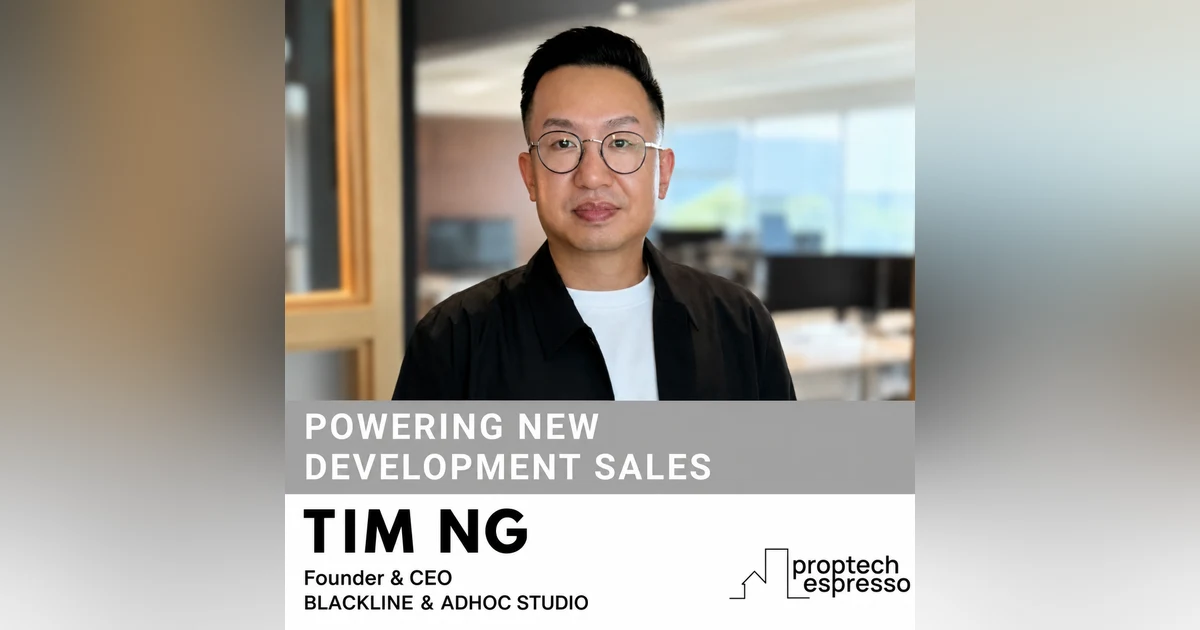
Powering New Development Sales

 Apple Podcasts
 Spotify
 Castro
 RSS Feed
 We talk with Tim Ng about turning new development sales from paper-heavy routines into digital experiences that actually help buyers and sales teams move faster. Tim shares how ADHOC STUDIO led to BLACKLINE, why the SaaS pivot was hard, and what proptech can learn from the moment COVID forced the industry to change.
• Defining proptech as connection, transparency, and efficiency across real estate
• Growing up in condo communities and learning sales and development through family
• Aiming for investment banking while building tech skills on the side
• Noticing how manual new development sales stayed for decades
• Starting Ad Hoc Studio with digital renderings and interactive sales gallery software
• Moving sales presentations to touchscreens and iPads for a better buyer journey
• Shifting from front-end visuals to back-office inventory, reservations, and allocation
• Creating Blackline and moving from services to a product-led SaaS model
• Balancing two companies while funding the new platform with existing cash flow
• Seeing COVID accelerate virtual launches and digital real estate adoption
• Naming Blackline after architectural black line floor plans
• Comparing bespoke studio work with scalable software operations
• Applying AI to data-driven recommendations, decision support, and hiring standards
• Founder advice on team care and getting customer feedback early
• Finding Tim on LinkedIn and Instagram by searching Tim Ng
Be sure to subscribe to the podcast on Apple Podcasts, Google Podcasts, or wherever you listen to podcasts. To learn more visit www.proptechespresso.com.
Where is this appearing?
00:00 - Welcome And Meet Tim Ng
01:04 - Defining Proptech And Why It Matters
03:27 - Growing Up In Condo Communities
08:55 - Chasing Investment Banking Then Pivoting
12:42 - Spotting Real Estate’s Manual Bottlenecks
18:37 - Founding Ad Hoc Studio In 2008
21:44 - Touchscreens And iPads Change Sales
28:20 - Moving Into Inventory And Reservations
33:58 - Building Blackline As A SaaS Product
40:16 - COVID Forces Virtual Launches To Work
43:40 - Where The Name Blackline Comes From
45:00 - Bespoke Studio Versus Scalable Platform
46:50 - Using AI For Smarter Decisions
49:22 - Founder Lessons On Team And Feedback
51:40 - How To Reach Tim And Closing
Welcome And Meet Tim Ng
SPEAKER_01
Welcome to Prop Protect Inspiral. My name is Mark Hurst, the former investment banker and serial startup, jumpkeer, and real estate technologist. On each 15 to 20 minute episode, you'll hear from leading entrepreneurs and experts on the opportunities and challenges of the rapidly changing prop tech sector. Thanks for listening today. Grab your favorite beverage and let's learn something new.
SPEAKER_02
My guest today is Tim Ng, founder and CEO of Black Line and Oddhoc Studio, solutions addressing new development sales and visualizations. With over 17 years of experience in the real estate industry, Tim is a prop tech trailblazer and leader, pioneering industry-leading digital solutions that merge real estate art technology to transform the sales experience and enhance the buyer journey. Tim earned a Bachelor of Commerce from Toronto Metropolitan University's Ted Rogers School of Management. Tim, welcome to the show.
SPEAKER_00
Appreciate it. Thank you, Mark. Thank you for the invite.
SPEAKER_02
No, no, my pleasure. Thank you for coming on. Excited about our conversation and looking forward to uh learning more about what you're building and a little bit of your background as well.
Defining Proptech And Why It Matters
SPEAKER_02
But would like to start off uh the conversation with my traditional prop tech question that I ask all my guests. Would love to hear your definition of prop tech. And given your um kind of journey in this space, interested to hear if you've kind of seen the term change over the time that you've been involved in prop tech.
SPEAKER_00
Yeah, absolutely. Um I think prop tech um where I saw it kind of really formally um take place and and really kind of kind of term itself or coin itself as PropTech, similar to what you saw over the years with like FinTech. Um it kind of started during like maybe right before COVID or like um during the COVID or pandemic. Um I would kind of describe PropTech in in layman terms as really like the technologies and the platforms um that are connecting um real estate together um and also creating like transparency um and creating efficiencies um in pretty much every single like facet of of real estate in general.
SPEAKER_02
Yep, yep. Um yeah, I mean it's you know when you when you think about the um expansiveness of of real estate, it really is is huge in all of the supporting processes that exist um around it. Um it is it is really mind-boggling given kind of the um the size of the asset class, the um you know, the the all the different types of of real estate and and how how it is you know used in many different ways, and and also the complexity uh and bespoke nature of so much of the real estate uh world that um the fact that you do have applications and and technologies that's kind of providing a solution across all of these, sometimes it it it's uh it's surprising that that's the that we've wouldn't been able to apply that sort of technology. But I'm excited to see how that that term continues to to to evolve and um to be applicable to uh to to real estate.
Growing Up In Condo Communities
SPEAKER_02
Um uh let's uh let's uh get a little a little bit of insight in into who you are and and and your background. Um, you know, from from our brief uh previous conversations, I know you come from a real estate family, so we'd love to hear a little bit about what it was like uh kind of growing up in that in that world and and also kind of how that uh influenced uh perhaps uh your your journey and where you've uh ended up at.
SPEAKER_00
Yeah, no, it's uh I was, you know, it was always a main topic of conversation um at home, whether it's the dining table or if we were having breakfast with my mom and dad. Um my mother, my mom worked um on the developer side, and then my my father uh worked for like the brokerage uh sales and marketing side of things. Um and I would, even if I wasn't trying to hear certain things, it obviously it would naturally have been. Um but I would yeah, be you know immersed in how let's say my dad as a as a broker would be you know on a day-to-day uh deal with his clients and how to close deals and where you know the the blockers are with certain clients or nurturing clients and developing relationships um in terms of uh selling uh primarily condo projects. Um and then and then my mom, um more on the accounting and finance side, kind of saw like some of the stuff that and and obviously natural naturally um was able to see what she was she was also uh doing as well. Um so it was and also um another thing is I my entire life I grew up uh living in condos. Um so I I got a first hand experience of you know what it's like to uh to live in a community uh that's completely like a vertical build. Before even condos is really a thing, um, I was already living in condos. So I got to experience like you know what the amenities um would be like, um, really how you know, instead of having uh your typical neighbors that were living beside you, but you'd have neighbors that were like um above you and below you um and and beside you as well, um and community gatherings that were you know set up and and experiencing like condo boards and and things like that too. So I really got to understand like um what it's like to to really live in a condo community.
SPEAKER_02
Gotcha. Yeah, and it's I I had uh never never kind of thought about that, that sort of um um experience. Uh, you know, I think um, you know, I've uh I've primarily lived in uh um single family homes my my life, but I I know that that's um just one one one kind of uh childhood path. Any anything that kind of stands out as different from from from perhaps how um kids that you knew that were perhaps um in single family um kind of homes growing up that that kind of stands out as a a a difference. Um just kind of curious as to kind of yeah what you may have uh observed.
SPEAKER_00
Yeah, part like a big chunk of my childhood was like living in this like master plan community, like of four towers. And it was very unique. Like in the middle of these four towers was an amazing like outdoor space where they had um like a kids' park, barbecue areas, um, different trails and paths where you know, as a as a kid you'd be able to like rollerblade or or uh ride your bike along along these paths and trails, all within um the community of these four towers. So what I saw was was really cool is like my like where I lived was actually like the gathering spot where all my all my friends would meet me uh to go biking and and things like that. Or if we wanted to, you know, um either play baseball or basketball or hockey or anything like that, they would they would gather, um they would come to my place and then we would just go outside uh inside that middle uh courtyard area, uh which is a massive area. But uh that was kind of the advantage because we I had like literally that outdoor space, like uh compared to like a single family home, where obviously uh with their backyard, it's a little bit smaller, more limiting.
SPEAKER_02
Very cool, very cool. Um awesome. Um let's um uh you know, you were kind of uh talking about your kind of immersion around um real estate, just kind of given the uh the the family background and kind of where your parents worked, um, you know, uh would like to hear kind of a little bit about college too. And that's always kind of an interesting uh decision uh point, like why people chose to go to certain universities, what they were thinking about, would love to hear kind of um what uh what your what your plans were kind of uh during university, where you thought you may uh end up professionally and and kind of how that experience uh kind of influenced you.
Chasing Investment Banking Then Pivoting
SPEAKER_00
Yeah, from uh like starting from high school, I was very lucky um to be part of part of the program in my high school was a co-op program. So you would basically take half day and they would um partner you up with an employer. Um starting starting from, I think I did it for three years, um starting from grade 10. And my goal was always to be actually like an investment banker. I just saw a lot of these movies growing up and all this stuff like that. Like when I associated with a business person, it was always related to finance and banking and things like that. Um, so I selected in my co-op studies in in grade 10 as uh uh partnering up with like the number one investment broker um in Canada, actually. So I was lucky enough he he eventually became um a big mentor of mine. Um so throughout university, um enrolled into uh business commerce, also uh did a ton of finance and and things like that too. So I was never like pressured into real estate by my parents. It was I was always pretty laser focused in getting into like investment banking. I did a ton of like um on the side, I did a ton of like um programming and was always meeting with friends to to build new tools and things like that on the technology side of things. Uh so I was always pretty immersed in that. And and I part of my degree was also uh taking uh a business technology uh focus as well, um, as part of the uh the commerce degree. Um but I yeah, I never I never thought that I I would get into real estate um until uh pretty much I would say like my second last year of university, uh where my program uh actually started the first um technology incubator um in Canada. So it's kind of like you're you know, um very similar to what you would see in Silicon Valley. Uh, but for a Canadian university to to start up a tech incubator and start like an ecosystem like that, nobody was ever, you know, that this was around like circa 2006, 2007, when that never really existed. Um, so I was part of that um kind of founding members team and I I got into this incubator and and part of uh this um final um project was was really about um they they did like a business case study. So you would essentially have like four months uh to create a business plan, uh, create different like UI mock-ups and things like that, and and then present it to a bunch of VCs and stuff like that. And I I came up uh with this uh kind of like new development real estate marketplace at that time. And that's kind of where I started to really uh deep dive into it. And then I yeah, it was it was a super uh competitive uh business case uh competition and ended up coming first, and that's kind of where I uh really kind of started my my journey into technology and real estate uh together. Um but in the back of my head, I've always kind of like obviously with my parents, always been dabbling into kind of being in real estate. So I always thought that there'd still be, you know, some type of intersection eventually of like technology and real estate together at a very young age. But I I always thought that I'd go down kind of like that i banking investment banking route.
SPEAKER_02
Yeah, gotcha, gotcha. So yeah, no, uh Masters of the Universe, uh yeah, I I certainly had had similar early aspirations and and did some time on on Wall Street myself before uh kind of uh going going down other other other
Spotting Real Estate’s Manual Bottlenecks
SPEAKER_02
paths. Um as you were um uh kind of developing your kind of the some of those those kind of uh the technical side of things, like where how how did uh was that something you had always been passionate about? Or where did where did technology um kind of emerge as a um a kind of central theme to your kind of uh in interests?
SPEAKER_00
Um yeah, I was very lucky. Um my dad bought me like a computer when I was like five years old. It was like one of those super old school like IBM, you know, uh computers that were like massive and um was pretty much on a computer at a very young age, even just like um you know, doing research and and book reports and things like that. It would it would help me a lot, even just like typing up book reports and things like that. Um, so I was always very into technology and on the side, I would always be yeah, doing certain building up projects, uh building different small applications with different friends and cousins and and things like that in the summertime or after school and stuff like that. So I was always never like um, even though I didn't formally like study it, obviously, um, like it was my focus was more like the i banking stuff, but I I was always on the side um really into technology and really always following the trends and and things like that too.
SPEAKER_02
And how about any um um observations about um uh technology and and real estate that you gleaned from your parents? What was uh did they were they uh um uh heavy users? Was it uh something that was um emerging? Um obviously, you know, prop tech and and these solutions kind of uh existed or kind of grew um kind of in uh massively uh um in the uh in the early um uh kind of or towards the the COVID area, but what were what were you seeing kind of with your experience with with PropTech as far as your your your parents were concerned?
SPEAKER_00
Just super manual, right? Like I even to this day, I I I still feel like real estate and in particular, like especially like more on the new development side, like it's uh always like 30, 40 years behind all the other types of industries, whether it's automotive or uh consumer packaged goods. Um it's always like a like an endless race to to catch up with the different industries. Um it was always very manual, like even when I saw at a very young age, like um whether it's um doing a transaction or doing an offer on on the resale side, um, working with the different types of like MLSs. Um saw my mom on more of the finance accounting side. It was just always just like Excel spreadsheets and and things like that, right? So there was really no real kind of play in in technology to really like create efficiencies and uh really kind of connect all the manual like tasks, uh the day-to-day tasks together. Um, where I'm only like really starting to see it kind of, you know, really kind of come together on on the technology side with different uh platforms consolidating and stuff like that in the last I'd say uh seven years or so. Um so it's it's still a very, very, I'd find like in kind of an infancy stage. Um yeah.
SPEAKER_02
No, I agreed, agreed. There there was uh definitely um resistance, um I think. And and also uh uh you know, I think in addition to that, probably in many cases um uh it wasn't seen as a an area of big opportunity for for technology. I think that the like eyes were um you know on on other areas where there was more um easily identifiable kind of applications and and and opportunities. Um and it's only as um I think the the the the kind of uh there's there's been deeper inspection of of real estate and identification of the the obviously the the need and and the ability for solutions to provide um um you know automations and and digitizations of processes, et cetera, that that we've kind of seen um uh things really take off. But it it certainly was not the uh um uh what what everybody was immediately drawn to as far as like um uh providing uh new innovation in and around this uh real estate space.
unknown
Great, great, great.
SPEAKER_02
Um so the um the the you know you were talking about uh being at university and and kind of working in the uh the the technology incubator that was uh that your university was launching and that you were you had this success and you had this idea. Like what uh uh like after winning the competition, kind of uh did you choose to um fully pursue that opportunity? Kind of where where did that path lead you?
Founding Ad Hoc Studio In 2008
SPEAKER_00
Yeah, um I I actually also wished I I pursued that opportunity because there would have there was a huge gap in terms of like what I was developing with there, uh developing with that. Um but I yeah, out of university, I I started um our parent company ad hoc studio, uh which you know really focused on uh primarily two things. Um first thing is creating award-winning uh beautiful like renderings and visualizations. Um so um that was focused on all like new developments, and then also the the other side of the business uh that we've been laser focused on was uh building software, uh primarily like interactive software for showrooms and sales galleries and and things like that. Um also focused on new developments as well. Um so those would be uh primarily two of my focus. So it wasn't exactly what I did with um the business uh competition uh with the incubator, um, but from doing uh that competition, um, there was a lot of research, a lot of like knowledge building that I I kind of carried over uh when I started um our parent company ad hoc studio.
SPEAKER_02
And did had this been something that you had um talked to your dad about because it seemed like there there's kind of natural uh intersection with kind of uh where where he was focused in in terms of the the sales. So was it was it part partly part of your research kind of bouncing some some thoughts off of off of him to see if they they resonated?
SPEAKER_00
Yeah, a thousand percent. Um like one of the first things when I when I was starting to like develop this uh business plan around starting ad hoc. Um funny enough, my my dad was actually working with the kind of the leader in this space before I started. So they were like the top rendering firm. They were the top firm that was building all these like interactive applications for a lot of the developers. Um and he really kind of helped me um identify like where the opportunities and where the gaps I could fit in. Um and there wasn't really many people doing it at that time. Uh so there was an opportunity for like a new player uh to come in and and kind of change things up and and think outside the box a little bit more. So for sure, like my yeah, my dad was definitely um a huge proponent of um kind of guiding me um when I was starting up. Yeah.
SPEAKER_02
So I guess um, you know, what were what were the rend where were rendering still primarily hand drawn at this point? And and what was the how how was um new what was the state of new development sales, um, and and kind of the you know, perhaps the technologies and the visualizations. What did what did that look like as as you were um taking
Touchscreens And iPads Change Sales
SPEAKER_02
a hard look at this this space and and talking with your your dad about uh about what what he needed to be even more successful?
SPEAKER_00
Yeah, a lot of the renderings and the and the visualizations, um, like before I got started and and when my dad was working with a lot. Of it was um watercolor style renderings. Uh so they weren't really digital at all. It was kind of yeah, all like manually drawn. Um not like that realistic stuff that you're getting and seeing these days. Right. Um and then on the software side, um there was really nothing, there was really nothing um that was really readily available, aside from maybe like kind of some yeah, makeshift DOS uh softwares and and things like that back in the day. Gotcha. Everything was printed and and manual. Um if you know, if you're selling a community, whether it was a single family home or um a multifamily or a condo, um, whenever a unit got sold or leased, um it would literally, you know, you'd see the salesperson uh grab a red sticker and and stick it on a availability board um in the in the sales office or the showroom. Um there was nothing um digital at all.
SPEAKER_02
Gotcha, gotcha. Um yeah, no, I have a uh I don't know if I I would say I've necessarily seen that exact thing, but it it has a very um uh something that I can imagine occurring that um and uh kind of seeing a uh seeing somebody with those the the red the red dots as you were saying and the red like a cowbell right and putting it over the the uh the uh the the unit, etc. Um so where like what were what were some of the um early solutions that you developed at um ad hoc studio that you um were that brought this um you know first generation of of kind of technology in into this space that kind of helped them move from a purely manual process to actually um um you know having having technology come in and uh help them in in the in their in their roles as as salespeople.
SPEAKER_00
Yeah, um so when I first started um 2008, 2009, whenever there was a new project, everything was manual, like whether it's the floor plans, the priceless, um, learning about the neighborhood um in the area for new development, everything was you know printed material. Um so the idea I came up with like, hey, why don't I take all these materials and and digitize it and create like an interactive immersive application with it? And you could use it on touch screens, let's say uh that was like um around that same time uh the iPhone first came out. Yeah, people started to really see that, hey, you can actually use you know your finger to interact with content as opposed to a mouse and a keyboard. Um, so something a little bit more tactile where you know you're interacting with the touch of your finger. Um, so I started to build out these like applications that were touch-enabled where um somebody that would walk into a new development showroom, and you'd have, let's say, at that time, like a 32-inch touch screen mounted on a wall. And then somebody would be able to walk up um along with the sales, let's say the salesperson, and they could do like a guided presentation um with these touch screens. Um and then it started to translate into when the iPad uh first came out, the first gen iPad, we started to build these applications on iPads where they're very intuitive because a salesperson can literally walk to any, you know, anywhere, um whether it's inside the showroom or if they were coffee shop selling uh somewhere, they could bring the iPad with them and present the materials in uh in a very consolidated, uh clean, user-friendly way. Uh so that was kind of like the the beginning uh portions of like some of the interactive software uh we were starting to build. And I was really helping like facilitate um sales presentations to walk through buyers and purchasers uh to understand the the marketing materials. That was obviously typically very manual and printed.
SPEAKER_02
Sure, sure. Um did this evolve further to kind of uh kind of help an end-to-end process because obviously you're you're the um, as you were describing earlier, you've you've you've got the uh um you know the the traditional kind of uh watercolor type visualizations, um, and then moving to the digitization and um you know high quality mobile um kind of um experience that you're able to uh leverage the the iPads for. But then there's that that notion of like the the board with that you're applying the the red dot to that you know you you um need to um also tie it tie into this um um next next uh phase of digitization. So um uh but but obviously uh perhaps not as uh uh you know sexy or or as uh kind of uh you know back that being kind of back office as a departure from kind of the the more visually pleasing kind of front end stuff that you had been doing. So uh kind of what how did how did that solution evolve evolve? What were the did you have serious um conversations about like is the is this the right place we need to take the company? Kind of what what was what was that like?
Moving Into Inventory And Reservations
SPEAKER_00
Yeah, because as we're starting to like really, you know, um get really dialed in and and finesse all the details on on really beautifying the front-end experiences that we were doing all these years. We were really like highly specialized in it. And then we started to get you know clients um asking us um in terms of some of the back office stuff, like, oh, how do I control availability? Um I want to be able to like you know take a reservation. I want to be able to specifically like allocate units to uh certain VIP brokers or realtors that I'm working with. Um so a lot of it was really like a collaboration um and and driven by our clients that especially like the the clients that wanted to really move the needle and and connect more back-end operation stuff with like the front-end presentation uh items. Um and we were also integrating. There was a couple like smaller players in this space on the back-end technologies, and we were always forced to kind of like integrate with them and and I saw what they had, and I was never a fan of it. I thought it was like really poorly done. So I saw a huge opportunity where we could really like create something that was a lot more modern, more user-friendly, and and really dominate this space on more the back office uh backend operations. Um so it was really a natural progression driven by our clients working with them like very closely all these years.
SPEAKER_02
Awesome. Awesome. Um just interest, like as you were um from a kind of a company building perspective, like what what were um what were some of the the challenges that you've you faced kind of uh taking ad hoc from kind of those those early days through this this evolution and expansion that you were um going through as you you had success as your as your customer base started to to grow? What uh um what do you what you know as a as a as a first-time founder and and kind of uh company builder, what where were the challenges for for you and um kind of how do you feel uh you did uh um kind of working through those challenges?
SPEAKER_00
Yeah, I think the the first big old biggest hurdle, um I'm not sure I've ever shared this before, but uh when I first started and and graduating university, like my my mom like never supported like me starting like a new company um out of university without having any type of experience or connections or anything like that. And she's generally coming from an accounting background, like very conservative as well. So um literally like every day when I came back from work for the first five years, like my mom would be waiting for me at the door and asking me, like, how many resumes did you hand out? Did you apply, you know, for a real job? Um, and that was ongoing for like five years when I was still living at home at that time. Um so definitely in a sense, I kind of like disowned me, never supported uh that that vision. But I I always at a young age, I I wanted to uh really you know start my own company, be my own boss. I I wanted to do this um before I got older. I didn't want to be in that position where I'm like, you know, 45 years old and you know, I have all these different obligations with family and commitments and things like that, and then have the itch to then start a company where I wanted to, you know, when I didn't have a lot of uh strings attached, um I would be able to have that space and that time to build something up. Um, and then when I started, like another thing that was, you know, very difficult was just managing people. Like, you know, school never teaches you how to manage people. Um, so that was definitely the hardest thing because everyone has you know um different goals and different career aspirations. And um it's very hard to kind of, you know, as a as a solo entrepreneur, very hard to figure out uh really to work with people and and get the most out of them as well and keep them motivated and and things like that.
SPEAKER_02
Absolutely, absolutely, yeah. Um as you said, like and and and doing that with no with not having worked in um uh corporations before, like you have no you have no kind of nor star to draw from, right? You're kind of um uh dependent upon um just natural intuition, uh things you read, people conversations you have, like it's um, and then the the perhaps the the scars that you get from from from actually experience, you know, kind of going going through that. Um, but um obviously uh you have survived and and prospered um uh even without that that experience and the uh um extra motivation your your mom provided you do to be successful um here. Uh we've we've talked a lot about like ad hoc. How did like how did Black Line kind of um how did you formulate that concept? How does it tie into
Building Blackline As A SaaS Product
SPEAKER_02
ad hoc? We'd love to kind of hear about the this side, this business that you've you subsequently launched that's you know related, but um obviously not um a different um solution than than the uh what you were doing at at ad hoc.
SPEAKER_00
Yeah, um we touched on it a little bit earlier, um, you know, was really like was driven by our clients and and that collaboration, working with them over the years. Like we were getting asked to do a lot of the back-end operations items and and also like integrating with different third parties that managed inventory and and overall sales management and things like that. Um, so we were starting to like integrate with different third parties, getting asked by many of our clients to do certain things on the back-end side of things. And um, there just came a moment, kind of like an aha moment, where I was like, okay, like we there's a huge opportunity for us to really elevate what is currently available in the market. Um and then it was like I think end of 2017, early 2018, when we started to really formalize and and decide to to really put in resources and focus on on building um a product, um, which is Black Line. Um, so we were transitioning from more of a a service company and more of like a custom shop, like based on different uh scope of work. And then we would build out software based on scope of work and discovery calls with our clients and transitioning that into um a product-led company. Um and that that's not easy at all because a service-based business compared to like a product-based software as a service business, um are almost ran completely different uh with different roles, different executive teams, different resources. Yeah.
SPEAKER_02
Yeah. I know it's an interesting, I imagine, to kind of uh live that um birthing of this new entity and the um you know the challenges that um that you're faced with like um you know not uh not starving the new business to focus on the existing business and and the um the needs there. Um you know what what were some of the uh what what were how did you how did you balance that? You mentioned kind of different executive teams where they're in did you hire completely new, did you bring over some some resources from from from ad hoc to um kind of uh you know seed and and drive black line? What did what did that look like?
SPEAKER_00
Yeah, I was like it was very challenging. Like that transition. I literally had to take three of my strongest engineers on the ad hoc side and position them completely full-time on the black line side to build out our product, like architect it, design it, and and build it out. And that was like a year and a half process where literally like three of my most talented people that you know were making the biggest impact in in my company, completely working on something that generated no revenue, no cash flow for over a year and a half. Um, but they're obviously building something of value. But was I getting cash flow for a year and a half? I was getting zero. And taking like my most talented people out of you know, very custom project client engagement uh was a was a very difficult decision. Um you really had to be super focused and and committed to uh to really you know transition yourself into a product focused company. Um so that was the hardest thing. And then and then building out after like separate teams, because we we would have to have like a client success team that we had to build out that we never had to in a client success um in a in a service-based business. Um, we had to build out like a support team, like support engineers. So if you know there's troubleshooting and things like that, there'd be like dedicated support engineers around it. Um, so it was like a completely like almost new team and a new company while also still juggling like everything with ad hoc because ad hoc was really like facilitating, um, they were really the company that was generating all the revenue at that time. Um so I needed like the revenue from ad hoc to support the starting up of and and the flow of of getting uh black line going. So it was like literally like doing double duty running uh two separate companies in parallel and and making sure both were um one was like starting up and growing, and then the other one was you know maintaining but growing at the same time because the cash flow was so important to facilitate the growth of uh the startup of Blackline.
SPEAKER_02
Yeah, no, it's uh uh amazing to be able to pull that off again, like being, you know, leading being the the CEO of one company is difficult enough, but to be able to have to kind of wear the CO hat for two companies and that are kind of, as you said, we're kind of different, very different businesses related, but but very different. Um and you were um, you know, kind of uh uh you know taking taking things away from the established business in order to kind of um seed the other the other business, but still needing to grow and and stuff like that. It's a uh uh uh a Herculean task for for sure. Um and I'm sure uh Stuart there are um scarce scars from from that in in terms of kind of what it what it took to uh what it took to uh to accomplish that. Um another thing I know is that like your your timing was um you know uh perhaps fortuitous,
COVID Forces Virtual Launches To Work
SPEAKER_02
but also challenging in the sense that this was happening um just a little bit before um the whole world kind of experienced the the kind of the the COVID interruption. And um just uh as you reflect back on that time and this, you know, these these macro world world events were happening, kind of how how did that um impact the the the company and like how did the was this a time of um uh doubt or did the did the opportunity just explode um given kind of the um the kind of the forced change to real estate?
SPEAKER_00
Yeah, it was like great timing for sure because we we launched Black Line in late 2019 and I think the the pandemic shutdowns was like like March 2020 or something like that. Uh so we are still kind of in the infancy of the launch, and part of our thesis around Black Line was really to um really kind of like change up and elevate um how real estate and new development was presented and make it a lot more digital and and allow for more remote presentations. And that thesis obviously um you know really exploded when when the pandemic happened and you know things everything was shut down and nothing was happening in person. Um and it just so happens when things shut down in in 2020. The first three um condo new development projects that launched um decided to launch virtually through our platform when everybody was literally kind of like had no idea what to do at that time because they were like, there's physically no option for us to launch a big condo development without any type of like physical showroom where people can come in and you know and see our project. And when that happened, where the first three projects launched digitally through our platform, uh pretty much, yeah, the phones were off the hook after that. Like everybody wanted to figure out how to launch their project on Black Line. Um and that and that's what really kind of uh accelerated our our growth. And ultimately, obviously, as as I'm sure you know, Market accelerated like digital real estate in general. Um, I'd say like tenfold, right? Um where you never saw it happen in all these years prior to the pandemic.
SPEAKER_02
Yeah, no, it kind of like it it it removed the you know, that's not how we do things too. Like we we absolutely have to do. We absolutely have to have to do this. Um and um, you know, I think um obviously so much so much good came from from that or to the real estate space as as as um it really kind of took foothold as you as you mentioned, like um success was happened despite kind of the the historical reservations and kind of we we haven't looked back since then. Um one thing I forgot to ask that I I've been I've been curious um as we've gone through the conversation
Where The Name Blackline Comes From
SPEAKER_02
is like um where did the name Black Line come from? What is what is there a significance to that? Like what is the uh how did the the company name uh come about?
SPEAKER_00
It was probably one of the the most difficult decisions. Like we like me and my executive team went back and forth for like over like I think like a year. year to to really consolidate a name. And yeah, the the name black line like definitely like very, very catchy, but it's actually coined from the the term with architectural drawings. A lot of times with like architectural floor plans, they're all made up of black lines. And that's where it uh that's where it really like stemmed from. And a lot of our developer clients would always call like the the layouts and the marketing floor plans for like multifamily and condo units. They would call them uh black line floor plans.
SPEAKER_02
Yep.
SPEAKER_00
Uh so we would uh yeah we would always be working from black line floor plans and that would be like the terminology we're like hey let's call ourselves black line because we're you know working directly with the floor plans working directly with the inventory um so that's yeah that's how the connection happened.
SPEAKER_02
Awesome. Awesome um as you reflect on on on kind
Bespoke Studio Versus Scalable Platform
SPEAKER_02
of the the two companies what what stands out is some of the the the challenges for leading black line versus um ad hoc again kind of different business models um but just um since you've had the uh the unique opportunity of leading kind of both both organizations um what's uh what what is uh big difference that stands out in your your mind yeah I'd say for for ad hoc over the years and and more more than ever now um it's really ad hoc has always been very focused on like boutique uh bespoke uh kind of custom uh executions um so we really kind of you know dig deep into like discovery of exactly what our clients' goals are and visions are for every project and and develop a very bespoke custom package so we very um tailored to exactly what their needs are um and we would really sit down uh with our clients and and dive deep into like scope of work exactly what they're trying to achieve and then and then come you know come with a very uh custom solution for them um uh so that would be like ad hoc focus and then on the black line side uh because it's so product focused as a software as a service um it's it's really meant to be a very scalable business so you know you could really you know scale in other markets um internationally globally um so it's running yeah almost like two ends of the spectrum where something is very bespoke very custom and something very scalable um very large in scale with black line as well um and and balancing operations and talent and um you know what you're focused on on building and growing every day is is is very different.
Using AI For Smarter Decisions
SPEAKER_00
Yep yeah um you know we're we're living in an age where um you know you can't get away from um you know any conversation without talking about ai so um is uh AI um a an aspect of of the black science solution kind of how does how do you intersect with this kind of um emergent technology that's um uh kind of in an inundating um personal and professional lives yeah absolutely um for more like the client uh facing stuff like we're we're like this year we're heavily focused on allowing our clients to live like really elevate and and leverage um different type of AI feature sets and AI tools um around their decision making because we collect a ton of data um a lot of different data points uh throughout the entire real estate transaction process um now we're trying to really um consolidate that data and provide our clients with um AI-driven uh solutions in terms of like recommendations on on what to do with next steps with different purchasers and and leads and and and making decisions around AI as well um so really leveraging AI to really facilitate and help our clients guide them through um different stages of the project and also like around their decision making um whether to you know what to do with this prospect if you know you've talked to them 10 times what do they do after that um can AI provide solutions on that or if we're aggregating data across the project um what are some of the the top things around this project that that people are seeing value in uh for example or or how to increase pricing where the demand is coming from and things like that and and for more the internal operation side um a lot of our new hires are are focused around like um if that person is really immersed them immersed in in AI themselves as a skill set um especially with our engineering talent and a lot of our product designers as well um so they have to be you know really really immersed in AI as a skill set for themselves and um and it's almost you know becoming even more important than than writing code in the sense right so uh that's become like a mandate um across the board and in terms of uh how we hire and who we decide to hire.
Founder Lessons On Team And Feedback
SPEAKER_02
Awesome um final question before we we wrap up today um you know you're as as a kind of multiple time entrepreneur and kind of company builder what are what are some of lessons learned that you would um pass on to um kind of uh entrepreneurs and and others that are contemplating their next um or first uh uh kind of startup yeah I would say um the number one thing is is really be you know focused and in tune with um managing your team um really you know putting in the the care and the attention uh to uh to nurture your team and and you're growing it because you know at the end of the day um nobody can do it themselves like they really have to have a strong team around them uh to really you know build up a business and and scale up and also I think we chatted about this previously Mark it's um a lot of founders uh when they're building up a company especially in the tech space like they're so focused on like building the perfect product uh uh kind of thing before they even like start to really kind of show it to their customers or their potential customers yeah uh where I'm I'm a big proponent on like you know getting a couple of your inside track customers or ideal customers, you know, when you're in the building phase and and starting to show them what you're doing, uh whether it's wireframes or um kind of MVPs, um uh starting to get feedback early on as early as possible uh because you don't want to you know spend all this time build something and then at the end of it when you finally launch you actually figure out like your actual ideal customer or your customer profile actually sees no value in this that you know in what in terms of what you build and they're ultimately not even willing to pay for anything uh for what you build as well so get in early start those conversations early with those uh with those ideal customers why wise words for sure uh building in building in isolation you know is is not uh is not the not the most uh uh successful route to to go so as you said um
How To Reach Tim And Closing
SPEAKER_02
you know get feedback work with the the the true experts your your your customers and and make sure you're building something for for them not for yourself um yeah exactly 1000% uh with that Tim unfortunately we got to draw our conversation to a to an end thank you so much for uh sharing your your journey and and kind of how you've evolved um as a entrepreneur from from ad hoc to now leading blackline it's it's been it was a fascinating discussion and and really uh impressive um would love to keep in contact and potentially have you back for uh another episode in in the future but for anybody in the audience that's looking to contact you or blackline or or uh ad hoc what's the best way for them to reach out yeah I'm on LinkedIn like and Instagram like super actively uh just search up my name Tim Ng um on on both platforms and and connect with me there.
SPEAKER_01
Awesome awesome Tim thanks so much best of luck and we'll we'll talk again soon thank you Mark appreciate it take care of you've been listening to an episode of Prop Tech Expresso be sure to subscribe to the podcast on Apple Podcasts Google Podcasts or wherever you listen to podcasts to learn more visit hearstex.com backslash podcast thanks for listening and we'll be back soon with a new episode.