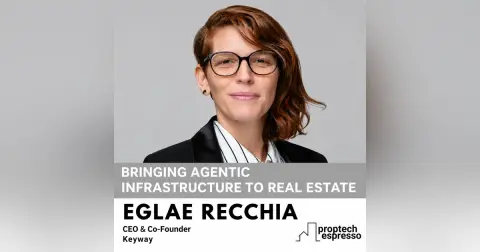
Eglae Recchia - Bringing Agentic Infrastructure to Real Estate


 Apple Podcasts
 Spotify
 Castro
 RSS Feed
 We talk with Eglae Recchia, CEO of Keyway, about how Proptech grows from building tech into AI that gives commercial real estate teams back time for judgment. We also trace her path from a childhood of constant moves to MIT's SloanSchool of Business and a career built on turning data into action for lenders, REITs, investors, and operators.
• Proptech as a broad umbrella across the built environment, fintech, and AI
• Why “insights” are no longer enough and how “so what” drives adoption
• How moving often shaped adaptability, networking, and comfort with pivots
• Philosophy and advertising as training for clear thinking and persuasion
• Early career lessons from editorial work, technology shifts, and ops problem solving
• Choosing MIT's Sloan School of Business to build analytical tools and a problem-solving mindset
• Graduating in 2009 and using networking to break into financial services
• Finding commercial real estate through Capital One strategy and portfolio questions
• Keyway's evolution from investor-operator thesis to agentic infrastructure for CRE
• Who Keyway serves today and how it combines public data with internal data
• What comes next: enterprise agents, risk management, and fraud detection
Be sure to subscribe to the podcast on Apple Podcasts, Spotify, or wherever you listen to podcasts.
To learn more, visit proptechespress.com.
Where is this appearing?
00:01 - Welcome And Guest Introduction
01:11 - Defining PropTech In The AI Era
05:08 - Moving Countries And Learning To Adapt
14:35 - First Job Lessons On Tech
18:29 - Why MIT Sloan And How To Think
22:54 - Graduating Into The 2009 Crash
25:48 - Finding Commercial Real Estate Through Finance
31:26 - Kiwi’s Pivot To Agentic Infrastructure
37:51 - Speed Of Building With AI
40:52 - Who Kiwi Serves And What Data Matters
44:27 - Enterprise Agent Plus Risk And Fraud
47:07 - 2026 Outlook And How To Connect
Welcome And Guest Introduction
SPEAKER_00
Welcome to Prophet. My name is Mark Kirst, a former investment banker and serial startup computer and real estate technologist. On each 15 to 20 minute episode, you'll hear from leading entrepreneurs and experts on the opportunities and challenges of the rapidly changing project sector. Thanks for listening today. Grab your favorite beverage and let's learn something new.
SPEAKER_01
My guest today is Eglae Bakia, co-founder and CEO of Kiwi, the Agentic infrastructure purposely built for commercial real estate. Egla brings deep experience at the intersection of technology and real estate finance, most recently leading product development for real estate businesses at Goldman Sachs and Percadia. Earlier, she had her roles at Capital One and Freddie Mack. Eglay earned a BS in advertising and philosophy from the University of Miami and received her MBA from MIT Sloan School of Management. Eggla, welcome to the show.
SPEAKER_02
Thank you, Mark. That's that's the best intro I've ever had. I want to thank you everywhere.
SPEAKER_01
Thank you. It uh uh I had a little a little help, but uh uh I am uh glad that it it was uh it uh it resonated and and uh kind of uh hit on the the major highlights. Uh
Defining PropTech In The AI Era
SPEAKER_01
excited for our discussion today and uh definitely lots for us to dig in, but we're gonna start out with my traditional Prop Tech Espresso question. We'd love to hear your definition of PropTech. And for somebody that's kind of been in the uh kind of technology and commercial real estate um space for a while, we'd love to see if you've noticed any uh kind of evolution of the definition during your time kind of operating in this space.
SPEAKER_02
Yeah, absolutely. Uh and it's funny because I think in LinkedIn there's been a lot of talk about this. So my my circle of reference uh continues to create an evolution of what the definition is. I think when I started 15, 20 years ago, Prop Tech was the most random things that you could think about. It's like, oh, how do you make your HVAC better than what it was? And it felt very specific to a very small area of commercial real estate that mattered. Um, as I think about PropTech now, that's that's increased, right? Like the space. I think somebody the other day used the words like anything in the build universe that connects in any way, shape, or form can now be considered prop tech. Um, some people don't even like the word prop tech anymore. They use, you know, financial services or fincos or things like that. For me, it's kind of one and the same. Like the build world is is so big. And it depends where you're sitting and where you're standing that it what it means to you. And so for me, ProfTech is anything that can make a company that is mostly focused on commercial real estate better now, whether that's in lending, asset management, development, property management. Uh, I think the definition now encompasses all of that umbrella.
SPEAKER_01
Yeah. If I was to uh kind of riff a little bit on your definition there, it'd be interesting to have almost like this three-dimensional space around the definition. Because as you mentioned, there, you know, prop tech is a can now be a big and nebulous term. And there are other uh areas of tech, you know, fin tech, construction tech, etc., that kind of cross um, you know, uh in into this sector and you know are you know relevant to the individuals kind of operating in in that in that space. So it's definitely not uh a one size fits all and it and it really has some nuances based upon your uh where kind of where your focus is. But I do think that that kind of universal kind of connection of uh the built environment um through through some automation is is perhaps kind of the uh most uh generic way of describing this this this area. And and and definitely there's been uh uh evolution and continued stuff, and LinkedIn's a great source to kind of track that uh that uh evolution uh for sure.
SPEAKER_02
And I think we purposefully need to be generic now when we talk about PropTech, right? Like depends on the market and who I'm speaking to or who understand commercial real estate versus AI versus SaaS is how I talk about my own company. And I think that that's the case for everybody else, right? Like it's it it has become a broader term on purpose and more it has to be a broader description because what we now do with our companies and and how we can influence the industry has broadened itself. And so if you don't broaden the definition with it, then the definition remains old. Whereas now, you know, if you talked about prop tech and AI six years ago, like people would be like, huh? Whereas now they're they're the same thing. Like, for example, for me, Kiwi is AI for commercial real sake. It is a prop tech company. Yeah. But the the definition had to grow for for us to be part of that definition.
SPEAKER_01
Excellent.
Moving Countries And Learning To Adapt
SPEAKER_01
Excellent. Well, we're we're definitely gonna dive into that in in great depth during the conversation, but would love to uh hear a little bit about your early background. It's it's definitely um unique and and interesting. Um so if you can share a little bit, uh kind of leading up to uh kind of your your college days, just to kind of I think set the the the tone and context for for your um uh background.
SPEAKER_02
Absolutely. So I'm originally from Argentina, that's where the accent comes from. And I grew up in an awesome household, but a household that moved every 18 months to two years. My dad used to work in oil, and so we moved a lot. Sort of military kids in the US is what you call oil kits uh back home. Um, and so I started my my childhood in Argentina and actually moved to Venezuela when I was nine years old. And so uh a joke that my brother and I always make is that we can speak to Iraq because we needed to make friends within a day of being somewhere in order to have friends to celebrate birthdays with in order to say bye to them 12 months after and start all over again. Um, before technology and other things made those friendships um be able to withstand distance. We were kind of quick, quick to adapt was kind of how I would describe my childhood, uh full of laughter and and honestly, my parents did an amazing job making sure that we continued having that support system while we moved to to crazy and very random places in the world.
SPEAKER_01
Awesome, awesome. Yeah, I know uh having having moved around quite a bit, um uh can can relate to that experience and um uh know the um uh the kind of uh how how being able to establish those those um you know friendships or at least to kind of be able to uh start to get to know kids is is critical in in those early age groups so that you're part of the the community and and able to um kind of get uh uh integrated into school and everything like that. Um so were you uh living in the US when you decided to uh uh go to the University of Miami? Were you were you living um uh internationally? Kind of how did that uh kind of transition point come up? And then also um what drew you to studying um uh advertising and philosophy? Uh if you could uh dig into that a little bit for us.
SPEAKER_02
Absolutely. So actually, we were still living in Venezuela, but things had gotten a little bit uh different with the political landscape in Venezuela. And so my parents, uh being the kind souls that they were, they gave me options. They said, your options are you can stay home in Venezuela, um, but life will look different because of what's happening around us. You can go to Argentina, you can figure things out. Um, and at the time we were going to an American school, just because again, talking about continuity and being able to provide continuity for kids, American schools were in a lot of oil this oil, all specific centered cities or towns, honestly. And what why University of Miami was 100% based on how can I get a great education in a place where there is some part of my culture. So my culture shock is not that cray crate. And Miami was it. Like if you go to Miami today, but even 25 years ago, you still had uh a few restaurants where you could eat Latin American food. You have people that spoke Spanish, you went to the University of Miami itself, and half the teachers had a name similar to mine, or maybe not mine because it's special, but a name that you knew uh where people are from. And so it was 100%, it's not far from home. It's a great school, it's a good way to migrate or immigrate to a new country in a thoughtful manner. And uh my parents were obviously uh very supportive, and I had a great school counselor that helped me with all my applications to the US. Um, and I think Mark, you and I have talked about the the value of sunshine in my life and the fact that I value it very highly, and Miami has that in the space. And so I kind of chose University of Miami a little bit out of a pamphlet and said, this is it, it's two hours away from home on a flight. Uh, I can do this. Um, and I was pretty young. I graduated um because of all the moves that I had for better or for worse. I never did fifth grade. I went from fourth grade to sixth grade. One of those moves also meant that the school year was half off. So actually, when I graduated high school, I was 16. So I started college at 17.
SPEAKER_01
Wow.
SPEAKER_02
Um, and so being close to home, you know, now I look at my kids, my son is 11. I'm like, no way, he's ready to go to college in six years. Um, so being close to home was as much possible as it could be, uh, was super important. And then what I studied was honestly what I was drawn to. Um, I think I should have been a lawyer, maybe. I always like debate, I always like the theory. I've always been books are sort of both the best thing that could happen to me. And to think we're, you know, having this extroverted personality where I had to meet people and make friends quickly, books were my refuge when I when I didn't want to be that, or and I always thought that there's very few things that I loved more than somebody giving me something that made me think and to to sit with that thought and to write and and to be able to think about what that is. And so when I went to university in Miami, my love was to be a writer, to one day, maybe not even a writer, maybe a person that read books for a living. Like somebody paid me for doing what I love to do. Um, and so I went to Miami thinking, like, that's that's who I want to be. I just want to read and write books under a punk tree in Miami. And philosophy for me was just an excellent way to think. Like I didn't necessarily care about the what the philosophers were saying or how I really just cared about the fact that you could look at a problem from 12 different ways and still come out feeling good and still come out being friends with the people around you because everybody approached it with let's have a conversation about the problem. It's not about you, it's not about me, it's about the problem. And I think philosophy gives you a way and a language that not many of us get in in other parts of our education. I believe I keep on saying this to everybody that I need like everybody should take at least two philosophy classes when they're in college, just to learn how to be able to talk about something without necessarily it being the end all be all after that conversation is done. Um and advertising honestly came because at some point my parents very kindly told me at some point you're gonna have to pay your own rent. What is that gonna look like? Right. Um and for the same reason, I was always impressed about how words and images can move a person, how unexperience can move a person. You know, nowadays, maybe I'm not into advertising as much, but it was just a World Cup and I'm from Argentina. Like when I see ads from Argentina that are in the World Cup, I cry. Like I get emotional about how people can tell a story in 30 seconds to the point that I'm emotionally affected by it. Um, so I just love both things, and I was lucky enough to be able to get an education on things that I loved, even though, as you very well know, not necessarily worked from either of those. Uh, but they gave me they gave me a foundation of how to think that I use every day of my life.
SPEAKER_01
It's fascinating. I I can, you know, uh one uh uh can't imagine myself going to off to college at 16 and a half. Um, and and you know, I have a younger son, and and and even at 18, I'm I'm kind of projecting forward having uh questions about uh about that. But um I also have a um a sister that went to boarding school and I know that you know and and she traveled throughout the Middle East by herself. I mean, to go and visit her her mother um when she was much younger. So I think I like part of me can't imagine it, but then I have frames of references that also say, yeah, actually it's really it's really possible. Maybe part of that is a different time and place. But um uh it's it, you know, it's certainly um uh you know, kind of I think perhaps all that moving that you did do probably made that that sort of transition a little easier than some people that perhaps, you know, living in just one location for all of their life, um, it would have been harder to kind of move away from. Um I agree.
SPEAKER_02
I think it gave you it gave us the the possibility to try new things and fail and and pivot and do it right quickly. Like we had to, like, hey, that bit of work, you you need to uh rethink how you approach certain things. And when that is part of your upbringing, that kind of becomes second nature, yeah, regardless of where you're putting.
SPEAKER_01
Yep.
First Job Lessons On Tech
SPEAKER_01
Well, it kind of um obviously your your kind of love for uh reading kind of led to your your first kind of work in kind of at an editorial company. Um uh what did you take away from from kind of working at this in that environment that per perhaps is foundational to your um uh work today and and and how do you kind of uh uh kind of utilize that skill set in in what you're doing at the moment?
SPEAKER_02
Absolutely. Um so my first editorial job, and on honesty, my only editorial job, I started as an internship in UM and then kind of continued as my first job post that. And there were so many things that I got out of it. It was a small company that had a joint venture with a much larger company at the time, based in Miami. Um, and I started basically helping the editorial team, like helping uh proofread articles, read articles, do anything that required reading or writing, which I thought that was where uh I would end up and what I wanted to do. Um, but I had uh a great manager that she always gave me the opportunity to try new things. And so when the CEO was looking for a chief of staff, they said, hey, Ella seems to have those jobs. She she can get things done. And I got put into uh a job that also passed off me to learn how to use Excel to look at where were we getting the best distribution? What would that look like? And also think about technology and how magazines should be uh should be seen. And and it basically looked like a PDF with uh with a little scroll on the right that would make it look like you passed the page and that was it. And we thought we were doing the best thing since live spread when it came to technology and magazines, but it definitely opened my world in in two very different ways. Maybe a third one that I'll talk about as well. First was I had no idea what I was doing as a chief of staff. And somebody saw potential in me and they gave me an opportunity, and I my job was to just go do it. But I realized very quickly that all I was doing was what somebody told me to do, and not necessarily whether or not I was doing it better than the person before me or if I was improving in any way, shape, or form. And so it gave me a little bit of awareness about what I didn't know and what I didn't know and what would I want to be, right? I don't think I now know, but then I thought, okay, I don't want to just be the person that does the work of somebody else over and over again. I want to be more. Secondly, it opened my mind to technology. I mean, you always think about technology, but especially when you're young, maybe not now, but when I was young, technology was like this thing that was out there and you thought about it, but it wasn't a big deal. And here it was changing the industry that I thought I was gonna live and breathe in. And so it gave me an opportunity to, in a very low-risk environment, try things out and see why they worked and they didn't. And honestly, the third thing was it taught me a little bit about networking. Like I've always been a great person about meeting people and hanging out. Um, but the CEO of this company, as well as the magazine itself, it was all about, you know, what do these business people think about the world? And it was about reaching out to them, hearing about them, giving them something that they found interesting so they would give us their time and energy and either write an article or do an interview with us or something like that. And so I think those three things were key learnings that honestly I take everywhere with me, um, as well as what I and who I want to be and what culture I want to be in a and build in a company. For better or for worse, I learned that too.
SPEAKER_01
Gotcha, gotcha. Well, kind of uh you operated in this space for a while and then you decided to go back to business school.
Why MIT Sloan And How To Think
SPEAKER_01
And um uh interesting enough, you went to uh went to Boston to to to uh MIT's Sloan School of Management, which uh uh doesn't have as much sunshine as as the University of Miami. So what drew you to Sloan and kind of what why were what was um why why go back to business school?
SPEAKER_02
Yeah. The my brother had gone to Harvard Business School. So when I started to think about what was next for me, he was already at HBS and he was having the time of his life, like the type of things that he told me about that he was learning, how he was learning, the friends he was making, just he just seemed like he was having a ball. And I was like, that seems awesome. Uh, but for me personally, it was also what I mentioned before that I was doing the job that somebody asked me to do, but I honestly did not know how to make that job better. I did not know how to leverage certain aspects to know that change would be a positive thing to what I was asked to do. Um, and so for me, business school was hey, I know what I'm good at and I know also what I'm not great at. And can I can I strengthen that? Like I understand technology, but tangentially. I understand business, but tangentially. I I think I'm a smart person and I can get stuff um that I've never learned before, but I still need to be taught. And so when I was looking for for a school for business school, I went to see a variety of different schools, including HBS and not a mock against Harvard, but my brother and I do go back and forth every year about which one's better. Um and I sat in all the classes and Harvard, it was awesome. Um, again, the caliber of people, the the way they think, of course, unbelievable. Um, but I thought I could ace it with my eyes closed because it's like, oh, here's a case, read it. Here's 20 pages, read it, and then come back tomorrow and let's discuss. And I'm like, oh hey, I did this. And this is this is what I this is what I know how to do. I know how to read an article and I know how to talk about it. And I don't need to um I don't need to really stretch myself too much. When I went to Sloan, I actually sat in an accounting class and the the professor was like, let's grab pen and paper, let's do a balance sheet. And I'm like, wow, I have no idea how to do that. I understand sort of maybe the words that he's saying, but I can't really follow without using my whole brain and my whole self to dedicate it to learn. Um, and so between that and the fact that the school has a ton of diversity, but at a much smaller scale than many of the other universities, I just felt like I've found my my place in the world. The the people, the professors, Boston itself, the way that um that education matter and how it mattered, the way that it makes you think. The again, I I think it maybe goes back to what I was talking about philosophy with Sloan. I I felt not only that they were teaching me, but that they were giving me the tools to learn how to think. And I value that above everything else.
SPEAKER_01
Yeah, I I think uh I think core to uh MIT is this notion of of problem solving. Like it goes across every everything that uh um all subjects, all kind of uh matter of of of education. So that notion of like you know, giving you helping you build this skill set uh and and these tools and ways to solve problems is uh fundamentally what what they're what the education there is all about so definitely resonates with me about kind of what you what you saw and what you sought out um from from uh from sloan um so that's that's great to hear and um uh you know I'm I'll always side with you on that HTTPS uh versus uh Sloan uh side of uh the uh the the debate there. Um uh graduating from from Sloan um uh you know at an interesting time kind of was uh if you can share a little bit about about that and kind of how you navigated that particular uh uh kind of period professionally and personally.
Graduating Into The 2009 Crash
SPEAKER_02
Yeah absolutely so I graduated from Sloan in June of 2009 probably the worst time in the universe to graduate from an MBA school uh with zero experience in financial services or consulting or all the big things that people usually graduate from business schools from so I come out um a year before Sloan when I was you know June 2008 things were still messy but not as messy 2000 uh the end of eight to nine people start losing job offers that they got in internships you start seeing a lot of the big banks come down you start seeing a lot of um job offers rescinded and job offers just not being there and then the competition becomes not only the people that are coming out of this MBA schools the the great caliber of talent but add two to three years of experience in some of these banks that were failing and that was a market. And to say that it was daunting is it's it's minimizing it because obviously most people including myself see an MBA as an investment. It says hey I'm gonna hold for two years on on wages and career progression, go get way better and hopefully leave two or three steps ahead from where I would have been had I stayed in the existing camp. And I most definitely wanted to uh change you know where I was the type of job I was getting who I could be um but I got super lucky I don't know if this goes back to what did you learn on my first job and it was that networking I there was this amazing mother and daughter duo at Mary Lynch uh that did private wealth management and she said to me you know I I didn't live in New York I lived in Boston but I went out to New York and I was like can I buy you a coffee? Can we talk? Can we have a conversation? And she very graciously gave me her time. And after that she's like you know I I think there's there's something in you can you do you want to come and join me like I need to be able to leverage technology much more than I'm doing it. I am I need to be able to uh expand my team's voice in the thirst LinkedIn being a key thing uh 15, 20 years ago I I need to start getting out there and I think you can help me. Um I did not tell for this but I had no idea what that entailed. I had no idea what technology meant in financial services. But I had the attitude of like I'm gonna learn and I'm gonna rock it. Like I I don't care what this turns out to be, this is my stepping stone. And so I took it that way I moved from Boston to New York my parents helped me uh pack my little uh valuables I I sublet an apartment for three months hoping that it would turn into something longer term but without really knowing um and it did it became something awesome it became my entry point to the financial services and transformation of financial services which obviously is is what I've built my career around ever since then.
SPEAKER_01
Yeah yeah
Finding Commercial Real Estate Through Finance
SPEAKER_01
and you certainly went to work for for a number of marquee uh firms um and uh kind of uh definitely uh had some tremendous success so um was there um as you were kind of working in this uh emerging kind of technology area of the financial services like how did um how did real estate rear its head and how did that become um a an area of either interest or or focus how did that come kind of weave its way into in into your work I just read this book it's called I don't remember the name but it's something about luck and it's this woman talking about like hey there's luck and then there is like you make your luck and I I do believe that we as human beings have a little bit of both. Sure.
SPEAKER_02
And I would say I ended up in commercial real estate by luck uh but it happened because at some point I moved to HSBC. The area of HSBC I was in was purchased by Capital One and I really wanted to come back to New York City. I was in Chicago I like Chicago but again sunshine no sunshine too cold for me uh and my then boyfriend now husband and I were thinking about well do we stay in Chicago? Do we go to New York? What happens? How does it happen? And a huge blizzard hate hit Chicago and I called him up and I'm like stop looking in Chicago I'm moving to New York I can't do this. And then again I I sat with the right people I had the right conversations and so I ended working in commercial real in in the commercial bank at Capital One. And most importantly Capital One during that downturn had went out and bought a couple of really important banks and and their portfolios and they were trying to figure out who they wanted to be in commercial and so they again a great person looked at me and said like help us think through should we invest in reads and warehouse lending should we not what should the strategy look like how can we even know what's a value of this and basically an open-ended opportunity to look ahead and to say huh this looks like a problem that requires somebody to think through 10 different ways to look at it and come up with on a safe 1700 slides in a PowerPoint bag to then have a conversation. And that's how it all started it started with should we continue to invest in reads? Are they here to stay even through the downturn? We obviously all know yes but at the time I did a lot of research to figure out if it was yes or no and then it was like okay well which tools do we use to manage the lending portfolio within Capital One, the balance sheet the construction what percentage they want construction versus warehouse lending versus read lending like all these things slowly came into purview and I kind of fell in love with it. There's something extremely valuable about um being able to see the work you do, right? Like I I personally was never the underwriter of a building in New York City but I understood that the work that I was doing in technology allowed that underwriter to go to that building and see it. And when I rode my bicycle my like city bike or whatever or was it a cab I could tell my mom like my God Capital One did that building's lending thingy and there's there's power in seeing the connection between the work that you put in and how it gets executed. And from Capital One I I kept on growing I tried my hand at uh being an entrepreneur solo entrepreneur did not like it. It was not for me. I love people too much. I love being able to bounce off ideas. I love the ability to to have a team to brainstorm with um from there went to Freddie Mack loved Freddie gives you a completely different view of the industry what the industry does need how do they do it how do you execute on it and then I was lucky enough to go to Goldman Sachs and Goldman Sachs for me was the epicenter I think most of my friends from the NBA were shocked that I was a person leading global product for the investment bank at Goldman Sachs they're like really you Goldman Sachs like you study philosophy and I'm like yes and is there a real is there a bigger problem to solve than the technology that the number one financial institution in the country uses to do their job um and some of the questions that we were answering at GS at the time were wonderful not only about data and how we use data and how we leverage data but on the commercial real estate side is like do we use blockchain do we think about it or is there a new way to think about REITs? Do we want to affect or not affect regulation of these things? And being able to sit in a room with really smart people to talk through those things um kind of opens up the world of possibilities of commercial real estate is not just what we've been doing, but it could be so much more and it has the potential to be a lot more and sort of that inspired me to really go even deeper. And so I became chief product officer of Birkadia which is kind of the number one GSC lender um and uh joint mentor between Berkshire Hathaway and Jeffries Investment Bank and I got to see and and run honestly all the strategy the thoughts the idea the experience of all our internal and external tools including Red IQ which was my first kind of SaaS product. And so commercial real estate I guess a very long-winded way to say it started by luck and it ended with passion and it continues with I mean it hasn't ended hopefully uh it continues to be a passion it's it's amazing what what we can do and how much we can impact the industry with with a bit of thought on how to problem solve.
SPEAKER_01
Awesome
Kiwi’s Pivot To Agentic Infrastructure
SPEAKER_01
well let's get into your your current work uh uh a key way and kind of how did this um opportunity um kind of come about um would love to understand the you know the origins of the company your your your um what what uh solutions it's providing so uh let's uh let's let's dig into this uh uh current uh area of focus for you and and hear what you're what you're building.
SPEAKER_02
Absolutely uh Kiwi predates me from uh running it meaning Kiwi actually started um in early 2031 as uh the with a thesis that was let's use technology to underwrite find purchase and manage assets um and I had the best time helping my brother think through that problem so my brother was the the original head of and face of the company and thought about who do we want to be when we grow up and another market dynamic uh happened at in 22 that that made us really think through and pivot on what is the value that Kiwi can add to commercial real estate. And so as investors we were okay as technologists we were amazing. And so what we really focused on was how do we grab that technology that's our differentiator and help other companies have that alpha as well. And so the evolution of Kiwi has has come and brought us to a place where Kiway is now kind of a found foundation of a genetic infrastructure built for commercial real estate. So we help acquisition teams, development teams, uh asset management teams to really think through about the data of commercial real estate like what do you need to make smart decisions and then the outputs and the throughputs of how do you get to those decisions faster. I spent probably the first 15 years of my career in commercial real estate talking about how do we bring data into insights and that was my go-to for everything that I did for the first 15 years of my life. And now it's like insights is not enough. It's like oh thank you thank you for giving me insights that rent should be 2% higher so what like how do I get there? People or customers very I think appropriately are now expecting the so what to the answers. And that's what Kiway gives you it gives you that data point and then it says so what? Well here's what you do here's how you do it here's the output. So we help uh bring data into the platform we normalize it standardize it and then we we help you get to the so what much much faster and enable your teams to get there. And so my relationship with Kiway started very much as uh hiding in the background helping build a product uh until 2025 that I that I started kind of formally advising and taking over in 26 as CEO.
SPEAKER_01
Gotcha gotcha yeah certain certainly you know um you know uh observing um ai solutions within Proptech across many different um organizations and startups and and um uh kind of use use cases this um that point that you were you were bringing up about like uh so what or like how how to really take action on it right it's um you know uh you know I think evol evolutionary wise kind of this this you know you've gone from like better data to like the the the providing the insights now now to the um you know what what do we need to do and like how how do you um really create tasks and and and you know whether you automate that or at least um kind of make it um easier to kind of um uh take that next to next take that next step is is definitely where we're where we sit today and um uh you know I think it it's helping cut through the noise that that's existed right you know whether it's you know alerts or or other things that these solutions have traditionally spit out that have overwhelmed teams um and while you know in in so many cases like teams are getting smaller um but the workload is uh not not getting any any less um and uh being able to um really let those um individuals focus on getting stuff done as opposed to kind of the the overhead and that kind of figure figuring out aspect is uh where where the the value is is coming out in these these solutions today which is it really sounds like what you're uh providing that key way absolutely mark and I think that also goes back to your first question like what is the definition of prop tech like you just walk through all the difference and how the that definition had to stretch in order to suddenly fit all these things right that the first prop tech was nothing more like I'll help you with your hardware and commercial real estate by making it a little bit smart through technology than it was like oh I'll help you with your data then it was like oh I'll help you with your insights now it's I'll help you to enable your teams to get better.
SPEAKER_02
I'll help you to give back time to your teams so they can actually use their time for judgment and not for tasks. I'll give you back time so you spend with your clients and I'll prepare you for that meeting so that you come out on the other side with a better deal for yourself, for them and for the industry. And so I think that that that's key way's mission is how do I enable the team how do I give time back so that your team spends time in judgment how do I how do I become your partner through everything that you need to do where you worry about the human aspect of commercial real estate about the deal about the business about the individuals and I'll worry about the data the normalization the graph making the understanding what that lease says and how it says it and I think that's the differentiation. I think that's where the power is to truly change our industry for the better.
SPEAKER_01
Gotcha
Speed Of Building With AI
SPEAKER_01
um as as somebody that's kind of run technology teams uh and and probably had uh significant resources in in in those teams like how how is what you're building um at Kiway different than at other times in your career and the kind of like the you know what uh I guess what what's what's different now kind of um in the uh the time and place that uh Kiwi is is being uh developed yeah look I think what's different is that AI is not only a thing that we use to sell to our customers but it's also how we build how we think and the fact that we were built bottoms up using the the latest way of building allows us to move at a speed that I've never moved before.
SPEAKER_02
Right like if if my customer or my clients need a partner that can move and and execute at their pace and and fast, we can do that. I've had amazing teams in my career some people that you know as much as I possibly can would work with them tomorrow if given the opportunity. But the way to execute that we have at Kiway I I've never felt it before the ability to go from hey I have a thought to let's test that thought to put it in front of clients to hey they liked it let's put it in front of all clients I've never moved as fast as I do now. And I I do think that that's an expectation now as well from our customers. But it's also an expectation from the people that work at Kiway like they want to work with the latest technologies they want and expect kind of their work to be in the etherist faster and and to be you know excited about what they're building and how they're building. I think it there's never been a more exciting time to be a builder in technology and in commercial real estate because now we actually have finally have access to all that data. We always talked about data and how are we going to do it and it took you know three years or five years to be able to transport your data in a way that you can actually look into it and understand markets and understand your company and understand your loans. Now all of that with what we built that's weeks we can access all that and so I think the the value of how quickly we move mixed with how the depth of what technology can do for us technologies mixed with for the first time in 17 years commercial real estate is actually excited about technology and not just seeing it as like a boulder that they need to push up a mountain all those things together are are really what's exciting. It's really what makes me want to continue to lead a company that's that's invested in commercial real estate and I think it's what makes people want to stay in a company like Kiwi.
SPEAKER_01
Awesome awesome Keisher um kind of the universe of kind of client or customer types that are utilizing Kiway what what's kind of the uh um kind of what what does that landscape look like?
Who Kiwi Serves And What Data Matters
SPEAKER_02
Yeah it mainly started with owner operators and investors of commercial real estate honestly because that's where we started ourselves and has slowly transitioned to include as well uh lenders and REITs I think they both of those hold a soft spot in my heart and it's it's where I see a ton of value for us. So we really kind of try to serve as much of the gamma I I think commercial real estate is all about the asset and understanding it. And going back to maybe my philosophical viewpoint, how you look at it and how you define that asset is kind of where you sit in the asset life cycle but at the end of the day we're all trying to get better at understanding what is that asset, what does it look like in comparison to others? How does it fit in my portfolio? Should I buy it? Should I sell it? Should I keep it what's the best deal I can get out of that and so that's kind of how we approach uh our our personas and our our individuals is thinking through all the different viewpoints that we could have about an asset.
SPEAKER_01
Gotcha when when when you're thinking about an asset um I guess uh what are like how deep on the kind of the attributes of that asset do you kind of gather information and include in your your your analysis I mean are you looking at um you know obviously there's everything from the kind of the the revenue generation opportunity um but also on the kind of the expense side and the um the kind of uh efficiency of the bill of the of the of the asset from from perhaps kind of like a an energy or cost if um basis like how how how extreme do you do you get to go?
SPEAKER_02
Yeah I think there's a different answer of where we are today and where we hope we'll be where we are today is we can look at the asset we can give you comps we can look at the demographics understand if people are coming or going understand the pipeline and supply and demand of a specific space and then on top of that assuming that as a customer you have more information about that asset, we can pair that with the information that we have in order to kind of supercharge anything that you have about a specific asset. So if I have everything that's publicly available about the space, the area, the asset, the comps, and you have insights on rent rolls and T12s and who's the last person and any expenses, you're gonna want to bring those two things together to understand the value of that asset. That's where key ways truly shines is combining our data, your data and the so what um so that's kind of where we are today. Where we want to be tomorrow I think is exactly what you said, right? Like how deep can we go and how much more can we give in order to create the right efficiencies and the right value for teams. The the more that we can serve our customers and and they wear multiple different hats, the better that I think they'll be served and and we'll do awesome awesome um in terms of um
SPEAKER_01
I guess what uh we started to touch on kind of what's what's next for for for Kiwi, but in in in the uh I guess in the in the near versus long term, kind of where where are the the the the next areas that the company's focusing in on and kind of what what uh how how uh uh how far are the opportunities that you that you see for Kiwi?
Enterprise Agent Plus Risk And Fraud
SPEAKER_02
Yeah, and I think we started alluding to them a little bit. So we started as investors and operators, and that was our our biggest uh ICP and kind of group. As we moved into lenders, we understood, hey, the value of understanding insurance, the value of understanding what the agencies expect from a loan, the value of narratives or IC memos and all these things that require data to be structured, outputs to be executed, and somebody to read kind of the summary of that. And that's where the value is for us. And so as we look into the future, and we already have this in beta testing, is something that we call the enterprise agent, which is you have a ton of data sitting that truly is your alpha as a company, is that differentiation is all of that insight. I spoke to a CEO of a really big commercial real estate firm not too long ago, and he said, I don't necessarily care about everything, but I care about how do I make some of my normal people be as good as my best person, and how can technology close that gap between my average person and my best person? And so that's where Kiwi is leaning in is how how do I give you all the tools to a point where it's just about judgment, but that you are as good as the best person in the company. And also, how do I have your back? So a lot of the places we're also looking at is that risk management and uh fraud management, because that's another huge area for commercial real estate as a whole, is when things go great, it's great and Kiwi will be there for you, but we'll also be there protecting your back and making sure that things don't go bad. And so um, our biggest area is giving you your alpha back through access to your own data, helping you get to so what faster, and then making sure that your risk and fraud is there with a trusted partner that's highlighting things for you. So you don't have to be a hundred percent of the time always looking.
SPEAKER_01
Yeah, yeah. Uh and a just a somewhat related note. I was some I I just saw some headline today about like the increasing sophistication of like rent or fraud. Uh it's not it's not directly related, but um, you know, this this uh it's it's a it's a topic that's not going away, it's a big risk, and and to your to your point, like um more sophistication is is needed around this to um you know control and mitigate that that that aspect of of real estate in in all its forms.
SPEAKER_02
Absolutely.
SPEAKER_01
Um would love to uh ask you to do a little bit of uh looking into the crystal ball and reading T Laves.
2026 Outlook And How To Connect
SPEAKER_01
Um, you know, as you look out for the rest of this this year and into into next. Um are there macro things that you're kind of uh believe will be influential on the kind of commercial real estate uh market itself?
SPEAKER_02
I mean, I don't want to talk about rates because I feel like every quarter everybody thinks something, and then it's been three years that we've all been saying this is a quarter, when. Um but I do, I mean, obviously it's very subjective because of where I sit, but for the first time in a long time, I do think technology has the potential to truly influence how our industry does business and what does that look like. I think 2026 has already been a year of humongous change uh when it comes to that. Like when I speak to customers, it's no longer about like you know, I started 2025 and people were like, Oh, I need AI, give me an AI because my board or my client or my somebody's telling me I need to have AI, so I want you to do AI for me. And uh it took a while to talk to people about like, well, what problem are you trying to solve? And let, you know, I'll come as a partner. And it just happens that I'm AI, but more than anything, I want to be your thought of partner and your problem-solving partner. And it's taken all the way until now for people to be like, oh, hey, I do have a situation, I do want to change that process, I do understand that technology is how I do that. And so I do think technology is gonna truly change the way we do commercial real estate in the next 12 to 18 months. I think people are getting their feet wet and there's a huge potential ahead of us. I do think that uh the market, there's a little bit of us having to accept that the market is where it's at. And dot dot dot. So what? So what do we do with it? And how can we get really smart at answering those questions? And I think for the first time in a long, long time, we have really good tools like Key Wave, but many others that can help you answer that question with a much larger percentage of certainty than ever before. And so I'm hopeful that we are using this time as an industry to just get better at what we do and truly understand where where the differentiation is between you know doing business the right way and just doing business. So my hope is that 2026 brings that that big leap change into commercial real estate. And uh hopefully Kiwi is in the forefront to help that happen.
SPEAKER_01
Amazing. Uh with that, Igle, uh, unfortunately you got to draw a conversation to an end. Um, I've really enjoyed speaking with you, um, diving into your background and and hearing about what you're uh building with your your brother and the team at Kiwi. Um would love to uh kind of uh have you back for a future episode where we can uh kind of catch up and and hear about uh what's uh what's uh the the the growth in the business and the and the changes that you've seen. Um but for anybody that's in the audience today that's looking to contact you or Kiwi, what's the best way for them to reach out?
SPEAKER_02
Absolutely. Kiway.ai for anything Kiwi related and search me up in LinkedIn. The name is pretty strange. I think I'm the only one with it. So I hope to hear from folks and and and uh continue to get pushed to think about things differently and problem solve them together. So thank you, Mark. This was really fun.
SPEAKER_01
Uh well, I appreciate uh all your time and and your participation and look forward to that next conversation of ours.
SPEAKER_02
Absolutely.
SPEAKER_00
You've been listening to an episode of Prop Tech Expresso. Be sure to subscribe to the podcast on Apple Podcasts, Google Podcasts, or wherever you listen to podcasts. To learn more, visit hearsetext.com backslash podcast. Thanks for listening, and we'll be back soon with a new episode.