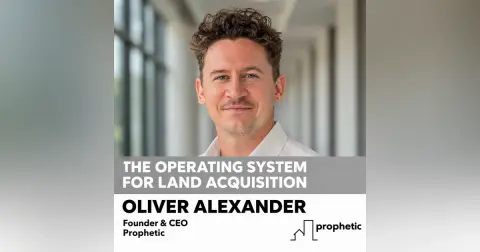
Oliver Alexander - The Operating System for Land Acquisition

 Apple Podcasts

 Spotify

 Castro

 RSS Feed
We talk with Oliver Alexander, founder and CEO of Prophetic, about why AI suddenly became a must have in proptech and how searchable zoning data changes land acquisition. We share the founder lessons behind Orchid Health’s early pivots and what it takes to make AI trustworthy enough for high stakes real estate decisions.
• A practical definition of proptech as any technology that improves a real estate outcome
• The market’s rapid 180 from avoiding “AI” to actively shopping for it
• Oliver’s early entrepreneur stories and what they taught him about building
• How Orchid Health survived a demand shock by pivoting to a new reimbursement model
• Why real estate stayed behind on software adoption and why that is changing fast
• How home builders use AI land acquisition to move from reactive to proactive sourcing
• What brokers keep that AI cannot replace, plus the pricing reality of brokerage tools
• The hardest part of zoning automation, including hallucinations, incompleteness, and constant updates
• Why rezoning and variances make “rules” more flexible than outsiders expect
• Predictions for faster entitlements and shorter deal timelines driven by AI
• What Prophetic is building next, including multifamily site planning and council agenda intelligence
Be sure to subscribe to the podcast on Apple Podcasts, Google Podcasts, or wherever you listen to podcasts.
To learn more, visit proptechespresso.com.
Where is this appearing?
00:00 - Welcome And Guest Introduction
01:17 - Defining PropTech And The AI Flip
04:44 - Early Hustles And Building Instincts
10:14 - Orchid Health Pivot Under Pressure
15:44 - The Real Estate Inefficiency That Sparked Prophetic
19:05 - Why Real Estate Resisted Tech
24:22 - How Prophetic Finds Off Market Land
31:22 - Making Zoning Data Reliable With AI
37:58 - Faster Entitlements And Development Democratization
41:05 - What’s Next And How To Reach Oliver
Welcome And Guest Introduction
Speaker 1Welcome to Proptech Espresso. My name is Mark Hurst, a former investment banker, s erial startup junkie turned real estate technologist. On each 15 to 20 minute episode, you'll hear from leading entrepreneurs and expertise on the opportunities and challenges of the rapidly changing prop tech sector. Thanks for listening today. Grab your favorite beverage and let's learn something new.
Speaker 2My guest today is Oliver Alexander, founder and CEO of Prophetic, an AI-powered land acquisition platform redefining how developers, home builders, and brokerages identify and evaluate development opportunities. Prior to founding Prophetic, Oliver co-founded Orchid Health, a healthcare services company working with underserved rural communities. A serial entrepreneur, he also co-founded the co-working community remotely. Oliver earned a BS in business administration from the University of Oregon's College of Business. Oliver, welcome to the show.
SpeakerThanks, Mark. Really appreciate you having me and looking forward to the conversation today. My career journey has been up, down, left, and right. But at the end of the day, I really just like solving big problems. And so looking forward to getting into all the details with you.
Speaker 2Excellent. Well, I know it's going to be a great conversation and some really interesting work that you've done prior to Prophetic that I hope we have a chance to touch
Defining PropTech And The AI Flip
Speaker 2on. But we'd love to start off with my traditional PropTech Expresso question that I ask all my guests. We'd love to hear your definition of PropTech. And you've been kind of in and around this space for a while. So if there's any changes you've seen during the kind of the time that you've been involved, I'd be interested in your observations.
SpeakerYeah, to me, PropTech is any technology that helps achieve a positive outcome in any real estate scenario. So pretty broad term, but it can be anything from IoT devices in the wall to AI land acquisition like we do to legacy software that's been around 30 years. So pretty broad term. And then what was your first question, Mark?
Speaker 2It was since you've been involved in this space for for a while, how you've seen it change over time.
unknownYeah.
Speaker 2If you have, I mean, not every, you know, it may it may be that it's it's not one that's that's really changed.
SpeakerYeah, it's changed pretty dramatically from my perspective. So I started work on Prophetic about four years ago, and we entered the market about two and a half years ago. Um and in that two and a half year period of being in the market, it has it has done a complete 180 in terms of what the market's perception of prop tech and especially AI really is. Um, when we first launched, the first six to 12 months, there was not a single mention of AI on our website. There's not a single mention of AI during demos. We really did not like to highlight the fact that a lot of AI was used in our platform because at the time it was it was seen as risky or scary or an unknown variable, and we just didn't want to inject any type of risk into our deals or spook people. Um that changed in early 2025. We started getting inbounds, and folks would say, wow, this is really cool. I've never seen you know national zoning maps and all the zoning data extracted. Is there AI in this? My boss said I need to go look for some AI tools to help us do land. And that light bulb moment for us really clicked when most of the inbound customers were actively asking and seeking AI. And so we overhauled our website and our marketing materials and our sales pitch to say, we actually do have AI. In fact, one of our co-founders is a PhD in the subject. Here's exactly how we use it and why it's trustworthy versus some other stuff which uh is far from trustworthy.
Speaker 2Yeah, uh there's definitely uh stuff coming out all the all the time in in terms of kind of nefarious activities, but um to your to your point, like um there's so much interesting work that that can be done um with uh AI that's on on this sort of you know uh area of uh of focus. Um and um you know I think it's uh to your point, like it has been such a rapid um landscape change um um uh occurring with the ability to use AI in um you know so many facets uh and so many antiquated facets of of real estate that uh exciting things happening, really exciting things to to come. So uh definitely interested to kind of uh learn more about uh um what you're doing at Prophetic. Um let's um let's get uh let's get to know you.
Early Hustles And Building Instincts
Speaker 2I I definitely uh shared a little bit in the intro about your background, but if you can share uh um more details, kind of um how a little bit about that that uh that journey, that random walk that uh you've kind of taken to uh to get to uh Prophetic and what you're working on today.
SpeakerYeah, sure thing. Um so Prophetic's the third company I've started. Uh as you mentioned, Orc and Health and remotely came before that. Um, but I mean, ever since I was little, like really as long as I can remember, I've had this itch to build things and curiosity around business specifically. So I'll tell you a couple stories of like how I knew this was kind of my path as an early age. Um the first endeavor I ever tried was selling uh uh sweet pea little little flower bunches and some like little onion starts at the grower's market where my mom had a cut flower booth. And so I remember prepping those and selling them, and it was oh, cute kid, Charles, pay a dollar for your little onion packet or something. So that was kind of fun. Um, and then the second one I did, I would always be on road trips with my family, driving all over Oregon and California. Um, and I'm to this day a big car nut, and especially old vintage American muscle. And so we'd be driving past some rural town and I'd see a 68 Camaro RS sitting a field. Wow, amazing. I wish I could buy that. But I'm 12. I can't, okay, let me write down the location of it, or you know, an old Packard or something like that. And eventually I had this list of hundreds of cars in their rough locations of like this highway, roughly this address. And uh at the time I discovered Craigslist, which is you know, um highly addictive if you're uh a fiend for old cars and working on them and stuff like that. And so I posted an ad on Craigslist and said, Hey, here's a list of all the cars. I know where their locations are, they're just sitting out in fields. And uh, if you want to contact me, I'll sell you their location, 200 bucks a pop. Um, and I remember vividly I got one single phone call, and the guy gives me a ring and says, Um, hey there, I'm looking to find the location of you know some car. And I responded, Great, I can help you with that. It's about five seconds of dead air, and he just goes, How old are you? But and it and it didn't work out. It you know, he was he said some nice things, but he was kind of just like, What the hell did I just call into? Um, and so that moment though, it really like crystallized for me of man, I I took something I was interested in. I I took notes, I did something about it and posted an ad, and someone took an action from it, and it like the loop was closed, and that was real. That was it happened. I did something and it worked. And yeah, I didn't end up making any money from it, but that kind of like planted the seed in my brain of you really can go do it if you want to. So, how am I going to do this professionally if there's no guarantee of you know job security and no funding to go start companies? Like come from a super middle class background. Um, and so that that was the impetus of going to the University of Oregon, studying business there, and focusing in entrepreneurship and really trying to learn the craft from a strategic analytical side instead of just winging it.
Speaker 2Awesome. Um just kind of listening to that story, I brought back some some great memories. One, um, I I worked with my dad on uh on a Porsche 914 when I was in high school. So uh, you know, and my dad was my dad is uh old school electrical engineer and like bringing bringing out his tools and just seeing his kind of methodical way of figuring out like all the issues that were going on with the wiring and stuff like that. It was uh it was a cool experience. And um uh and then just recently, you know, on on my Instagram feed, every once in a while I go I go through the um the the reels or the shorts about um uh people uh uh that that clean up the old cars that have been like in the in the farms and um barn finds. Yeah, exactly. And and they take these like incredible cars that you know for the past 30 years have just been collecting dust and you know, and then they they kind of refurbish them, get them running again, and just beautiful automobiles. So definitely uh I can I can appreciate uh and and uh uh having uh done done similar kind of rural drives in in California, do you do you see those still today, those those cars that are um you know amazing automobiles for sale in in kind of the the off the uh off the kind of primary roads that uh would love to have uh the time, the money, and the the space to uh to acquire and work on those.
SpeakerYeah, it's it's a lot of fun. Worked on them a lot with my dad growing up. So, you know, learned a lot from hard work and sales from my mom and entrepreneurial spirit from her. So um kind of all packaged together and then um ended up spinning up my first company while I was still a student at the University of Oregon. Um, and I can give you that story and that kind of weird, weird road if you're interested in that, or we can just jump to prophetic.
Speaker 2Well, no, I want to want to definitely talk about um uh the those initial um experiences and would love to hear that story, and then just ask um as you're as you're kind of sharing the um the remotely and the ORCID health stories, um, things that you learned from those co you know founding and running those companies that are um that you reflect on today when you're running Prophetic.
SpeakerYeah, yeah, I could talk about that all
Orchid Health Pivot Under Pressure
Speakerday. Um so I'll start with ORCID Health. Uh and ORCID actually spun out of a business plan contest that the Oregon Public University system put on. Uh Nobel laureate Mohammed Yunus came and partnered with the Oregon University system, and he's the founder of social business, which is this concept that says for-profit business doesn't have to be evil and profit maximizing. You can make a healthy profit while solving a social problem. So let's look at it from a new light and avoid the nonprofit route, but also avoid the you know profit maximization at all costs. And so this the contest was very simple. It said, solve a social problem with for-profit business, and then come tell us about it at a statewide pitch contest in October of like 2012. Um, so the invite went out in the middle of the summer, and almost all the students that responded across, I think there were like 56 teams across Oregon, they all were graduate students. But I was an undergrad working like a part-time catering job, really passionate about entrepreneurship. So I responded to the email, and one other undergrad student showed up to the meeting, and we ended up partnering and forming a team together. Um, and that student is my co-founder, O'Rion Falby, and he's from rural Alaska. And uh his sister had a lot of health stuff growing up, and they were constantly having to fly into town for treatment or fly to Seattle. Yeah. Um, and so it really left an impression on him of man, rural healthcare is just completely screwed. We should really dive into this and see if we can do something. Uh, and that to me was great. I wanted a really big problem that we could make a splash with, and I wanted something that was objectively needed. I didn't want to have any risk of like, oh, my new app, does anyone care about it? Like, no, let's focus on something we can sink our teeth into and really get some support behind. Um, and so we did a bunch of research for you know a six-month period or something, and then we ended up coming up with this model that said, we're gonna bring direct primary care to rural areas. And direct primary care is a membership-based healthcare model that says, you know, Mark, I'm gonna pay you as the clinic manager or the clinic owner 80 bucks a month, a hundred bucks a month for unlimited visits to my provider, and then in return, you don't bill insurance, there's no insurance involved, so your practice is much, much easier to administer. Um, so less waste overall. And we uh really believed in this. I mean, it was a pretty new concept, it was working really well in the urban cores. We talked to hundreds and hundreds of people across the healthcare world and finance and really learned how to make this thing work. Um but then you know, fortunately or unfortunately, depending on how you look at it, um, when we opened up the first clinic uh in 2014, and so I was 22 at that point, had just graduated my undergrad degree, and we opened up the first brick and mortar ORCID office, so a team of six or seven employees. I'm working the front desk, plus running the company, plus doing billing, like everything. Um, this was the same time, I think six months prior or something, Obamacare had come out. Which is great. A lot of a lot of people had additional Medicaid coverage, but it also now required that you had to have insurance of some kind, which means instead of paying us for a direct primary care in live in lieu of having no insurance, you had to buy a high deductible health plan, which was not cheap, which meant your money was now going to that and you couldn't really pay us as well. So these rural towns, just as we entered, the market kind of evaporated overnight. And uh we had a hell of a problem on our hands. Um the first clinic which we opened in Oak Ridge, 45 minutes southeast of Eugene, we thought we would have something like 350 of these direct pay patients in the first three months. You want to know the the max that we ever signed up for? Yeah, 18. We never cracked 20. Um, so right away we were like hair on fire. We got a big problem. This has not gone according to plan. Uh, but what we found were the Medicaid patients, which are low-income uh state insurance, they were coming in droves, like 5x as many as we expected. So we went back to the rule book of state regulations, and then we got a rural health clinic certification that allowed us to bill a lot more for seeing those patients because the state of Oregon and the federal program uh basically say we want healthcare in rural areas, we'll pay you like two or three times the price of urban core to go serve them. And so we were able to tap into that program, reach profitability, and get the company stable and eventually start growing it. So um, even the best laid plans, all the research, uh sometimes you just get you know bad timing. Uh so that that was a reality of getting ORCID started. But um today ORCID's got what, six locations, 97 employees will do like 13, 14 million in revenue. So it's done really well, but it's very, very stable, not like an exponential hockey stick type of thing.
Speaker 2Awesome, awesome. Um, you know, I just I'm sure, you know, being, you know, the you know, throwing out the business plan, pivoting and and uh but but still staying um uh true to kind of what you were trying to accomplish. That's um that's amazing. Um and and I'm sure you've uh learned so many things um in in that in the experience. So um we'll uh we'll probably touch on uh a few of those as we continue in our in our discussion today. But um what was the what was the pathway to prophetic? Was there was there anything that um uh could you know as working at ORCID that kind of contributed to um um uh a light bulb moment or at least uh uh a problem you you I you kind of experienced that that you figured needed uh solving?
SpeakerYeah,
The Real Estate Inefficiency That Sparked Prophetic
Speakerit actually all started from ORCID. Um there were kind of two events that happened that led to me accepting this idea of prophetic. And the first was that we knew exactly what towns needed health care. It was very clear, you know, population divided by medical professionals, and you get like a health professional shortage score. We we know where to go. But as we look at these towns, the first two or three clinics we opened, we just went and took the old clinic that had been closed for 10 years, paint and roof, and were open. And we quickly ran out of towns who had an old clinic to use. And now we have to start understanding can I renovate that diner into a clinic? What about that nice corner lot with no structure that everyone has to drive by? I'd love to put one there. Is that allowed? Are there flood zones? Who has a mortgage on this building? All these questions that I had a really hard time answering became clear that man, there needs to be some software solution that you can assess ground up development a lot easier. But at the time, I was 25. I just figured software's probably out there, it's probably too expensive. We have exactly zero dollars I'm willing to spend on this, so I just didn't really take it that seriously. So I I found the problem back then, but didn't really confirm it was a problem. And then the second piece that constantly stayed like eating away at the back of my head, I just could not stop thinking about it was uh Dollar General, if you can believe it. Um Do you know the story of Dollar General? How they how they so Dollar General is fascinating. It's like Dollar Tree, you know, cheap cheap store. Their plan that they started executing in like the early 2000s, I think, was we're gonna go put Dollar Generals in every little rural community in America. And that's what they did. So their stock price, you can look at it, it was just like a hockey stick in the 2010s because they figured out who's the best customer base for dollar stores, towns of 5,000 people with almost no available retail outlets. And so in every town we put an ORCID in, all of a sudden there'd be one or two dollar generals that pop up. And it it just occurred to me like, man, what a beautifully simple business model, cheap products in an area with not a ton of income and multiply by scale. Of course, that's going to work. How long was that opportunity sitting there that no one else capitalized on for the retail outlet? But at the same time, how long did the opportunity for the landlord who could have been buying up land and building these and leasing them in partnership with Dollar General both of those opportunities sat on the shelf for like decades and no one knew they were there? How many more opportunities are out there where people just don't understand what a market needs and better data and transparency can help shed light on that and ultimately make the market more efficient? And so that was this idea that has just to this day never escaped me is real estate development in the real estate world is extremely inefficient. It runs on information arbitrage, and even though there's so much tech in almost every industry, real estate is somehow very far behind still. Uh, and I can detail exactly why on that, but that was the impetus for profit was actually started in like 2016, and then I didn't start actually developing it until 2022.
Speaker 2Yeah, I'd I'd I'd love to hear your um uh your you what you believe the reasoning is behind this this kind of uh lack of uh uh adoption. I I have my own theories, but I'd love to to to see if we um if we meet or if we are coming at it from a different uh perspective.
Why Real Estate Resisted Tech
SpeakerYeah, uh I'm curious to hear yours. It's it's a hot topic, but I think from what I've seen, it generally there's a few events that happen that kind of influence this belief of mine, which is one when we were fundraising for Prophetic years ago initially, before we had any product built, um a lot of investors would say, Oh, PropTech, I don't invest in PropTech. Like, thanks, but no thanks. I was like, what? The market is huge, like I'm a serial entrepreneur, this is gonna be huge. Why don't you want to at least take a look? And they would respond and said, Well, well, PropTech, like people in that industry don't buy. So you can have a great solution, they just don't buy it. And to me, that was that was like talking la la land. Like if the product is valuable, people buy it. Like it's just human nature. So then I went and researched more of who actually are the buyers and what's their personas. And the decision makers and those who hold the checkbook in real estate are the folks who have the capital and they're older. And those guys, those folks the line went up 80 the 80s, the 70s, 90s, 2000s, up until like 08, the line went up. So you buy land, you buy a building, you lease it, commercial, medical office, residential. You just kind of made money almost anywhere in the country. And so those guys, why do they need technology? The line went up. I made money, I'm doing fine. Sure, it could be more efficient, but I don't manage it. My property manager does that. Like, what do I really care? So the buyers just didn't really want tech. But what we're seeing now is those guys are retiring, their kids are inheriting the assets, and the assets are being transferred to a younger generation who is born and raised on tech and just thinks that this is completely inefficient and unacceptable on how to run these very serious real estate companies. So, just in the last five years, we've gone from an industry where the buyer is cold and just couldn't care less, to the industry is white hot where everyone is buying tech as fast as they possibly can because it provides such a tremendous edge, either in operational efficiency or growth.
Speaker 2Um yeah, I mean, I I think you you you spot on is that they, you know, they were already making plenty of money, and it was money that um not necessarily that was passive, but it it didn't require just this on this ongoing refinement and tweak and and um uh it just it wasn't it wasn't what they were worth uh worth their their their time or their interest. Um Proptech, I think um to your point, like you know, COVID, like it it exploded with COVID, like because um you had to adopt technology to do things remotely that you couldn't uh because of the time do it in in person. So that kind of it ripped off or kind of destroyed this barrier that had you know been there kind of preventing mas mass adoption. Um I think Proptech also went through This period of like um, you know, there were so many solutions, so much happened, but a lot of it didn't deliver on the values that it it professed that it was going to bring. So, you know, Proptex had this like boom, you know, these kind of boom and bust cycles. Um uh, you know, in addition with just mega failures like Katara and We Work and and a few others that just kind of tainted, you know, those that kind of crept in um as investors um quickly retreated when they when when the kind of these these bigger kind of headline um uh uh failures were were were happening. And you know, probably real estate is this different area, right? It's you know, it's it it has you know, you're either working on something that's uh you know 100 years old or you're gonna build something that's gonna be a you know gonna last for a hundred years. Like it has this like lifetime that a lot of other tech just doesn't um have to contemplate in in in their realities. And and like, you know, poor investments um can have material impact on the on this on this real estate in a way that like um is is is different from other tech. So um uh it's super interesting to to know that we kind of we had similar observations from from kind of uh experiences in very different um different areas. Um but um uh and and and kind of uh to your you know this this notion of um uh uh kind of land acquisition, you know, I think things are in uh just kind of reflecting on um uh how that space is changing. I know like on the um on the builder side with the big builders like um you know your uh Lenars and and and and DR Horton, big, big scale builders, like they're they're they're kind of um working with land banks now. So there's like I I feel like they're you know they're so their models are evolving um um as the um as they kind of take a new view on on the on this on this space. Um
How Prophetic Finds Off Market Land
Speaker 2have you have do you run into um uh or do work with any of the the large um uh home national home builders out there?
SpeakerYeah, absolutely. Uh we're nationally deployed with one of them that you just mentioned, so um can't use their name publicly, but you can Google it and see which one it is. And they've got us deployed across every one of their divisions, and it's been incredibly high ROI for them to deploy this technology. And you know, frankly, they're just wiping the floor with the competition because it provides such a tremendous edge. And we really focused on home builders as our initial entry point into the market because they're insatiable with their need for land, right? They can buy one piece of dirt, do 100 homes. If it's a better piece of dirt, maybe it's 150. If it's two pieces of dirt, now they're growing you know 40% a year, 200% a year. So they are up against a massive housing shortage, and there's only a certain amount of good land in terms of how it's zoned or the environmental conditions. And they really have lived in this reactive world forever, where they wait on the broker to call because they're the big dogs and they've got the checkbooks, yeah, or they try and brute force their way through the off-market world and just throw these very expensive analysts at a given market and just manually go parcel by parcel and try and analyze it. And that just doesn't scale because as soon as you're done with that market, you know, the zoning changes or the parcels transact, and you got to restart. So um the industry has been really inefficient, really reactive when it comes to land acquisition, and that has put a glass ceiling on the entire real estate development industry's growth. So this technology is helping find the dirt, right? So since we went out and got all the zoning maps, we extracted all the rules from them with zone AI, now you can use our search AI and search against them. So I could search across three states right now for a five-acre parcel for a retirement home with no structures on it that's near a major highway or whatever, and I can find every single one of those in 30 minutes. And then I could spend a week calling down the list and surface all the good off-market opportunities. So when you have that level of power versus just kind of waiting for the phone to ring, it really does change the whole power dynamic of the development world. And I think we're going to see a huge spike in development volume in the next three to five years, you know, interest rates aside, because there's so much more light being shed on where the opportunities are in the market.
Speaker 2And and kind of with that disruption, is it is it going to be like um, you know, you're you're gonna have this weeding out on the home builders of those that are adopting this technology early and utilizing it and doing it at, you know, um, doing that at the the velocity that this solution allows them to do versus like late adopters that you know are you know kind of get caught um standing still and they because of the um the the kind of the finite supply of of land and plots, they're they're ultimately gonna be um uh miss out on on this opportunity and and um be disrupted themselves.
SpeakerI think there's real risk of that. Um if you're doing individual custom homes where your clients are bringing you the dirt, yeah, you're probably not at risk as much. But if you're a multifamily developer trying to grow or even maintain your you know two 200 unit complexes that you're building per year or something, or you're a production builder doing you know at least 20 homes a year, I think in the next three to five years, the funds are just gonna slowly stop ringing because the opportunities are being surfaced ahead of when the brokers can even find them and they're being sniped before that transaction ever had a chance to hit the market. And by that time, it's it's kind of too late because the markets have been scoured and picked over so much that a lot of the good opportunities have already transacted, or there are folks that put options on them. So I do think if folks don't adopt, it's going to be a pretty bleak picture in the next like three to five years. We're very far from that currently. But I think it's not a bad thing for like housing development. You know, there are some that are weak or slow to adopt that will, you know, be snuffed out, and that's the reality of competition. But we think there's a much larger segment of the market that we call the development curious that will enter. Because when you're able to operate with off-market efficiency, like like our technology allows, when you're able to estimate the costs and the STC charges and permit fees, utilities cost to get that line out to your site, when you can do all that using AI, which is it's all possible now, the risk is so much lower than it was in the past. And the opacity of trying to understand what the heck you do in this given municipality versus the other one, all that stuff, the barrier is falling so quickly. So that folks who have capital, like Mark, have you ever done a ground-up real estate development?
Speaker 2Uh no, I want to, and I need to uh yeah, I need to I I am curious, yes, definitely.
SpeakerYeah, we're we're development curious. I've had the same thought. Like all these rural towns, some of our patients can't get an apartment because there are no apartments available in a town of 5,000 people. That doesn't mean that's going to be the best investment ever. In fact, it may be a terrible investment. But there's so much opportunity out there where if you have some capital and you have tech doing all this legwork that was previously left to the you know 30-year veterans, why not do it? So we think there's a lot of folks who are on the fringe who've wanted to enter the space that will now be able to, um, and that they'll be very, very efficient at doing so.
Speaker 2Gotcha. Um we've we've I think we've touched on on this a little bit, but like does do the do the brokers just survive, or do like how did how do they have to evolve in order to um continue to be a participant in this market?
SpeakerYeah, the brokers, they're very good at the relationships, right? And that's something AI can never replace. I cannot get this technology to go knock on a door. I can't get it to make make you and I have a better connection than the other brokers in the area or the other sellers. So the interpersonal skills and the work ethic are what will help them survive because a lot of clients they don't want to go do door knocking and deal with off-market acquisitions. They need a piece of dirt that meets this criteria. Call me when you got three that I can consider. So there's always going to be a need for brokers because this level of work is difficult and time consuming, and companies don't want to specialize in it. But the brokers who will succeed are the ones who can flip results back and say, Great, here's five options I found today. Let me know which ones you want me to start calling. That's possible now. And we do have brokers going crazy in here producing those kind of outcomes. Um and that's this is another piece of like why PropTech has been so neglected in the past decades. Brokers don't like overhead, they hate having overhead costs when their income is all over the place based on when commissions do or don't come in. And so for them, they really have to believe that this is going to result in at least one more deal per year. And if it does, great, then it hopefully is going to be five or ten or or even more. So there's definitely a price point that they need to be comfortable with to try this experiment. And if it works, then they're gonna be customers for life.
Speaker 2Gotcha. Um
Making Zoning Data Reliable With AI
Speaker 2you mentioned zoning earlier, and I know that's just like how fragmented that is across the US. Like, how have you um with the zoning tool that you referred to, how have you kind of um uh utilized I assume AI to kind of look at the the municipal codes and the the different groups there in order to create a a product that uh everybody can use?
SpeakerYeah, so first we had to go get all the maps, and so some of them we got from a partner, some of the excuse me. Some of them we went and collected ourselves. And a lot of them, you kind of just have to set up an agent to go talk to the Muni and just keep hitting them every week until they send you a photo from their phone of a zoning map that's attacked to the local municipal wall, and like that's the official copy, and then you have to digitize it. So there's a lot of work on just generating this info that is not available online, and then the zoning manuals that was a year and a half long process to get that dang system to work right. If you feed a zoning manual to Claude or Chat GPT today, it'll be like 80% accurate, and it might be accurate 10 out of 10 times you try. But there's a couple things there for one, it hallucinates like crazy still to this day, even the best of the models. And two, the info it returns often satisfies your request, but is incomplete. And so those are the problems we really had to fix out of the gate is how do we have a 0% hallucination rate? How do we make sure that the minimum lot size, all of them are returned? It's never just one value, it's 6,500 square feet for single family detached homes, 4,000 for attached. You can get a 10% reduction if you preserve some green space and a 15% additional reduction if you do X affordable housing units. There's all these criteria, and often they're 200 pages apart. And so we really built a system that can go exhaustively collect it all. And then we have adversarial agentic review where the other AI goes and says, I'm gonna check all your work and see if it's right or not. And if it doesn't pass, it doesn't hit production. And so that system has to be accurate, it has to work in any type of format, HTML, PDF, images, and get the good information out. And then it has to be able to check for updates and keep it live.
Speaker 2So I was gonna go exactly to that point about like, you know, as with everything with real estate, like zoning is never static, right? It is um an evolving thing. So as soon as you, you know, the as soon as you get it, like it's out of date and and and and updates. So like uh, you know, main maintaining the the up-to-date um um reflection of of kind of where where things are is is hugely important in um you know so many aspects of of prop tech um and and zonings, no, no doubt about that. So um uh it's definitely uh uh uh a massive component of of building and maintaining one of these solutions, right?
SpeakerYeah, it's the information currency is is a constant battle. Some counties are just slow, they don't publish updates to their data often. Um other counties publish updates often, but they have bad OCR, and a lot of the data will come across as just it's current, but like that that's not you know Pulty on there, it's like pulky for some reason. And so there's a lot of data cleansing that has to occur to actually put quality data in the system. And the reality is the counties will never be perfect, therefore we can never be perfect. So it comes down to how quickly can you correct it if there is an issue when they do rise up, uh, which does happen sometimes. Yeah, but um I think a lot of people outside of real estate or those who are unfamiliar with real estate development don't understand how flexible the rules are. Right. The you can go file for a rezoning and you can change that parcel from industrial to residential potentially. You can take that agricultural one and change it to industrial and then put a data center on it potentially. Like the rules are set, but rezoning them is a constant piece of the industry, just like variances are. So if, for example, you have a municipality that says you need 20-foot setbacks on the front side and rear of this residential development, they might let you do five feet if they really want housing to get developed, which means your project now has 20% more density and now it pencils. So there's a huge impetus for us to not only collect the data and the rules, but to assess the sentiment of the muni of how willing they are to bend or break their own rules.
Speaker 2Yeah, and I think, you know, to that like to the uh that notion of economic opportunity with with land and how do you, you know, based upon um I guess the you know, either maximizing that or at least uh kind of your your your particular um aims or expertise, like things can uh you know, you can use a tool like Prophetic to really uncover opportunities that aren't aren't necessarily immediately uh apparent. Um and um you know uh go to these um you know uh municipalities or or or cities in order to kind of um uh propose changes to them that you know um ultimately will you know hopefully is a win-win and benefits uh the the community, the city and and the uh and the development group.
SpeakerYeah, there's tons of opportunity out there and there's tons of opportunity by right today. Like one of the the best questions we get asked regularly when we're talking to a new prospective client is they'll say, Yeah, I don't even I don't even want to see all the residential zone land, there's nothing left. So just show me the agricultural and I'm gonna go after rezone it if I want to buy it. And we'll test that right off the bat and say, Well, I don't know about that. Let's double check. And we'll draw a polygon or we'll search their city for their exact criteria and we'll surface 2,000 parcels that match their criteria. And generally they just don't know about those because they've never been able to search like that. And so there's plenty of opportunity that's just kind of sitting on the shelf today, and then there will be plenty of opportunity down the road when you can kind of master how this specific Mini works.
Speaker 2Yeah. Um, you know, one of one of the things that I think we've all observed with AI is just the the just the incredible pace that um is is happening around this. And you know, if you're if you kind of look out a couple years from now, like how do you think um real estate development is gonna be done differently than it is to today? Um any any thoughts on on kind of where where where where the puck is going?
SpeakerYeah,
Faster Entitlements And Development Democratization
Speakerthe the pace of innovation with AI is is just tremendous. Um it's it's hard to even overstate how fast it's going. But I think you know, at the end of the day, AI thrives in really data respect. So finance, healthcare, real estate, those are all heavily disrupted by this new technology. And I think what'll happen is deals will occur so much faster. The uh developer can move faster, the lender can move faster, the title company, even the Muni at some point will be using this technology to analyze the you know rezoning application or the permits or those type of things. So the the reality right now of six to twenty-four months to entitle and close and you know get your building permits and stuff based on the Muni, there's a pretty clear future where in the next two, three, four years, that's gonna be like two weeks. And so I'm really excited about getting that huge piece of administrative burden out of the system and just letting the markets breathe, really.
Speaker 2Gotcha. Um Do you think that that that future state's gonna be you're you're gonna see um something some more kind of democratization of real estate development? Where you know, we've obviously talked about um how how adopters are um uh taking advantage of this, but then also there's the um the development curious that can also take opportunity. Do you think that it it's going to um uh kind of lead to this democratized state? Or do you think like the those that actually have are kind of, you know, there's gonna be a capital aspect to this, and if they're able to really lean on that, then they're gonna kind of uh perhaps uh you know, we're we're gonna see kind of asymmetries enter into the uh the equation.
SpeakerYeah, I mean there's there's no escaping the capital requirements. It's a very capital-intensive industry in terms of real estate development and always will be. Um, so there's definitely going to be a lot more players entering, but they're still gonna have to be putting their names on things. They still have to put up some amount of the capital, or their LPs will, and they have to be trustworthy enough to justify doing that. So while there will be a lowering bar barrier of entry, there's always going to be the capital level requirement. Um I just hope that munis start to use this data more effectively and really start to use it to not only plan how the future of their zoning and their cities are changing and how they should be, you know, rolling out new zones or expanding their urban growth boundaries or whatever, but also using it to assess affordable housing and uh doing it a little smarter. Um, I still don't really understand to this day why there's so much focus on affordable housing of building new projects. Three, four hundred units, brand new, beautiful apartment complex. Why aren't we just buying more existing assets, refurbishing them, managing them, and going faster to get more units out the door versus these five-year, hugely expensive projects? I just still don't understand that. So it may just be my ignorance on the subject, but I'm hoping that data and speed can help get the munis to deliver those type of units faster.
Speaker 2For sure.
What’s Next And How To Reach Oliver
Speaker 2Um, what's next for Prophetic? What are you where are you, you know, what uh what kind of stuff is coming uh down the pipeline that you can share?
SpeakerWorld domination, Mark. Uh there's so much coming. We've really scratched the surface on what we're building. Um, so we're about to come out with uh a couple new products. So one is side AI for multifamily. So I can now click any parcel in the country, check if multifamily is allowed. I can input the size of units and ratio that I want, and it generates the structure and includes the courtyards, includes the parking, and tells me how many units I can reasonably estimate uh for that site. So this will unlock multifamily development on a massive scale because those guys don't buy a ton of dirt, but they do buy it regularly. And so getting them more out of the brokerage reactive world into proactive will be pretty big for the industry. Uh, and then we're also about to release Council AI, which is national aggregator of city and county council meeting minutes and agendas. And this is where we're detecting these projects at the earliest possible stage, pinning them on the map as hey, there's something potentially occurring here. And then also is letting us analyze the sentiment based on the voting records of this Muni does or doesn't like data centers. And if they do, they're this size or these these type of criteria that get approved.
Speaker 2Gotcha. Um, with that all over, unfortunately, we got to draw a conversation to a to an end. Thank you so much for coming on uh the the podcast and sharing your your story and and and your journey. It's really been interesting to hear kind of how you've um you know gone from uh selling the the the peapods and onions that with your with your mom all the way to to what uh uh the the amazing AI stuff that you're doing at Prophetic today. Um but uh we'd love to keep in contact and hopefully we can have you on uh back on the the podcast for uh for a future episode.
SpeakerThat sounds great. Thanks so much, Mark, for having me. Um and if folks want to learn more about prophetic, they can hit our website at www.propheticsoftware.ai. Uh and if they want to get in touch with me, they can ping my EA page, P-A-I-G-E at propheticsoftware.ai.
Speaker 2Awesome. Thanks, Oliver. Take care and we'll talk soon.
Speaker 1You've been listening to an episode of Prop Tech Expresso. Be sure to subscribe to the podcast on Apple Podcasts, Google Podcasts, or wherever you listen to podcasts. To learn more, visit hearstdecks.com backslash podcast. Thanks for listening, and we'll be back soon with a new episode.