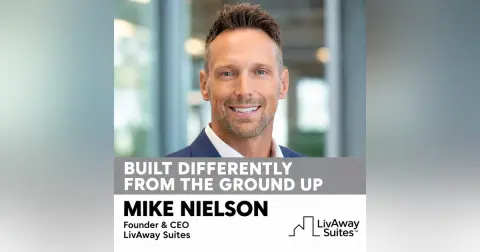
Mike Nielson - Built Differently From the Ground Up

 Apple Podcasts

 Spotify

 Castro

 RSS Feed
We sit down with Mike Nielson, CEO of LivAway Suites to break down how proptech shows up in real hotels, from check-in and packages to data platforms that keep operations tight. We also dig into why affordable extended stay behaves like a hybrid of multifamily and hospitality and what it takes to build a brand that puts the real estate first.
• Mike’s background in multifamily real estate, law, development and post-2008 workouts
• the pivot from boutique downtown hotels to economy extended stay
• why affordable extended stay looks like its own asset class with long average stays and lean labor
• the essential workforce customer profile and why kitchens and space matter more than pools
• operational tech that reduces friction: kiosks, parcel lockers, smart laundry and reliable Wi-Fi
• a new AI platform vision for consolidating fragmented hotel data into one operating system
• utilities and forensic water concepts balanced against guest experience
• site selection strategy using KPIs, geofenced on-market feeds and off-market outreach
• brand strategy that keeps fees low and decisions centered on the property’s performance
Be sure to subscribe to the podcast on Apple Podcasts, Spotify, or wherever you listen to podcasts. To learn more, visit proptechespresso.com.
Where is this appearing?
00:00 - Welcome And Guest Introduction
01:02 - Defining PropTech In Hospitality
04:14 - From Law School To Development
11:21 - Entering Hospitality Through Bellevue
16:12 - Why Affordable Extended Stay Wins
19:53 - Who Stays 40 To 80 Nights
23:12 - Designing Rooms For Real Life
28:33 - Tech Stack Kiosks Lockers AI
38:10 - Utilities Water Forensics And Savings
41:13 - Site Selection KPIs And Outreach
46:07 - Building A Brand That Serves Real Estate
51:38 - Growth Plans Orbit Platform And Closing
Welcome And Guest Introduction
SpeakerWelcome to Proptech Espresso. My name is Mark Hurst, a former investment banker, serial startup junkie turned real estate technologist. On each 15 to 20 minute episode, you'll hear from leading entrepreneurs and expertise on the opportunities and challenges of the rapidly changing proptech sector. Thanks for listening today. Grab your favorite beverage and let's learn something new.
Speaker 1My guest today is Mike Nielson, founder and CEO of West 77 Partners and LivAway Suites, a fully integrated platform that brings development, construction, property management, and brand new operations under one roof. Prior to forming West77 Partners, Mike served as president of WGR, a Salt Lake City-based real estate investment firm with over 18,000 apartments under management. Mike is a graduate of BYU and it's J. Reuben Clark Law School, where he received a JD after earning an undergraduate degree in business finance. Mike is a member of the Utah bar and a licensed real estate broker. Mike, welcome to the show.
Speaker 3Thanks, Mark. Appreciate having me.
Speaker 1Awesome. Well, I'm looking forward to our conversation today, a lot to uh dig in and
Defining PropTech In Hospitality
Speaker 1learn about. Uh, but we're going to start with my traditional Prop tech Espresso question, ask all my guests this. Um, would love to hear your definition of Proptech. And as you were just describing to me, you've uh been deep in it recently. So um please uh kind of tell us about um the definition and kind of what uh what you're seeing out there.
Speaker 3Yeah. I mean, I would my personal definition would be really just fusing technological advances with the real estate platform, which obviously is more traditional. Real estate uh tends to be more of a tried and true uh segment, I would say, within business. And and I I really look at PropTech as is what are those technological touch points that are guest or user, user-facing, I'll say, whether it's in multifamily or hospitality or even an office, but they they streamline the usability of the of the real estate itself and simplify processes that you know may be archaic, like like a formal check-in process where you had to fill out all this information. Now you can do it through, you know, a kiosk in the vestibule as an example.
Speaker 1Yep. Yep. I I know uh one recent uh stay I had, I had the kind of the kiosk experience that was um uh kind of a display that was going directly to somebody that was in some central kind of office and kind of so you had this kind of hybrid experience of of kind of an an individual but not a uh a local presence. Um so uh that was uh had the first time I'd I'd kind of run into that particular type of uh check-in.
Speaker 3Um you recall what hotel it was?
Speaker 1No, it was up um in just outside of Sacramento. I was there for a soccer tournament. Um so um, but uh uh yeah, I don't remember the the specific um uh hotel we were we were at. I'll I'll think about it.
Speaker 3The ability to we were I was speaking at a as I mentioned, the prop tech uh conference yesterday in in Dallas, or at least my section was on prop tech. And um we were talking about how technology can have a way of depersonalizing the uh the experience, especially in hospitality, which is so it so critical to the touch points, so to speak, in the stay. And um, and we were talking about how some people really enjoy not having to talk to people, and then other people still want the those touch points with somebody at the front desk that asked them about how their day went or just connecting in some way. So yeah, it's yeah, yeah.
Speaker 1And yeah, I think uh yeah, depending on my mood, I'm it falls into different the different categories of of of that. But um, yeah, I think what was nice was like it was a late check-in. Um uh it was super efficient. You kind of got you got some of that personalization, but they were able to kind of uh move move the check-in experience pretty pretty quickly. So uh kind of felt like I got just enough and and then was ready to like get on into my room and just relax for a little bit before heading
From Law School To Development
Speaker 1to bed. So well, let's get to know you, Mike, a little bit. Um we'd love to hear about your background. Um, I know uh from our discussion um that you uh grew up around real estate, um, then took a little bit of a different track going to law school and then then circled back. So um please uh kind of tell us a little bit about yourself and um would love to hear how uh the law school experience kind of has uh come into play and shaped kind of your some of your uh the ways that you you think about real estate.
Speaker 3Yeah. So I I grew up actually down in Southern California. Um and uh then in high school moved uh to Logan, Utah, which is in way northern Utah. I'll leave it at that. But it's it was a culture shock back in the early 90s. That was definitely a culture shock. They didn't have the internet back then. So um, but my family was has always been heavy in real estate in in one form or fashion. Um, my family now holds probably 20,000 apartments, and that's really more the food group that that I grew up on was learning about apartments. I mean, I in high school and college, I was aerating the lawns and then I got jobs working with the apartments. At one point I was a leasing person, and other times I was working on technology things or whatever it might be. So just got I was definitely exposed to the multifamily side of real estate early early on in my career. Um, and almost through that, I I didn't want to go, nothing against the family business is amazing, but I really just wanted to blaze my own trail. So after college, I decided to go to law school. And really the intent was uh I I well, I should say going in, it was more just it'll be a great education. But then, like all good law schools, they they train you to want to be an attorney. And I that about halfway through law school, I said, okay, I'm gonna go work for Baker McKenzie in Chicago. I'm gonna be an attorney. I want to do law review, I want to do the whole thing. And um problem was that didn't align with who I was, I guess. So I learned quickly that uh that it's I'm one, it's hard to do that. Um two, you have to definitely be uh cut out of a certain mold to be able to do that. And I think uh where I kept running up against that, even as I got under me out into my career and stepped into um working for law firms. I I my personality didn't jive with that approach, and it does for some people, and it's great. Um, just it didn't jive for me. The the entrepreneurial spirit of just trying to get things done came out too often. And um, and so I I pivoted after law school, passed the bar and was uh operating as an attorney for really just a short year, and then uh pivoted into real estate. And again, not with the family business, but it's a private equity group out of out of Arizona that owned these luxury. You've heard of these luxury resort second-home communities where they do the high-end golf courses and sometimes ski and ski out, Yellowstone Clubs one up in uh up in Montana. Um, the one that I worked for was a project called Promontory. It was a brand new project in Park City, Utah. And I had the opportunity to go really become their legal counsel, not knowing my, you know, what from a hole in the head, they they hired me still and say you be the legal counsel. And um, this is right about the time Google was, you know, Google search was coming out. And I I remember I I had figured that piece out. Most people hadn't, and and uh honestly, Google helped me get through that first few years. People thought I was a lot smarter than I probably was because I could just Google documents and hey, what about a document for this? And and then I would, you know, form documents from it. So it was the the law school training was was huge, and then obviously operating as as a true attorney, even though it was within a within a company, was just great experience because it I did everything from permits to entitlements to contract law to overseeing a sales team. Um, and I was doing everything literally from from jumping into a hole to double check a coupling on a on a sewer, you know, main to and I it wasn't me doing that, but you get what I'm saying. I was I was doing that type of development to running sales teams, to writing contracts. So it was just a great primer, I think, for the rest of my career because I I touched so many things in a in a short five or six year period. Um and then I did it, then the 08 crisis hit, and uh my family built uh these it's a multi-hundred million dollars of project up in uh Bellevue, Washington.
Speaker 1Yeah, which really okay. If you know Bellevue, it's well so well I do uh so well because um I grew up in Kirkland, Washington, which is like this right next to it, next to it. And I've seen, I mean, Bellevue has massively transformed even since I've been there. But I I I saw that. So uh well we'll have to talk more about that.
Speaker 3It was always kind of a bedroom community, and then you know, I mean it had the high-rise towers, a handful of them, but it really blew up from about you know 2000 through you know, present day. It's you know, it's in that 25-year run, it has changed dramatically, as you know, and it's it's uh in every way, it it doesn't rival Seattle from a size standpoint, but from the composition and what it is, it's it's just a great clean, uh I I call it still relatively safe city. And uh, you get the city environment and that downtown environment. So we had built two, my family had built two high-rise condominium towers in downtown Bellevue and um got a little caught by the 08 crisis, had overruns on contractors and timelines and everything. And so I I got called on a family mission just to go up there and I honestly, I think at the end of the day, I was just I was the only one dumb enough to not say no. And I went up and did it. And so um, but again, that was a that was a great experience and kind of launched about a I would call it maybe a seven-year, eight-year run for me, where all I did was fix things. So I got this early experience where I got exposed to contracts and construction and development and a massively expanding market in the early 2000s to then moving into an eight-year period where all I was doing was was workouts, and they weren't workouts on deals that I originated. It was just I was the guy called in to go fix them. And I I learned from some great people, including family members, that that really taught me well on how to do that. Number one, and then you know, when you look at enough things that are broken, you start building the primer of how to make sure they don't get broken ever because you start saying, Well, I see what they did there, and oh, that was wrong, and oh, they over-leveraged that. That's the problem. So it really did create a great probably a secondary primer for me in my career of just here's how you here's how things go wrong, because they do wrong at times, and here's how do you fix them. And um, and so that that was a great experience as well. And then realized in 2014 that I was doing a lot of that, just kind of I don't always call it babysitting, but I was babysitting a bunch of assets that I wasn't the owner of. I didn't originate, you know, and I was yeah doing this work, and I I really wanted to get back into development.
Entering Hospitality Through Bellevue
Speaker 3So we we started West77 partners. I left, I left a good paying job and um took a salary of zero and uh and tried it on my own, hung, hung my own shingle out there. We we the company was called West77 Partners, still is to this day. And and really we had one mandate from the family. It was don't don't compete with the family business of multifamily. You know, I mentioned that's predominantly multi-family. Um, and so that that was what really got us into hotels. We looked at uh uh and about four billion of assets that we had at the time in the family company. We had one hotel. I thought, well, if that's blue water, that that that looks like blue water, so we'll go play in that space. And that was really our introduction into hospitality.
Speaker 1Awesome, awesome. Uh fascinating, fascinating stuff. And uh where were you uh just one quick uh question on those those condominium hotels? Was it close to Bellevue Square or Yeah?
Speaker 3It was Kitty Corner. We were you know Bellevue, so it was on on uh Northeast 10th and 106th.
SpeakerOkay.
Speaker 3So there used to be a big Cadillac dealership, if you remember, kind of Kitty Corner from us. Um we were yeah, but we're right next to the Hyatt Hotel. We were the next block east from the the Hyatt Hotel.
Speaker 1Gotcha. Yeah, I mean, great location, obviously. Um uh, you know, with uh the with with access to Seattle with you know with Redmond and Microsoft like blowing up and stuff like that, like Belgi was a amazing, amazing place for for sure. Um and then close to Lake Washington as well. So exactly it's stunning. Yeah. Um so uh I mean as you kind of looked at hospitality um uh like what what was it that or I guess how did you identify the niches that that kind of were um potentially interesting for you? Obviously it you know, hospitality, you know, there's there's a there's a range of um uh kind of options there from the the Yellowstones that you're kind of that you were talking about to to um other less glamorous uh places that uh us common folk go to. So um how did you what what did you were you kind of brought you know trying to find a an an undis or kind of uh an underserved niche or what um what uh how did you go about this investigation?
Speaker 3Yeah, so I stopped the story there when I say we got into hospitality, but uh we we really I again we we looked at hospitality as being a good space to get involved in and didn't know much about it, to be honest with you. And so um, like I said, one hotel had a little exposure within the family company, but I didn't I wasn't even the project manager on that, just was a part owner in it. Um and so we set out into hospitality. We luckily in downtown Bellevue, we had a our first hotel opportunity on that same block where where we did the condos. We owned the entire super block, they call them in Bellevue Superblock. So we owned it between Northeast 8th and 10th and 108th and 106. So we owned that whole block. So on the kitty corner, kind of uh opposite corner where the condos were, um, I saw an opportunity to build a uh a really nice boutique hotel. And so we we started going down that path. It was 250 to 260 keys in our original prototype. And and uh along the way, we connected up with Hilton and Hilton said, you ought to make this uh a Hilton Garden Inn. And we're like, Yeah, but we don't want a Hilton garden inness. Do something like high, high end. And they said, and Hilton was awesome to work with, you know, Matt Welling, he's now I think he's head of North America for uh maybe even something else now, but last he was head of North America for Hilton. So no, no, no, but you guys can you can do this any way you want, make it like a boutique hotel. We just want to put the Hilton Garden in sign and we'll we'll require a couple things that are Hilton Garden in this, but at the end they just make an awesome hotel that that's downtown Bellevue and and walkable, and and you'll have the engine of Hilton Garden in behind it. And and so we did that project, and and it's been a massive success for us. And I and I then through that process, we started to see, hey, maybe there's an opportunity to go into downtown cores and build really nice higher-end versions of hotels where there's limited supply, or at least limited certain supply of like there wasn't a lot of Hilton hotels in downtown Bellevue. Uh, and then, you know, build it as a boutique hotel, but then slap one of the big brand engines on it. And it it really was a great concept. The difficult part is finding dirt in downtown cores where you can actually go do this. And we just so happened to be lucky enough that we already owned it. So it was an easy, hey, let's develop this versus going and buying third-party dirt. So it was in that we were really trying to find our way in in hospitality.
Why Affordable Extended Stay Wins
Speaker 3And as well, we were doing that, um, we were introduced through another private equity group out of New York that we knew um to economy extended stay or or affordable extended stay. And you'll hear me say those words are kind of synonymous. It's it's really that low end of extended stay hotels, but there's what we learned as we were being introduced to them, and this is where it kind of clicked for us. Uh we had so much multifamily experience, as I mentioned earlier, and that's my background, my family's background. Um when we were underwriting these hotels or getting to know these hotels, we we started to see some really interesting characteristics of these hotels that were not hotel characteristics. Like average guest day was, you know, sometimes anywhere from three weeks to three months, you know. Whoa, whoa, that's a that's not a normal hotel. The the the labor model is it was incredibly efficient. Instead of having 25-30 hotels, like or excuse me, 25-30 employees at the hotel like you normally do, these things were operating on six to eight employees. I mean, very, very lean. Um, and and the way the rooms were set up, they weren't a hotel room. They were almost like a a studio apartment. You had full kitchens. I mean, it's not even the college boy refrigerator, it's full-size refrigerator, cooktops, dishwashers, microwaves. I mean, it was it was everything you'd need for basically a studio apartment. Um, and uh we we started looking at the data and the metrics, the investment metrics, and we just fell in love with it right out of the gate. We were looking at the private equity group that introduced us to this space um had given us uh access to about a little over a hundred hotels that they had in their portfolio at the time. And so we underwrote a hundred hotels going back to 2022. This is in like early 2014. Um, so we had a lot of data, saw how they operated during the 01 crisis, saw how they operated um during the the GFC. And that was the characteristic that probably sold us. It was the coup d'égras. We we looked at these hotels and went, man, they are incredibly recession resilient, um, seeing how they operated at that time over the last two recessions, and knowing that the that you know the 08 to 2010 crisis was that was a deep one, right? And it still operated incredibly well. Um on our our analysis, we saw only about a six percent drop in top line revenue from peak to trough during that entire crisis, you know, or or recession, which was astounding. Most hotels had, you know, 30, 40, 50 percent drop in revenue. So we we came up with this thesis that hey, these are hotels that they're hotels, but they operate almost on a continuum in between an apartment and a and a normal hotel, which I get that. When you say extended stay, most people think of it that they think of like a residence in or a home two suites or something like that. But what we found in this analysis is these affordable extended stay hotels, uh their their guest day was just so much longer. I'm talking weeks and months longer than than you get with uh some of those brands I just mentioned. And so it really kind of we we saw it as its own an asset class of its own a little bit. And um, like I said, fell in love with it, uh started developing those throughout the Northwest. We kind of abandoned the um let's go build in downtown cores. You know, that was that was hard. It took a lot of money, and we said, we can go build these and get, you know, it takes us, takes us four or five. We got to build four or five to equate to the one big downtown hotel, but the returns are sometimes double that of what we're getting with these hotels. And so it was it was just much better returns, and that's that's really what got us into affordable extended stay or economy extended stay.
Who Stays 40 To 80 Nights
SpeakerGotcha.
Speaker 1What what sort of um this this clientele that's uh you know staying at these places for multiple weeks, are they um are they uh kind of uh temporary workforces that are kind of uh working on large projects? Or what what's kind of the um do you have a sense of kind of who these individuals are that are um kind of the the these ideal um uh kind of customers for the these types of properties?
Speaker 3Yeah, no, there's definitely and and I I always say if you just want to refer to it real simply, you think of anybody that kept working and didn't start zooming it. We all went home and zoomed it during COVID, right? Yeah. So think of those people that during COVID weren't doing their jobs from home at a computer, and we called those people essential workforce, right? So included everything from Amazon package deliveries to firefighters to uh military to construction work to medical workers, um, manufacturing, uh, you know, defense contract. I mean, you can go through the list and it's education to a degree continued. And so um, anybody that really fell into that essential workforce, which was a pretty broad base at the end of the day, if we really stop and look what a lot of times we think essential workforce and we're like, okay, paramedics, nurses, you know, but it like the category was huge.
Speaker 1Yeah, yeah.
Speaker 3So that is our customer, and it it tends to, it tends to be um the I would distinguish it, it's it's it's not that there's there our our demographic doesn't work with computers, but my job a lot of times I'm sitting in front of a computer versus somebody who's you know renovating a submarine for the Navy. They got to be out there. I mean, there yes, there's computer work, but they've got crews that are out there working on this submarine or you know, the construction of the drywall crew that's redoing the Walmart, you know, down the road that's that's here for the next 14 weeks. Um they're working with their hands. And so it is it is more of that labor force. I will I will say the the The uh work with their hands or blue collar. I hate to put terms on it because it's it's not just blue collar, it's gray collar, and candidly sometimes it's white collar, but we find it's it's a lot of medical related, it's it's military construction is a big category for us. Um any type of manufacturing or um distribution can can be big for us. Uh, we do a lot with training schools here now. When I like truck driver trainings or um, you know, XYZ company maybe brings in 20 people a month for doing trainings for three weeks, you know. That's that that's a great customer for us. So, but it's typically anybody that that needs accommodations for we say seven plus days, but I would say the average is is needing it even more than that. It's not really intended for the the guest that comes in and says, I'm on a business trip, like I was in Dallas yesterday, I uh for one night. I'm not the right customer for for this product. It's people that need a quasi-home, you know, temporary accommodations while they're on work assignment or just need to be in this locale for multiple weeks, if not months at a time. That's that's who this product really caters to.
Speaker 1Gotcha,
Designing Rooms For Real Life
Speaker 1gotcha. And then and so you know, you mentioned some of the um kind of uh the the different labor force model for the and uh for these um these these properties. How does the kind of the um the the physical um experience different for these longer stays versus your you know the the the the family-oriented um hotel um that you would go for for uh for one or two nights?
Speaker 3Yeah, it's and it it is quite different because you think about it. You're if you're I was I was in New York, when was it, a couple months ago, and I stayed at a Moxie hotel, which is a great hotel. I mentioned this yesterday at the conference. So a great hotel was so cool. You check in at a bar, you know, you go up to your and I get up to the room, I'm like, man, this is a small room. I mean, it was basically a bed and you know, a little place to turn around and kind of a make-shift bathroom. It was just small, but it was fine. I was there for two nights. I didn't care, you know. Um, so one of the big characteristics that it's really different with our our space is that the rooms need to be a little bigger. You're gonna be there, you're gonna be actually living there. It's where you come home from work, you're unwinding. Um, I've been out grinding on the construction side all day. I want to come back and, you know, eat some dinner, have a drink, and watch the ball game. You know, like you don't want to feel like you're pegged into the corner. And so it's one of the things we did with our space. Even and so the rooms in general are a little bigger, I would say, within our space, but right our rooms uh uh we actually took them even bigger and went about 20% bigger than the than the rest of the the segment on average. And so we really think there needs to be space to you know store things and relax and have space for some alternative seating. So I'm not just sitting on the edge of my edge of my bed. Another big uh characteristic I think that it's uh I guess tied to these longer stays is just having a kitchen. And and I say that in quotations because a lot of times you think hotel kitchen and they've got a little makeshift refrigerator. Yes, they do have a sink, there's a microwave, like that's not what I'm talking about. I'm I'm talking like a legit kitchen. So island peninsula, I've got a dishwasher, I got a full-size sink, full-size refrigerator, full-size microwave. Um, I've got a cooktop. It's really, it's really everything you need to real to uh cook, actually cook, not just warm up a burrito, right? So you've got cooktops, like I said. The only thing they don't have is ovens. Um, and but outside of that, they have anything that your kitchen at home has. Uh, and that's that's a huge thing that's needed with this space because again, if I'm here for 32 days, I'm probably gonna need to eat some dinners at home. Not I can't eat out 32 days in a row, right? Yeah, yeah. So I need to be able to buy some groceries, be in there. If I'm a traveling nurse and I'm staying here for the next six weeks on assignment, I'm gonna want to buy food and cook it and have room in a fridge. It's not the again, it's not the typical hotel fridge where you can get like four drinks in there if you wedge them properly. You need a full-size fridge, you need a crisper for lettuce, and you know, you need a place to put your eggs and your butter and the whole nine yards. So that that's another big characteristic. The other, I would say the last thing, just to keep it simple right now, is the the traveler, the extended, the truly extended, extended stay traveler. We'll call it the the economy extended stay traveler, because it's it is, like I said, more like 40 to 80 nights, let's say that's the average or middle of the bill curve. They they don't really care as much about a lot of the amenities that you and I might care about, like a pool, for example, or a hot tub being, you know, every every hotel tries to put those in. And you know, we've built hotels where we had those and they rarely get used, unless you have like a soccer team staying at the hotel. Outside of that, the hotel pool is not really getting used. Um, things like big meeting rooms and things like that, um, that don't really matter as much to this guest. Um, having a big restaurant in the hotel or something, you know, again, I can cook in my room. And typically the guest, so we do do we do gyms in each hotel because we think that's important. Yeah, a lot of the companies that we do business with, like Boeing, for example, they they this was years ago. I don't know if it's still a requirement, but it was a requirement. They would stay with us, but we had to have a gym. And so we ended up repurposing one of our rooms as a as a gym, learn from that. Now every hotel just has a gym in it, and so little things like that. So they have they have some lobbies, some breakout spaces, guest laundry. They have they have uh really nice guest laundry in in our hotels, and then a really nice upgraded gym from probably what you would expect with uh a typical hotel. And so um those are kind of things that are important because again, they're staying there for long length of time, and their company may be paying for it, they may be getting a per diem and they're paying for it, you know, whatever it is. But the the affordability of the is is super important to them, right? They're not where they want to pay 160 bucks a night for a lot of the extended state brands that I've mentioned, they're looking to spend you know 70 to 80 bucks a night. And that because of that affordability, you really do have to optimize the box and the building to be deadly efficient um to be able to accommodate that type of a
Tech Stack Kiosks Lockers AI
Speaker 3rate.
Speaker 1So then how does um how do you uh how does technology come into this in terms of um kind of imp improving it from um an omer owner operating perspective, as well as providing um uh kind of services and amenities that are meaningful to this uh target uh client group.
Speaker 3Yeah. Yeah, it's I think I I take technology and I kind of break it into three buckets at least, how we're how we look at technology. So we have, I'll call it our common area or just um common space technology, and we'll talk a little bit about that. Um, the in-room technology, which isn't overly pervasive, but it's uh there is in-room technology that's important to have in these rooms. And then AI. And I'll kind of come, that's probably gonna be the deepest um section. But um what we've done in the hotels, everything goes back with in our hotels with an aim of optimizing the model. You know, as I mentioned, with six to eight employees, I mean, you don't have extra labor anywhere, right? So everything just has to work like clockwork. And and to be honest, if I can free up two hours of my front desk person's time through different initiatives, that's two hours they get to go do something else because they always have more plate, more on their plate than they have time to do. And so, because of just the efficiency of the model from a labor standpoint, so we've done some things I mentioned at the outset. Um, we partnered with Verdi, which is a kiosk, a virtual check-in kiosk. Um really served two purposes for us. One, um, at night, we don't our front desk is not open, uh open with somebody at it 24-7. Usually in the later night hours, call it, you know, one 1 a.m. to about maybe 5 a.m. That person will be there is always it's always staffed, but that person might be doing laundry or they may run upstairs and be stocking some of the the floor-by-floor um backup shelves or whatever it is. And so um that verti checking allows somebody like you. You mentioned you checking in late, you know, if you get in at one in the morning because your flight was flight was delayed. You can always call this person, they'll come down and check you in. But sometimes it's easier to do the kiosk check-in. It's quick, it takes about two minutes and you got your key and you you run to your room. So that's been one of so it serves that purpose. The other purpose it serves is when you know at rush hour for check-in, it serves as another alternative. Um, I mean, we'll open up two bays and have people checking in at you know, both computers. Um, so you try to get people as through as fast as you can. But if you have 10 people waiting to check in all at you know, 410, it allows people to go to the kiosk and and use that. So it's that has optimized and it's created a happier customer, I would say, because when they would be frustrated standing in a line, they don't stand in a line, they just go to the kiosk. Another thing that we've done is we partnered with Smyota Parcel lockers. And so we add in our lobby, we have, and I forget the exact number, but let's say there's 20 lockers in there of varying sizes. Uh, and what this does is typically in our type of hotel, you'll have uh the front desk will just accept FedEx packages, and then they will put them in a back room, and you get guests coming down. Are my ear pods here yet? Did that get here? Did my package there? And then, you know, and it's it's a lot of just interaction from that standpoint, as well as just the hassle of you know, tracking the packages, make sure we log them in, then get them back to the customer uh or to the guest. And Smyota just streamlines that entire process and takes our front desk out of it. Now, now the FedEy comes in with, you know, let's say Mark, Mark's staying in room 308 and he orders some some ear pods and they're gonna show up in the next couple of days. I mean, one, you have confidence that Smyota, as soon as it gets that, that those ear pods, you'll get an email. So you don't need to keep asking the front desk, are they here, they're here, because Smoyota will alert you. You'll get an email, you come down, it's a specific code, and you just go use the QR code on the on the Smyota locker, and your door pops open, and oh, I grab my ear pods. Each each one of the boxes or or containers is is pressure sensor sensed. So if your earpods stayed in there for an extra day or two because you just keep forgetting to go there, it'll keep reminding you via text uh or email. Um, it will keep reminding you that your ear pods are there. Uh streams lined it for FedEx. FedEx can come in with you know 16 packages and just open up the lockers and get them all in, never even need to deal with the front desk. So that's been another thing that's I mean, we're talking it's it's minor, but that's a lot of what our world is. We are we're so optimized already. You're trying to figure out where can you grab even just a little bit more and optimize the model even better. So those are two things we've done in the common areas outside of just uh you know, we do a gig, you know, wife, Wi-Fi. In my opinion, you should never stay at a hotel and have laggy internet. It should you should have all the capacity you need for doing whatever you're doing, unless you're you know a crazy gamer and you're throwing all these things at it. But uh even those guys though, they they can game in the hotel because it's because of our capacity. So um it's it it really that's a big one for us was internet and just making sure it's that's never laggy for people. And uh and then so those are a lot of the common areas. We have our our our guest laundry is tech enabled, so you go put your clothes in the the washing machine, it texts you when they're done, so you don't have to keep checking it, or or heaven forbid, you wait a minute to go down there, and then somebody's taking your clothes and putting them on the floor, and now you're done, you know. It's like yeah, things like that. Just again, they're little things, but they're little things that make a difference because I feel connected. And that the whole aim of this was there's a dissociation sometimes in our segment. It's not like you know, staying at a JW Marriott where you got 30 people connecting with you, and I got the bartender, I got this. So the the connectivity is is less just because of that labor force. And but the guest is here for a longer period. So it starts to feel a little bit more like home when they're there. And what we've tried to do is create this balanced experience between providing enough hospitality through the human interaction, but also allow the person to feel connected to the building, like I'm connected to all the things that that I would use or need within this building, whether it's getting a replacement key from the kiosk or being texted that my laundry's done or you know, the ear pods example. They're there. I'm gonna run down and get them. It's two in the morning. Guess what? You don't need anybody at the front desk, you know. You just go down to the kiosk and get or the the locker and get it. So little things like that. Um, and then we've done some things in the room really to enhance the experience. Casting to the TV is probably the biggest one. We've done some upgraded things with, I don't know if it's necessary technology, but it is. It's the way we've created better soundproofing in our rooms. We have the highest soundproof rating in in the industry. Um, we've got or in our segment, I should say. That's all we've really compared to is our segment. But um, we've done things with exhaust. You know, smells can be a big problem when you're cooking in all these rooms. How are we getting smells out of the building, which again is is technological. Um, but I think the biggest thing that we're working on now is is, and we've created it, but how are we how are we bringing all the fragmented data in in in our types of hotels? There's just a lot of places where data is stored. It might be on OneDrive. It's we have a ticket system for you know, fix it items. We've got our guest reviews that are coming through Trust You. You've got your whole your whole property management system that you're getting info from. So there's all these disparate uh, I guess I would say, sources of information or inputs for information. And we're we're creating a platform um through AI that basically takes all the fragmented data sources and outputs and consolidates it into one uniform integrated platform. So and I think that's that's the thing that's really gonna be interesting, I think, for LivAway Suites and our brand as we grow is it's it's gonna give you the platform. I mean it sounds crazy to say, but it's true, like having experience. It'll give us the ability to the same efficacy and guest experience that we would create if we just owned two of these hotels. And that was the only two we had. All of our time and intention was going into it, and we had all the data. Uh whether it's two hotels or 200 hotels, this platform that we've created will make them synonymous, at least as the guest experience. And and I think that's something you see just in any space as more you get more and more and more hotels, the management company or the brand. There's the the experience can sometimes be diminished just by aggregation of more and more and more hotels, and it's it's starting to become a number versus um, you know, if you had one hotel owner and it's their hotel and that's all they care about, you're gonna get a slightly different experience there. So um sorry, that was a ramble, that was a ramble, but those are the three areas that we've we've really dug in on.
Speaker 1Yeah, no, um I just the uh the discussion kind of led me to uh um uh an area that I'm I'm interested to kind of get your perspective on is um outside of um you know some of these um kind of I guess experience and operational technologies, um I I have to imagine uh in an area like um utility costs, energy, water are big line items
Utilities Water Forensics And Savings
Speaker 1for you. Are you um are there any um things that you're looking at to reduce that cost in order to improve the NOI of these these uh assets?
Speaker 3Yeah, I mean it and I don't know if you've heard of forensic water, but it's it's you know essentially, and we're still learning about it, but it's it's that concept of how do we how do we create smart smart water, you know, not the smart water bottles, but how do we how do we create smart water usage through our tracking and the forensics of how we're using water and then using AI to analyze where we're wasting water, right? We could get the same efficacy out of our out of our landscape if we just did it, you know, watered for two less minutes on each zone. Okay, great. Let's, you know, and so there's there's this whole kind of rabbit hole that we're starting to go down on just utilities and how how AI can analyze the data from your your utility usage and then make recommendations on how to optimize. Um, we do a lot with just energy and kind of the the energy savings and credits and things like that working with municipalities. So we're always trying to incorporate those. Um, but it's it's balancing it so that it it's not diminutive of the guest experience because sometimes you go and you put low flow shower heads on. And now I had one yesterday. Honestly, I was washing my hair and I'm going, man, this is gonna take me five minutes to get shampoo out of my hair, you know, because there's dribbling out of there. Yeah. Low flow head. So how do you balance, how do you balance water usage with also making sure the guest's experience is done is not diminished. And so that's that's something we're looking at heavily. We do a lot with just, you know, um yeah, like energy saving techniques within power and um different things we're doing, lights in the room, those kinds of things. Um, but yeah, we're we've done some. I think we need to do a lot more, and that's where we're starting to dive down the rabbit hole.
Speaker 1Awesome. Awesome. Yeah, I mean, uh water leakage, you know, just like uh, you know, like both from a damage perspective as well as the just the cost there um opportunity into like the water forensics. I'm not sure if that's a platform or just a concept that you're uh kind of uh sharing there, but um it would be a great product name. Um exactly. Um but um you know what is your um, you know, these um, you know, you talked a little bit early on about like this notion of um, you know, the the difficulty with putting hotels in urban corps where there's you know there's there's not a lot of availability and it's really expensive versus um like identifying the sites for these um uh this uh extended stay um um opportunities that um um exist out there.
Site Selection KPIs And Outreach
Speaker 1How do how do you approach site selection? Um and um I guess uh I have to imagine this is a um uh an advantage over competitors if you can get this right. Um so how do you how do you how do you go about site selection and making that a kind of a strategic uh advantage for uh live away?
Speaker 3Yeah, we we have kind of a top-down and bottom-up approach uh when it when it comes to acquisitions and and the the top-down approach is more first focusing in on the MSA and then the submarkets that we want to be in. And so we're constantly running these national evaluations that take about 26 KPIs that we've come to trust and and know as indicative of of a good uh extended stay market. And it's it's everything from just population based. We try to be in populations and MSAs that have 250,000 or more people to down to you know the number of construction permits that were you know issued in the last turning 36 months, and is that trending down or up? I mean, little things like that, that just that's a KPI. So we have all these KPIs that feed into a system for us of how we how we rank uh all of the MSAs in the country. So we take the top 100 MSAs and we rank those. Um, and then within those MSAs, we we drill down even further from a top down. We we use very similar metrics uh to evaluate those same KPIs as it relates to the submarkets. So you could take a market like Austin, Texas. We like Austin, it's a great market, but where do you want to be? Do you want to be down in in Bernie or do you want to be up in Round Rock or do you want to be by the domain, you know, which is a kind of an up and coming, uh kind of like a little bellevue, to be honest with you, outside of Austin. Um, so you know, what it's for us, it's really drilling down to the sub-market level. Once we isolate really the MSA and then the top sub-markets within a market, we have a national uh partnership that we created with uh a group out of Seattle and really started this out with them, but it was it was an off and on market. So here's kind of the bottom up now. Then we go, we have an on on market. So we have nets, basically geofenced nets that are cast all over the United States. I think we have literally thousands of these. Anytime it's uh a listing comes on for a piece of dirt or a building that needs to be teared down, torn down, or whatever, but um, that'll that'll we'll we'll be aware of it within seconds. I mean, so it gets listed, boom, it automatically hits our feed, and then our our acquisitions team is evaluating those. And it's a lot to review just to even get ones that maybe work. So you're looking, I mean, it's going through hundreds and hundreds just to find the one that might work. So we have that's our on-market approach. And then we have an off-market approach where you could take my example of Austin, Round Rock. We will then do a complete canvassing of the Round Rock market and look for any site that could potentially, any vacant site that could potentially fit our model. We then will sift it by zoning. Is it allowed? Is it not allowed? Is it, you know, other characteristics? Are there, you know, power lines going through the middle or anything that would kind of prevent it? Um, and and then our team, our acquisitions team has an outreach program where they reach out to those owners. So, I mean, Mark, you could own two acres, you know, right off of the highway in Round Rock, and you're not interested in selling. You're just, you know, it's been in your family for 10 years or whatever. And you'll get a call from our guys once they can get to you. Sometimes it's hard to get to, but you'll get a call from our guys saying, hey, you know, we're interested in buying that land. Would you look at it? Mark may say, nah, not right now, but you know, who knows? It's, you know, we'll see. My brothers and sisters may make a decision down the road, and that goes into our database. And you're going to get a call probably once every six to 12 months from us. Hey, anything changed? Just checking in or a text or an email, whatever, whatever your whatever your preferred communication method is. But we just keep tabs on it. And I would say of the deals that we've done historically over the last 15 years, it's almost 50-50, the ones that were off-market versus on market. And some of our best deals were ones that were never even, they never even hit the market. We just made an opportunity out of nothing. And so um that's really the way we look at it. And then we have sites that go, once it even gets to that point, we get under contract, we have a whole, it's a five-phase gauntlet that each site has to go through um to really pass our our litmus test, you know, and um different the noose gets tighter and tighter, obviously, as you get further down the road. But uh, that's really how we sequence finding the right sites and and then getting them to a position of development.
Speaker 1Awesome. Awesome.
Building A Brand That Serves Real Estate
Speaker 1Um one of the things uh I wanted to to get your thoughts on is the the notion of building the live away brand, right? That you've kind of uh you know created these properties and now uh trying to uh you know get this name into the community of the clients that you want to bring bring to these organizations. So how do you what's what's the strategy there? What have you what have you found worked? What is what is um the uh what are things that you've learned along this journey?
Speaker 3Yeah, I learned a lot, learned a lot. Definitely uh I would say this is not for the faint of heart. It was um many, many times over harder than I thought it was going to be at the time. And uh in a good way. I think we've come, we've we've been able to get through it. Um and I you know, I'm pleased with the success that we're seeing around the country with the brand. We have we have 14 hotels open, we have another eight that are under construction or development around the country. So we're we're getting ready to launch the next 10 uh hotels this spring. And so it's just you know slowly building that portfolio. Um, but I think honestly, maybe that's one thing to point is just that the biggest thing that we can do to help live away is continue to scale the brand, right? And it and it helps each hotel, each existing hotel get stronger. You know, we have a hotel just outside of Austin. That hotel gets stronger when now we have a live away in Miami, and we also have one in Charlotte because everybody travels all over the place. So they start to get to know, oh, great, there's a live away there. I stayed there last time. Let's let's take our guys there for this construction project. So scale is scale is going to be the best thing that helps us from brand awareness. But um, for us, the one of the big, I would say, quintessential points of why we did this. We didn't do this just we were building another brand and you know, we were successful at it. We we had, you know, made our investors great money, everything like that. Um I think the thing that ultimately pushed us into saying it's we need to do this was we saw just a general dynamic in hotels. And I don't want this to come off as critical of the hospitality industry because it's I'm gonna be critical of the whole industry. Just hospitality in general, it somewhere over the last 50, 60 years, the the model shifted back in the 50s and 60s. These brands, you know, like Hyatt and Marriott and Milton, some of these brands were created because there was really kind of two things. One, they wanted to create a standardization that would support the real estate, right? You had all these hotels, and if we do this all into one brand, people can get to know the brand and then they can know what to expect from the hotel. So it created this per this perception of consistency, you know, and that's really where the brands, but it was all done in the context of we want the real estate to be better. So all those brands were really built as foundational support for the real estate. And somewhere over the last 60 years, it's just shifted. And and if I was really being critical of our entire industry, I think I think the brands in general have almost the real estate feels subservient to the brands now instead of the brand subservient to the way it started. And so one of the big aims for us when we started live away suites, as we said, bar none outside of yes, we think we can create a better box in this space, and you know, we can you know have the ability to go anywhere in the country, those are those were all considerations. Um I think the biggest point was we wanted to create a brand that truly put the real estate first, and and you can say that, and any brand will say, Oh, yeah, we prioritize the real estate. But it's one thing to say it and it's one thing to do it. And so by virtue of everything we do, it always comes back to will this be detrimental to the properties? And if it's even a scilla of yes, we don't do that thing, you know. I mean, we or we have the lowest fee structure of any brand in the country that's our stated fee structure. Sometimes like brands will drop their fees momentarily, but uh our stated fee is the is one of the lowest. If it's not the lowest, it's one of the lowest in the country. And so little things like that to the way we you know burden the properties to the the programs that we um that we build that are truly supportive of the real estate and not supportive, uh it's not another revenue generator for the brand. You know, you see sometimes that. So everything we've done, I know that probably sounded incredibly critical of hospitality in general, but I I own a lot of those hotels too. So it's I'm being critical of myself. It's just we wanted to create a brand that woke up every day and said, number one, the real estate must work. It doesn't really matter if the brand works, it matters that the real estate work. And then we'll figure out the brand and other things, you know. But but the brand should be here 100% to support that real estate and do what's ever necessary in the way of support or sales or op support or revenue management, whatever to make sure that hotel is optimized. Um, and so that's I it makes a lot of our decisions easier. Like we made the decision to, you know, in 2027, we'll 5x our our marketing budget. It'll be a big, a big improvement. Yeah. Um, it's an easy decision to make because that's what's right for the real estate. It's not, well, do we have the money? No, it doesn't matter. We're gonna do what's right for the real estate, and that's always the first question. We'll figure the rest out as the second question. But if it's right for the real estate, then you do it.
Speaker 1Nice, nice.
Growth Plans Orbit Platform And Closing
Speaker 1Uh one one final question. We'd love to kind of uh have you uh share where where you're where the uh live away suites is going, where where you're gonna be focusing on on in addition to building the brand, which you just talked about, the the great investment you're gonna be making next year. What else what else is on the uh the docket for uh uh kind of the the the near-term future here?
Speaker 3I think that as I mentioned, I think expansion, just continuing to build great, great locations and or great hotels in great locations is really uh the number one goal. Um it's tough out there. Real estate is tough to, even though I described my top-down, bottom-up approach, it's and it's our it's worked for us really well. It's still very tough to get sites that ultimately can get through the whole gauntlet and pass our sniff test. And so it's um, but I get continuing to find great sites and building building our product on it, which we believe is a great product or best in class product, I think is is number one. So we'll launch 10 hotels in the spring, which should bring put us up around 32 hotels open or under construction. And so um continuing to push that, and I really see over the next five years advancing that to where we're building more in the the mid-teens um here shortly. Uh walk before you run, but uh that's that's the ultimate aim, uh, is get to that point. I think the other big thing we're working on, as I alluded to, there is just really creating stronger brand awareness and and doing what we need to. Yes, more hotels helps with that brand awareness, but there's also a number of things that that we're going to be doing and that will dramatically improve that, um, both through sales and marketing efforts. And so I think just getting more and more people that go, oh, live away. I've heard of that, you know, and I know what that is now. And it's um uh outside of that, a couple of of programs that that I think will also support uh sales and just how we're putting putting heads in beds, you know, to be crass. Uh and then finally, I I mentioned or alluded to it, but the full incorporation of this AI platform or AI-backed platform that we're uh introducing. And we'll probably make a formal announcement here shortly about it, but it's it's called Orbit. And uh we'll we'll be launching that within LivAway. It's already launched, I should say, but we'll probably make a more formal announcement. But I think really going deep on that and figuring out how we take how we consolidate, how we consolidate the the fragmentation and disparateness of data into a consolidated model. Nobody's doing that right now, candidly, anywhere in hospitality. So this will this if if if we pull this off, or when we pull this off, I should say, um, it will be kind of groundbreaking from that context. And and yeah, we're just a little old us. It's not we're not that massive of a company, but um this really will be forward, you know, on the edge of of forward tech. And so we're we're excited to incorporate that.
Speaker 1Awesome. Uh with with that, Mike, unfortunately got to draw a conversation to a to an end. Thank you so much for uh coming on the podcast and sharing your uh the your your journey and and what you're building at LivAway. Um hopefully we can get you back for another episode in in the future. We'd love to uh continue our our conversation.
Speaker 3Love to do it.
Speaker 1Uh for anybody that's looking to connect with you or live away, what's the best way for them to uh to reach out?
Speaker 3Uh it can I mean if you'd want to connect with me individually, I'm on LinkedIn. You can look for me there and then um by email, just Mike at West77Partners.com. And then likewise go to live away liveaway.com and uh you know check us out.
Speaker 1We'll do. Thanks, Mike. We'll talk to you.
Speaker 3Thanks, Mark.
SpeakerYou've been listening to an episode of Proptech Espresso. Be sure to subscribe to the podcast on Apple Podcasts, Google Podcasts, or wherever you listen to podcasts. To learn more, visit herstex.com backslash podcast. Thanks for listening, and we'll be back soon with a new episode.